Join us on a literary world trip!
Add this book to bookshelf
Grey
Write a new comment Default profile 50px
Grey
Subscribe to read the full book or read the first pages for free!
All characters reduced
Filthy Gay Erotic Stories - Explicit Erotica Short Compilation - cover

Filthy Gay Erotic Stories - Explicit Erotica Short Compilation

Michael Woods

Publisher: GreenStone Publishing

  • 0
  • 0
  • 0

Summary

Filthy Gay Erotic Stories – Explicit Erotica Short Compilation20 stories. Zero shame. All heat.This collection doesn’t waste time. It dives straight into the rough, raw, and filthy. Think hookups with tension, stories with bite, and encounters that get messier with every page. No fluff. Just explicit gay erotica that hits hard and keeps going.If you’re after clean, look elsewhere. This one’s all grit and grind.
Available since: 06/04/2022.

Other books that might interest you

  • Black Activists - The Lives and Missions of Malcolm X and Martin Luther King - cover

    Black Activists - The Lives and...

    Kelly Mass

    • 0
    • 0
    • 0
    This 2-book bundle contains the following topics: 
    1 - Malcolm X was a widely known African American Muslim minister and civil liberties leader at the time of the civil liberties movement. He was an enthusiastic supporter for Black emancipation and the big promotion of Islam within the Black community till 1964, when he ended up being the Country of Islam's spokesperson. Following his dad's death and his mom's institutionalization, Malcolm spent his teenage years in a series of foster families or with loved ones. He took part in some unlawful acts before being sentenced to 10 years in jail for larceny and breaking and going into in 1946. 
    2 - From 1955 till his assassination in 1968, Martin Luther King Jr. was an American Baptist clergyman and activist who ended up being the most identifiable voice and leader in the American civil liberties movement. King used nonviolence and civil disobedience to advance civil liberties, inspired by his Christian convictions and Mahatma Gandhi's tranquil work. He was the child of Martin Luther King Sr., an early civil liberties leader and clergyman.
    Show book
  • Roman Law and Governance - Foundations of Western Legal Systems - cover

    Roman Law and Governance -...

    Rogan Fish

    • 0
    • 0
    • 0
    The foundation of Roman law was deeply rooted in the customs and traditions of early Roman society. Before formal legal codification, Roman law was based on unwritten customs passed down through generations. These customs, known as mos maiorum or "the way of the ancestors," guided legal practices and social norms. However, as Rome expanded, the need for a more structured and consistent legal system became evident. This led to the development of one of the earliest recorded legal codes, the Twelve Tables, which became the cornerstone of Roman law. 
    The Twelve Tables, established around 450 BCE, were a response to demands from the plebeians for greater legal transparency. Prior to this, laws were primarily controlled by the patrician class, leaving the lower classes vulnerable to arbitrary decisions. The Twelve Tables provided a written and publicly displayed set of laws that covered various aspects of daily life, including property rights, contracts, family matters, and criminal offenses. While these laws were often harsh by modern standards, they were crucial in establishing the principle that law should be known and applied equally to all citizens. 
    Legal interpretation played a crucial role in the early Roman legal system, and the pontiffs, a group of religious and legal authorities, were responsible for explaining and applying the laws. Since early Roman law was closely linked to religious practices, the pontiffs held significant influence over legal matters. Over time, however, legal decision-making shifted from religious authorities to magistrates and elected officials, paving the way for a more secular and systematic approach to governance.
    Show book
  • Capitalism and Inequality - Exploring the Economic Divide in a Capitalist Society - cover

    Capitalism and Inequality -...

    Arlo Holders

    • 0
    • 0
    • 0
    Capitalism, as an economic system, is based on private ownership of the means of production and the creation of goods or services for profit. In capitalist societies, market forces—supply and demand—determine the distribution of resources and wealth. This system is characterized by competition, limited government intervention, and the pursuit of profit. Over time, capitalism has evolved in response to global events, technological advancements, and changes in social and political structures. However, a fundamental aspect of capitalism that persists is the inherent inequality it creates. 
    Inequality in capitalist societies can be understood in several forms: wealth inequality, income inequality, and social inequality. Wealth inequality refers to the uneven distribution of assets like property, stocks, and savings, where a small percentage of the population controls a large share of the wealth. Income inequality, on the other hand, concerns the differences in wages and salaries among workers, managers, and capital owners. Social inequality arises from disparities in access to resources like education, healthcare, and housing, which are often shaped by economic factors. 
    At the heart of capitalist inequality is the idea that economic success is determined by individual effort, entrepreneurship, and market performance. While this promotes competition and innovation, it also leads to stark divides between the wealthy and the poor. Those who control capital—such as land, factories, or intellectual property—are in a position to accumulate wealth far faster than those who rely solely on their labor. This uneven accumulation of wealth deepens the divide between rich and poor, creating a cycle where the wealthy continue to grow their resources, while those at the bottom struggle to access basic needs.
    Show book

  • Love Learn Play - A Simple Formula for a Happier More Meaningful Life - cover

    Love Learn Play - A Simple...

    Akhil Gupta

    • 0
    • 0
    • 0
    In a world that equates success with happiness, many high-achievers still feel unfulfilled. In Love, Learn, Play, Akhil Gupta offers a transformative mindset that reframes how we think about purpose, peace, and flourishing.
    Show book
  • The Betrayal - How Mitch McConnell and the Senate Republicans Abandoned America - cover

    The Betrayal - How Mitch...

    Ari Shapiro

    • 0
    • 0
    • 0
    In two previous highly regarded books on the US Senate, Ira Shapiro chronicled the institution from its apogee in the 1970s through its decline in the decades since. Now, Shapiro turns his gaze to how the Senate responded to the challenges posed by the Trump administration and its prospects under President Biden. The Founding Fathers gave the US Senate many functions, but it had one fundamental responsibility—its raison d'etre: to provide the check against a dangerous president who threatened our democracy. Two hundred and thirty years later, when Donald Trump, a potential authoritarian, finally reached the White House, the Senate should have served as both America's first and last lines of defense. Instead, we had the nightmare scenario: today's Senate, reduced through a long period of decline to a hyper-partisan, gridlocked shadow of its former self, was unable to meet its fundamental responsibility. Shapiro documents the pivotal challenges facing the Senate during the Trump administration, arguing that the body's failure to provide leadership represents the most catastrophic failure of government in American history. The last section covers the Senate's performance during President Biden's first year in office and looks forward to the 2022 Senate elections and beyond.
    Show book
  • Marcus Daly's Road to Montana - cover

    Marcus Daly's Road to Montana

    Brenda Wahler

    • 0
    • 0
    • 0
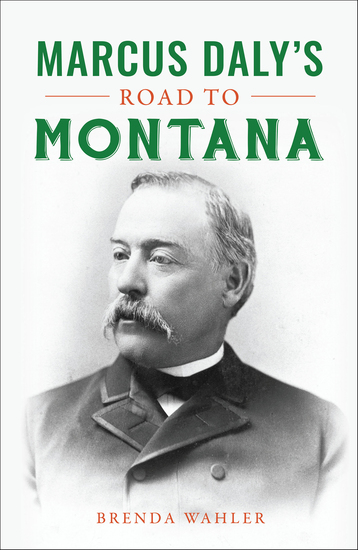
    The Making of a Copper King!Born in 1841 to tenant farmers, Marcus Daly came from ruralIreland to New York as a boy. Having learned the big city’s harsh lessons, he traveled west to the gold and silver mining camps ofCalifornia, Nevada, Utah and Montana. Then, a spectacular discovery in the Anaconda mine him one of Montana’s famed Copper Kings. Yet, his early life remained shrouded in myth. Famed for his machinations in state politics and shaping Butte into the “Richest Hill on Earth,” his path from farm boy to mining king has been overlooked. For the first time, author Brenda Wahler brings his secretive and formative early years to life.
    Show book