¡Acompáñanos a viajar por el mundo de los libros!
Añadir este libro a la estantería
Grey
Escribe un nuevo comentario Default profile 50px
Grey
Suscríbete para leer el libro completo o lee las primeras páginas gratis.
All characters reduced
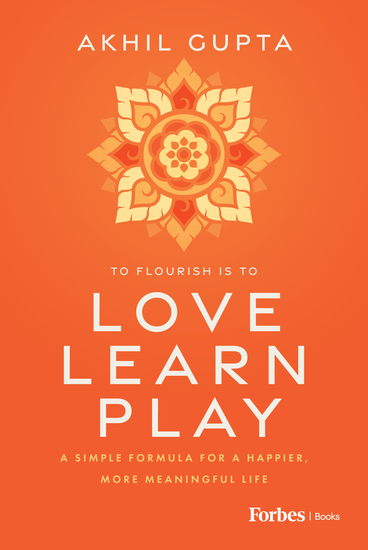
Love Learn Play - A Simple Formula for a Happier More Meaningful Life - cover

Love Learn Play - A Simple Formula for a Happier More Meaningful Life

Akhil Gupta

Editorial: Forbes Books

  • 0
  • 0
  • 0

Sinopsis

In a world that equates success with happiness, many high-achievers still feel unfulfilled. In Love, Learn, Play, Akhil Gupta offers a transformative mindset that reframes how we think about purpose, peace, and flourishing.
Disponible desde: 09/12/2025.
Longitud de impresión: 312 páginas.

Otros libros que te pueden interesar

  • Stillborn - Grieving and Remembering the Little Ones We Lost - cover

    Stillborn - Grieving and...

    Stacey Wilmore

    • 0
    • 0
    • 0
    Losing a child before they take their first breath is an indescribable pain—one that lingers in the heart, reshaping the world as we know it. No parent expects to say goodbye before they say hello. Yet, for those who have experienced stillbirth, this heartbreaking reality becomes a defining moment, one that forever alters their journey through life. The silence of a delivery room, the emptiness of arms that were meant to cradle, and the dreams that vanish in an instant—these are the wounds that so many carry, often in solitude.  
      
    Grief after stillbirth is unique. It is a grief that comes with memories that were never made, with birthdays that will never be celebrated, and with a love so strong yet without a place to go. It is a pain that is often misunderstood, leaving parents feeling isolated in their sorrow. This book is a space for that grief—a place where your pain is acknowledged, your baby is remembered, and your heart is given permission to heal in its own time.  
      
    In the aftermath of loss, many parents struggle to find words for their emotions. The world around them often moves on too quickly, expecting them to heal at a pace that feels impossible. Friends and family may not always understand, unintentionally offering words that hurt more than they heal. Some parents are left feeling as though their baby’s existence is slipping away, as if their grief is something to be hidden or minimized. But your love for your child does not fade, and neither should their memory. 
    Ver libro
  • The Sixth History of Man - cover

    The Sixth History of Man

    MD John Bershof

    • 0
    • 0
    • 0
    In the spirit of medieval writer Chaucer, all human activity lies within the artist’s scope, the History of Man Series uses medicine as a jumping off point to explore precisely that, all history, all science, all human activity since the beginning of time. The jumping off style of writing takes the reader, the listener into worlds unknown, always returning to base, only to jump off again. History of Man are stories and tales of nearly everything. 
    The Sixth History of Man is the last narrative in the History of Man Series that uses infection as the underlying foundation. The series will continue but use other disease platforms for jumping off. From a human infection perspective, this sixth book will visit with the King of Pop Michael Jackson, vitiligo and propofol, the famous and infamous sexually transmitted diseases—herpes, gonorrhea, chlamydia, trichomonas, HIV and the granddaddy of colorful stories, syphilis—with their very entertaining tales, a world of romance, suspense, and thrillers. We’ll hop from science to art to music, going back in time to the astronomy of the Persians, Syrians, the Greek Aristotle and on to Ptolemy, Copernicus and Kepler. Our travels will take us to the Renaissance of art and music, stopping along a few stations, such as da Vinci, Michelangelo, Rembrandt, and Monet. A discussion of why and how humans went from spoken language to written language is on our menu. We will pay homage with another visit with the First Viennese School, parse senility, delirium, and dementia and most assuredly discuss the women who helped build Johns Hopkins Hospital. OK Boomers! and the sociology of cohort generations will help complete this narrative.
    Ver libro
  • Pax Romana: A Captivating Guide to Ancient Rome during the Roman Peace Period - cover

    Pax Romana: A Captivating Guide...

    Captivating History

    • 0
    • 0
    • 0
    Did you know that the biggest territorial expansion in ancient Rome took place during the reign of its first emperor, who also ruled the longest out of all of the rulers prior to the fall of the Western Roman Empire? 
    The Roman Empire reached its zenith within the first two centuries of the fall of the Roman Republic, expanding its territory and spreading its influence well beyond the borders of Europe. During that time, a sort of global peace was achieved, which historians call the Pax Romana. But what exactly is the Pax Romana, and how does one delve into this huge, ever-expanding subject? 
    Like many other segments of Roman history, the Pax Romana is riddled with murky areas, contradictory information from contemporary sources, and fascinating archaeological finds. In this book, you’ll discover what made Rome tick during those roughly two hundred years of relative peace. 
    Throughout the pages of this tome, you’ll get brief glimpses of the reigns of many emperors who made the Pax Romana into what it was. Discover the Pax Romana’s long-term effects and how it managed to cement the Roman Empire as the go-to empire for many later civilizations to try and emulate. 
    Among other things, you’ll gain new knowledge on the following facts:How the empire evolved from the former republic and who the men were that brought about the changes What made the reign of each emperor uniqueWho the best emperors during the Pax Romana were, and which ones were considered the worstWhat role the provinces and territorial expansion played in the growth and development of the empireHow the imperial Romans were stratifiedWhat societal changes came about with the abolition of the republic and the return to a monarchic model 
    Scroll up, and give that “add to cart” button a click to learn more about the Pax Romana!
    Ver libro
  • Threats - Intimidating Someone with Potential Harm - cover

    Threats - Intimidating Someone...

    Cito Harder

    • 0
    • 0
    • 0
    Threats are an inherent part of human interaction and can manifest in various forms. At their core, threats are attempts to instill fear or assert power by creating the perception of potential harm, whether physical, emotional, or psychological. The nature of threats is complex because they exist on a spectrum, ranging from subtle and covert forms of intimidation to overt and aggressive expressions of force. Understanding the nature of threats is essential, as it allows individuals and communities to recognize and respond to them effectively. 
    A threat can be defined as any statement, action, or behavior that creates a sense of fear or danger in another person. It involves the intention to coerce, control, or manipulate someone by presenting the possibility of harm. Threats do not necessarily have to be acted upon for them to have a significant impact; the mere perception of harm can be enough to evoke a response. For instance, the threat of violence—whether verbal, physical, or implied—can lead to significant emotional distress, anxiety, and a shift in one’s behavior, even in the absence of any actual harm being done. This highlights the psychological aspect of threats: the fear and tension they generate are often more powerful than the harm that might actually occur. 
    Threats can be both explicit and implicit. Explicit threats are direct and clear in their intent, such as saying “If you do this, I will hurt you” or “You will pay for this.” These types of threats leave little room for misinterpretation and often provoke an immediate response. Implicit threats, on the other hand, are more subtle and may not directly articulate the intended harm. They may involve hints, body language, or situations that suggest harm without overtly stating it. An example of an implicit threat might be a comment like, “You wouldn’t want something bad to happen, would you?” which leaves the recipient uncertain but still fearful of what may follow.
    Ver libro
  • Jane Austen's Best Friend - The Life and Influence of Martha Lloyd - cover

    Jane Austen's Best Friend - The...

    Zöe Wheddon

    • 0
    • 0
    • 0
    The book will take the form of a "recipe for friendship" as Martha Lloyd is best known for her housekeeping and recipe book. 


    All fans of Jane Austen everywhere believe themselves to be best friends with the beloved author and this book shines a light on what it meant to be exactly that. Jane Austen's Best Friend: The Life and Influence of Martha Lloyd offers a unique insight into Jane's private inner circle. Through this heartwarming examination of an important and often overlooked person in Jane's world, we uncover the life-changing force of their friendship. 


    Each chapter details the fascinating facts and friendship-forming qualities that tied Jane and Martha together. We will relive their shared interests, the hits and misses of their romantic love lives, their passion for shopping and fashion, their family histories, their lucky breaks, and their girly chats. This book offers a behind-the-scenes tour of the shared lives of a fascinating pair and the chance to deepen our own bonds in 'love and friendship' with them both.
    Ver libro
  • Steel Drivin' Man: John Henry the Untold Story of an American Legend - cover

    Steel Drivin' Man: John Henry...

    Scott Reynolds Nelson

    • 0
    • 0
    • 0
    The ballad "John Henry" is the most recorded folk song in American history and John Henry--the mighty railroad man who could blast through rock faster than a steam drill--is a towering figure in our culture. 
    In Steel Drivin' Man, Scott Reynolds Nelson recounts the true story of the man behind the iconic American hero, telling the poignant tale of a young Virginia convict who died working on one of the most dangerous enterprises of the time, the first rail route through the Appalachian Mountains. Using census data, penitentiary reports, and railroad company reports, Nelson reveals how John Henry, victimized by Virginia's notorious Black Codes, was shipped to the infamous Richmond Penitentiary to become prisoner number 497, and was forced to labor on the mile-long Lewis Tunnel for the C&O railroad. Equally important, Nelson masterfully captures the life of the ballad of John Henry, tracing the song's evolution from the first printed score by blues legend W. C. Handy, to Carl Sandburg's use of the ballad to become the first "folk singer," to the upbeat version by Tennessee Ernie Ford. 
    Attractively illustrated with numerous images, Steel Drivin' Man offers a marvelous portrait of a beloved folk song--and a true American legend.
    Ver libro