Join us on a literary world trip!
Add this book to bookshelf
Grey
Write a new comment Default profile 50px
Grey
Subscribe to read the full book or read the first pages for free!
All characters reduced
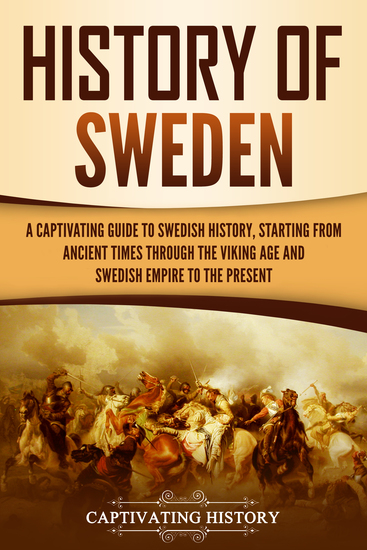
History of Sweden - A Captivating Guide to Swedish History Starting from Ancient Times through the Viking Age and Swedish Empire to the Present - cover

History of Sweden - A Captivating Guide to Swedish History Starting from Ancient Times through the Viking Age and Swedish Empire to the Present

Captivating History

Publisher: Captivating History

  • 0
  • 0
  • 0

Summary

Did you know that Viking-age Swedes were the founding dynasty of what eventually became Russia? 
 
In contrast to their Danish and Norwegian cousins, Swedish Vikings traveled east rather than west in search of riches, land, and power. The extensive river systems of Russia provided economic and military "super-highways" to the adventurers from the north, who journeyed down them all the way to the Black Sea and Constantinople in search of fame and riches.
 
The rise in TV shows and movies has renewed people's interest in Vikings, but the Swedish Vikings have been notably absent from these accounts. In Captivating History's History of Sweden, you will learn more about these Swedish adventurers, along with other parts of Sweden's fascinating history.
 
In this book, you will discover:

-  The Swedes' fierce struggle to gain independence 
-  The "Father of Sweden," King Gustav Vasa, and his dynasty spawned some of the greatest military minds in Europe 
-  How the Swedish Empire achieved success and expanded as far as North America 
-  Sweden's revolutionary war tactics and how they led to victories on the battlefield 
-  Why Sweden adopted its famous policy of neutrality 
-  The hero Raoul Wallenberg and his role in WWII 
-  And much more! 
Scroll up and click the "add to cart" button to learn more about the history of Sweden! 
Available since: 03/22/2022.
Print length: 120 pages.

Other books that might interest you

  • Kaya Mijikenda - The Nine Tribes - cover

    Kaya Mijikenda - The Nine Tribes

    Ibrahim Mwafrika

    • 0
    • 0
    • 0
    Based on a true culture, way of life in the year 1500 AD. The Kaya Mijikenda Community of the Bantu Origin namely Kambe, Ribe, Jibana, Kauma, Rabai, Chonyi, Giriama, Duruma and Digo, lived a life worth remembering. Here is their Story.
    Show book
  • Portraits as Animal - Poems - cover

    Portraits as Animal - Poems

    Victoriano Cárdenas

    • 0
    • 0
    • 0
    Portraits as Animal is a gallery of self-becoming in a "sunbaked house as tiny as a heart." With a toothy lyricism at turns sly and forthright, Cárdenas's hunger to belong carries us from a stove "bleeding a hundred kinds of caldo" to his "determined mitochondrial ancestors''-a journey framed by generational struggles with addiction, a queerphobic church, and the always-transforming land. 
    In conversation with Taos's rich artistic tradition and the brutal, binding legacy of colonization, Cárdenas writes through his transition, acknowledging that "to become a man means a lifetime of needles like the man who raised me." Here is pain and violence, but here, too, is the assurance that we are "built for this metamorphosis" and can follow our past incarnations "over scorched earth neon with new grass" to a future of our own making.
    Show book
  • Mikhail Gorbachev: The Life and Legacy of the Soviet Union’s Last Leader - cover

    Mikhail Gorbachev: The Life and...

    Editors Charles River

    • 0
    • 0
    • 0
    After going through three elderly leaders in three years, Mikhail Gorbachev was chosen as the new General Secretary of the Soviet Union at the relatively youg age of 54 in March 1985. Gorbachev hoped to build the Soviet economy to relieve the persistent shortages of consumer goods it faced, which were caused by enormous military spending of the Soviet Union. Gorbachev tried to introduce some economic reforms, but they were blocked by communist hardliners. Gorbachev then came to the belief that the Soviet economy could not improved without political reform as well. 
    In comparison with other Soviet leaders, Gorbachev was leader of the USSR for a relatively short period, but the changes that took place under his leadership were monumental, including some that were intended and others that were unforeseen. Gorbachev oversaw the end of the Cold War and the peaceful transition away from communism in Central and Eastern Europe, and he ended the war in Afghanistan and many other proxy conflicts in the developing world. Gorbachev improved relations with the West and developed enough trust with President Ronald Reagan and President George H.W. Bush to decommission thousands of nuclear weapons. He also liberalized the political environment within the Soviet Union itself, increased accountability, and brought in a certain degree of democracy.  
    	Gorbachev was awarded the Nobel Peace Prize for these efforts in 1990, but his regime also left a legacy of turbulence and destruction in its wake. As a result of his policies, many Soviet people rose up against the status quo, demanding national self-determination and reviving old grievances. Gorbachev could not prevent the USSR from disbanding at the end of 1991, leaving much of the country’s economy in ruins and nationalist and ethnic conflicts that are still unresolved today.
    Show book
  • Second Forgetting - Remembering the Power of the Gospel during Alzheimer’s Disease - cover

    Second Forgetting - Remembering...

    Dr. Benjamin T. Mast, Scotty Smith

    • 0
    • 0
    • 0
    There is hope in Alzheimer's disease, but it isn't where most people look for it... 
    Any form of dementia is terrifying and lonely for both the one suffering it and for those close to them. How do our relationships with those we love change with loss of memory or clarity of thought? What happens to our relationship with God? 
    For those suffering from early-stage Alzheimer's, for their friends and family, community and church, this book will help you understand the disease itself, how to love and care for those affected by it, and how to see the hope that's greater than it: we may forget, but God always remembers. 
    With pastoral tenderness and gospel confidence, Dr. Benjamin Mast shares his expertise on the subject and displays the power of the gospel that remains intact even when memory fades. Second Forgetting provides:Up-to-date answers to common questions about the disease and its effect on personal identity and faith.Personal stories of those affected and the loved ones who care for them and what their experiences were like—where they found hope and how they most needed support.Practical suggestions for how the church can come alongside families and those struggling or hurting. 
    When a person is diagnosed with Alzheimer's, they face great uncertainty, knowing that they can expect to live their remaining years with increasing confusion and progressively greater reliance upon other people to care for them. Dr. Mast will help you see how Alzheimer's disease cannot have the final say on God's unforgotten children. 
    Reflection questions are included in the audiobook companion PDF download.
    Show book
  • Love and Saint Augustine - cover

    Love and Saint Augustine

    Hannah Arendt

    • 0
    • 0
    • 0
    Hannah Arendt, the author of The Origins of Totalitarianism and The Human Condition, began her scholarly career with an exploration of Saint Augustine's concept of caritas, or neighborly love, written under the direction of Karl Jaspers and the influence of Martin Heidegger. After her German academic life came to a halt in 1933, Arendt carried her dissertation into exile in France, and years later took the same battered and stained copy to New York. 


    During the late 1950s and early 1960s, Arendt was simultaneously annotating and revising her dissertation on Augustine, amplifying its argument with terms and concepts she was using in her political works. The dissertation became a bridge over which Arendt traveled back and forth between 1929 Heidelberg and 1960s New York, carrying with her Augustine's question about the possibility of social life in an age of rapid political and moral change. 


    In Love and Saint Augustine, political science professor Joanna Vecchiarelli Scott and philosophy professor Judith Chelius Stark make this important early work accessible for the first time. Here is a completely corrected and revised English translation that incorporates Arendt's own substantial revisions and provides additional notes based on letters, contracts, and other documents as well as the recollections of Arendt's friends and colleagues.
    Show book
  • How to Become a Podiatrist Career Professional Development Planning Audio Book - With Job Interview Preparation & Coaching Guide for Men Women Teens & Young Adults - cover

    How to Become a Podiatrist...

    Brian Mahoney

    • 0
    • 0
    • 0
    End Money Worries! 
    How to Become a Podiatrist Career Professional Development Planning Audio Book 
    With Job Interview Preparation & Coaching Guide for Men, Women, Teens & Young Adults 
    by Brian Mahoney 
           Discover... 
    * What a Podiatrist does 
         * How to Become a Podiatrist 
          * What is the salary of a Podiatrist 
             * What is the Podiatrist Work Environment like 
                 * What is the future Job outlook for a Podiatrist 
             * how long does it take to become a Podiatrist 
          * How to Prepare for Your Job Interview 
       * Tips the pros use to Ace their Job Interview 
    * You'll be confident with the best answers for the toughest job interview questions 
    The knowledge and ability to change your life all for less than the cost of 1 movie ticket! 
     If you are ready to get started & want the knowledge, help & motivation to change your life now!... 
    Then this Book is for you!!! 
                         So Don't wait. You'll wait your life away...
    Show book