Join us on a literary world trip!
Add this book to bookshelf
Grey
Write a new comment Default profile 50px
Grey
Subscribe to read the full book or read the first pages for free!
All characters reduced
Censorship Humor - cover

Censorship Humor

Michael Davies

Translator A AI

Publisher: Publifye

  • 0
  • 0
  • 0

Summary

"Censorship Humor" explores the powerful role of comedy as a tool for resistance against oppressive regimes. It examines how humor, particularly political satire, becomes a subtle yet potent form of political defiance. The book reveals the strategic ways comedians navigate censorship and use satire to expose absurdities, ultimately contributing to social and political change.

 
It analyzes the subversive nature of satire, highlighting the resilience of comedic expression, and its socio-political impact under authoritarian rule. For example, comedians have historically used irony and parody to critique those in power while minimizing repercussions. 

 
The book progresses by first introducing fundamental concepts of humor theory and censorship. It then analyzes specific case studies from various countries and historical periods such as the Soviet Union and Nazi Germany. It dissects how comedians utilized different comedic techniques to critique those in power while evading detection or minimizing repercussions.

 
Finally, the book examines the long-term effects of comedic resistance and its implications for contemporary free speech debates and activist movements. This approach provides insight into the ingenuity and bravery of individuals who dared to speak truth to power, often at great personal risk, and offers valuable lessons for navigating contemporary challenges to freedom of expression.
Available since: 03/29/2025.
Print length: 58 pages.
Other books that might interest you

  • The Norse Eddas - The Ancient Texts of Norse Mythology - cover

    The Norse Eddas - The Ancient...

    Odessa Nightshade

    • 0
    • 0
    • 0
    The Norse Eddas are among the most significant collections of ancient texts in Norse mythology, preserving the beliefs, legends, and wisdom of the Viking Age. These texts, passed down through oral tradition before being written down, provide a glimpse into the cosmology, gods, heroes, and prophecies that shaped the worldview of the Norse people. At the heart of these works are the Poetic Edda and the Prose Edda, two distinct but complementary sources that serve as the foundation of our understanding of Norse mythology. While the Poetic Edda consists of mythological and heroic poems that likely originated in pre-Christian Scandinavia, the Prose Edda, written by the Icelandic scholar Snorri Sturluson in the 13th century, provides an organized narrative and interpretation of these myths.  
      
    Norse mythology is unique among the world’s great mythological traditions, offering a vision of a cosmos that is both grand and tragic. The stories contained in the Eddas depict a universe governed by fate, where even the gods themselves are not immune to doom. Central to these myths is the idea of cyclical destruction and rebirth, embodied in the prophecy of Ragnarok—the apocalyptic battle that will end the reign of the gods and bring forth a new world. Unlike the immortals of other mythologies, the Norse gods are flawed, mortal beings who struggle against inevitable destruction, making their tales both heroic and deeply human.  
      
    Beyond their mythological significance, the Eddas also reflect the values, traditions, and daily life of the Norse people. Honor, loyalty, and wisdom are recurring themes, guiding both gods and mortals in their choices and destinies.
    Show book
  • Opening Doors to Ambitious Primary EnglishPitching high and including all - cover

    Opening Doors to Ambitious...

    Bob Cox, Leah Crawford, Julie...

    • 0
    • 0
    • 0
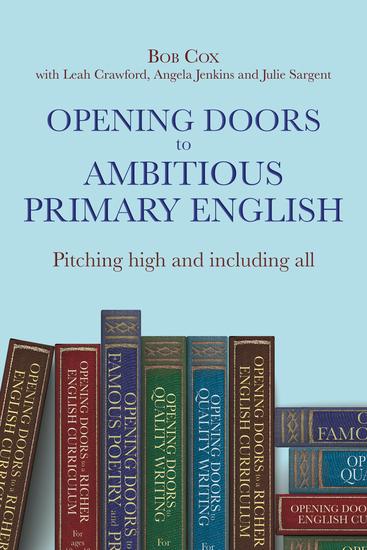
    Together with Leah Crawford, Angela Jenkins and Julie Sargent, Bob Cox has compiled this rich resource, complete with vivid illustrations by Victoria Cox, to help teachers enhance their learners' engagement with challenging texts and develop their writing skills as budding wordsmiths.Working in association with the Opening Doors network of schools, the authors address the vital concept of pitching high but including all pupils and how this approach can be delivered in practice.
    Opening Doors to Ambitious Primary Englishexplains and models top quality ways of thinking, planning and teaching. Theresources, case studies andauthors' innovative ideas on theorywill help you to make primary English vibrant, creative and challenging in your school. It alsoprovides frameworks and principlesfor any school wishing to be more ambitious in developing pupils' speaking, listening, reading, writing and thinking witha greater sense of curiosity and more originality.
    Opening Doors to Ambitious Primary Englishcontains chapter by chapter explanations of how English in primary schools can be developed in ambitious ways. Supported by research references, examples of pupils' work and illuminating case studies, the book provides teachers with a toolkit of strategies which schools can adapt and apply to their own contexts.
    The book is supported by the Opening Doors series of books which contain units of work based around selected texts. The authors hope this book will act as a starting block from which to develop an Opening Doors approach to English, and havesuggested key concepts around which the curriculum can be built, with the units providing examples to work from.
    Suitable for teachers and curriculum leads in primary settings.
    Show book
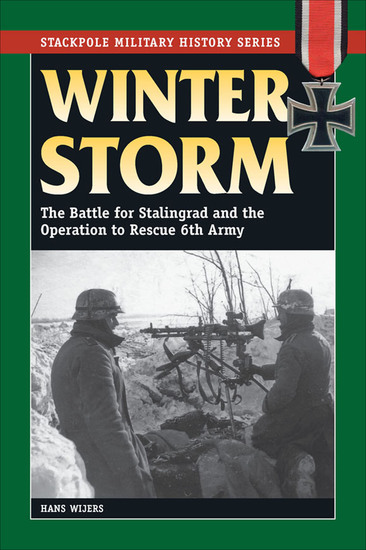
  • Winter Storm - The Battle for Stalingrad and the Operation to Rescue 6th Army - cover

    Winter Storm - The Battle for...

    Hans Wijers

    • 0
    • 0
    • 0
    A compilation of first-person accounts from German soldiers on their experiences at the Battle of Stalingrad during World War II, featuring rare photos. Real battles. Real Soldiers. Real stories.  By the fall of 1942, the battle for Stalingrad had become a fight for every street and building, and nowhere was the struggle more intense than in the bombed-out factories in the northern half of the city. There, amidst crumbled stone and twisted steel, German soldiers fought from room to room against a Soviet enemy who appeared never to tire. Meanwhile, Soviet offenses outside Stalingrad had trapped the German 6th Army inside the city. Erich von Manstein attempted to break through and relieve the encircled army, but to no avail. Both stories—the fierce battle for the factories and Manstein’s relief effort—are told here in the words of the men who were there.
    Show book
  • From Generosity to Justice - A New Gospel of Wealth - cover

    From Generosity to Justice - A...

    Darren Walker

    • 0
    • 0
    • 0
    Andrew Carnegie wrote his original "Gospel of Wealth" in 1889, during the height of the gilded age, when the country's 4,000 richest families held almost as much wealth as the other 11.6 million American families combined. His essay laid the foundation for modern philanthropy.
    Today, we find ourselves in a new gilded age—defined by levels of inequality that far surpass those of Carnegie's time. The widening chasm between haves and have-nots demands our immediate attention.
    Now is the time for a new "Gospel of Wealth."
    In From Generosity to Justice: A New Gospel of Wealth, Darren Walker, president of the Ford Foundation, articulates a bold vision for philanthropy in the twenty-first century. With contributions from an array of thinkers, activists, and leaders including Ai-jen Poo, Laurene Powell Jobs, David Rockefeller Jr., and Dr. Elizabeth Alexander, Walker challenges and emboldens readers to consider philanthropy as a tool for achieving economic, social, and political justice.
    That task requires humility, moral courage, and an unwavering commitment to democratic values and institutions. It demands that all members of society recognize their own privilege and position, address the root causes of social ills, and seek out and listen to those who live amid and experience injustice.
    What began in Carnegie's day as a manual for generosity now becomes a guide that moves us closer to justice—a guide that helps each of us find a way to contribute.
    Justice is calling. It's time we answer.
    Show book
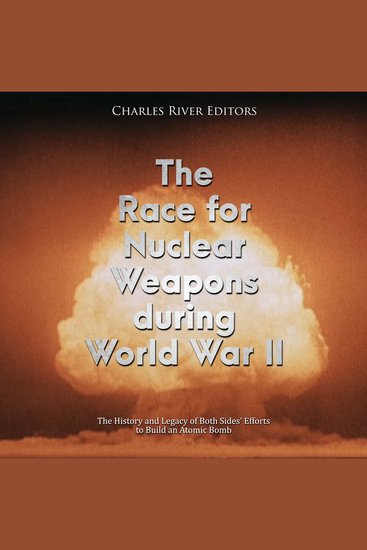
  • Race for Nuclear Weapons during World War II The: The History and Legacy of Both Sides’ Efforts to Build an Atomic Bomb - cover

    Race for Nuclear Weapons during...

    Editors Charles River

    • 0
    • 0
    • 0
    Before the Second World War, military conflicts were fought under orthodox conditions, usually termed “conventional warfare,” but several innovations had significantly changed combat, leading inextricably to the race for a nuclear weapon in the 1930s and 1940s. Conflicts had been fought by armies on horseback with guns of varying sophistication since the 16th century, but mechanized warfare and machine guns changed this calculus and set the stage for future combat by the end of World War I. Other sinister changes entered the fray during this conflict, such as chemical weapons like chlorine and mustard gas. The total warfare brought about by World War I and ensuing wars like the Spanish Civil War made the quest for the most powerful weapons somewhat necessary. 
    The Manhattan Project would ultimately yield the “Little Boy” and “Fat Man” bombs that released more than 100 Terajoules of energy at Hiroshima and Nagasaki, but as it turned out, the Axis were not far behind with their own nuclear weapons program. When the Nazis’ quest for a nuclear weapon began in earnest in 1939, no one really had a handle on how important nuclear weapons would prove to war and geopolitics. The attacks on Hiroshima and Nagasaki in August 1945, along with the Cold War-era tests and their accompanying mushroom clouds, would demonstrate the true power and terror of nuclear weapons, but in the late 1930s these bombs were only vaguely being thought through, particularly after the successful first experiment to split the atom by a German scientist. The nuclear age itself was in its infancy, barely 35 years old, but within a few short years the advent of nuclear war loomed over the world and the prospect of the enemy winning the nuclear race kept Allied leaders awake at night.
    Show book
  • Mansa Musa and the Empire of Mali - The life and tales of Mansa Musa and Sundiata Keita - cover

    Mansa Musa and the Empire of...

    Days of History

    • 0
    • 0
    • 0
    Take a journey back in time and explore the legendary story of the greatest African king of all time - Mansa Musa and the Empire of Mali. 
    This comprehensive book offers a comprehensive look at the culture, politics, and religion of one of the most powerful African empires. With vivid descriptions and engaging stories, this book will take you deep into the past to discover the secrets of Mansa Musa and his kingdom. 
    From the rise and fall of the empire to the great conquests and achievements of Mansa Musa and his successors, this book offers an immersive and engaging look at the past. 
    Get this book today and explore the fascinating history of the Mali Empire and Mansa Musa!
    Show book