Join us on a literary world trip!
Add this book to bookshelf
Grey
Write a new comment Default profile 50px
Grey
Subscribe to read the full book or read the first pages for free!
All characters reduced
A Voyage to Terra Australis - Account of an Expedition in South Pacific 1801-1810 - cover

A Voyage to Terra Australis - Account of an Expedition in South Pacific 1801-1810

Matthew Flinders

Publisher: Good Press

  • 0
  • 0
  • 0

Summary

In "A Voyage to Terra Australis," Matthew Flinders presents a meticulous account of his navigational expedition to explore the southern continent later named Australia. Written in a compelling narrative style, the book integrates rich descriptions of uncharted territories with practical observations of the maritime challenges Flinders faced. The work is not merely a travelogue; it serves as an essential document of early 19th-century exploration, reflecting the burgeoning curiosity about Australian geography and its natural history. Flinders employs a combination of scientific inquiry and personal reflection, immersing the reader in both the breathtaking landscapes and the arduous realities of exploration during that era. Matthew Flinders, a British navigator and cartographer, embarked on this notable voyage after a career marked by significant contributions to maritime exploration. His prior experiences, including his time in the Royal Navy and previous explorations of the Pacific, honed his skills in navigation and cartography. These experiences fueled his ambition to comprehensively chart Australia's coastline, as well as to foster an understanding of its indigenous cultures and ecosystems. For readers captivated by tales of adventure and discovery, "A Voyage to Terra Australis" offers an authoritative perspective on early Australian exploration. Flinders'Äô blend of scientific rigor and vivid storytelling makes this work not just an essential historical document but also a profound reflection on the spirit of adventure. It is a must-read for anyone interested in maritime history, exploration, and the foundations of modern Australia.
Available since: 12/20/2023.
Print length: 753 pages.

Other books that might interest you

  • Logic of Collective Action The: Book Summary & Analysis - cover

    Logic of Collective Action The:...

    Briefly Summaries

    • 0
    • 0
    • 0
    This is a concise summary and analysis of The Logic of Collective Action, by Mancur Olson.
     
    It is not the original book and is not affiliated with or endorsed by Mancur Olson.
     
    Ideal those seeking a quick and insightful overview.
     
    The Logic of Collective Action is a groundbreaking exploration of the paradoxical dynamics behind group behavior. This influential work dissects how individuals, acting in their own self-interest, often fail to act collectively—even when it benefits the entire group. From labor unions to environmental movements, the book reveals why smaller, more focused groups often achieve their goals, while larger groups face significant obstacles. Blending economic theory, sociology, and political science, this analysis provides a compelling framework for understanding cooperation, free-riding, and the challenges of organizing collective efforts. A must-read for anyone seeking to comprehend the forces shaping social, political, and economic groups.
    Show book
  • Magic from the Hilltops and Hollers - Folk Witchery Superstitions and Healing Practices from Appalachia - cover

    Magic from the Hilltops and...

    Leah Middleton

    • 1
    • 0
    • 0
    “This book stands as a valuable addition to the growing library of works on the lived experiences of Appalachians and how folk magic continues to be a valuable part of their cultural identity. I hope, after you read this, that you feel as in love with this land and its citizens, both human and more than human, as I do. Long live Appalachia!” —Rebecca Beyer, author of Wild Witchcraft   In an ode to her Appalachian roots and ancestors, known and unknown, of blood and kin, Leah Middleton, the Redheaded Witch, tells the stories of the grandfathers who had dirt under their fingernails from farming, the grandmothers who bled while sewing their garments, the relatives who decided to take a leap of faith and pave a new path, the ones who passed away too young, and the fellow practitioners and healers who showed her the way. It is a work of veneration to keep their spirits alive. If you share similar roots or find yourself creating new ones, this magical book is a hand to welcome you home.  Explore the superstitions of the mountains, the healing charms of doctors, and the folk beliefs of witchery.  Wander down shadowy paths lined with rhododendrons, uncovering the hidden corners where charms are whispered and prayers are spoken.  Uncover the superstitions captured in this region that have inspired magical workings for protection and healing.  Learn to walk the witch’s path as a rite conducted with reverence and solemnity.  Appalachia is a place where the lines between the mundane and the magical are blurred, and Magic from the Hilltops and Hollers offers readers exquisite insight into the enduring lore and magic of the region.  
    Show book
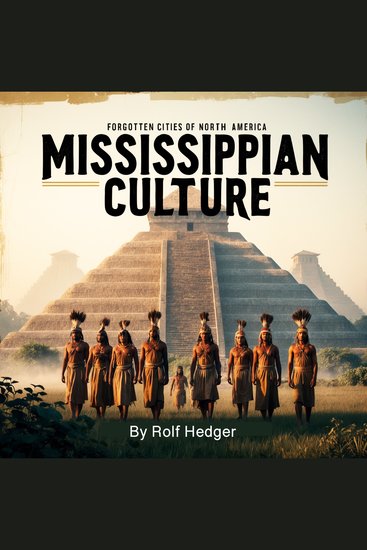
  • Mississippian Culture - Forgotten Cities of North America - cover

    Mississippian Culture -...

    Rolf Hedger

    • 0
    • 0
    • 0
    The Mississippian culture, a sophisticated and influential civilization, thrived in the southeastern United States from approximately 800 CE to 1600 CE. This culture, named after the Mississippi River, was centered around the river valleys and floodplains of the American Midwest, particularly in areas that are now parts of modern-day Illinois, Missouri, Arkansas, and Mississippi. It is best known for its massive earthworks, especially mounds, which were used for both ceremonial and burial purposes. The Mississippian people developed a complex society that was marked by large-scale agriculture, intricate trade networks, and powerful political and religious institutions. 
    The origins of the Mississippian culture can be traced back to the earlier Woodland period, during which smaller villages and simple mound-building practices began to emerge. By around 800 CE, however, the Mississippian culture had fully developed, distinguished by its highly organized cities, monumental architecture, and wide-reaching trade connections. The Mississippians were expert farmers, cultivating staple crops such as maize, beans, and squash, which allowed their settlements to flourish and grow in both size and complexity. 
    One of the most notable features of the Mississippian culture was its social and political structure. The culture was organized around large chiefdoms, with powerful leaders who held both political and religious authority. These chiefs often resided in large, fortified towns that served as hubs of trade, governance, and religious activity. The largest and most famous of these urban centers was Cahokia, located near present-day St. Louis, Missouri. At its height, Cahokia had a population of over 10,000 people, making it one of the largest urban centers in pre-Columbian North America.
    Show book
  • Ghost Writing Gold - Strike Gold When You Learn How to Hire the Best Ghostwriter For You! - cover

    Ghost Writing Gold - Strike Gold...

    Ben Geisler

    • 0
    • 0
    • 0
    Ghost Writing Gold: Strike Gold When You Learn How to Hire the Best Ghostwriter For You! 
    When you hire a writer for your eBook, what you are doing is enlisting the services of a ghostwriter. A ghostwriter is a writer who publishes under someone else's name, with the consent of both parties. Traditionally, ghostwriters have been and are still today hired by celebrities to write autobiographies when the celebrities are not talented writers. Ghostwriters also sometimes create works for well-known authors, such as Tom Clancy. This practice is done for business reasons, because the author's name alone will sell the books, no matter who actually wrote them. 
    In this audiobook, you will learn why eBooks are great ways to earn money these days and if you don’t have a talent for writing, you can employ the services of ghost writers that will help you write them. 
    This audiobook will cover the following topics: 
    - How to Select a Great Topic 
    - Where to Find Great Writers 
    - How to Choose the Best Writer For Your Project 
    - And many more! 
    Ultimately you will own the copyright of what the ghostwriter wrote, and you can sell the eBook as many times as you like. If it sounds like a pretty nice arrangement, it is. It's all completely legal and commonly done. To learn more, scroll up and click “add to cart” now!
    Show book
  • An Appeal by Shirin Ebadi to the world - That's not what the Prophet meant - cover

    An Appeal by Shirin Ebadi to the...

    Shirin Ebadi

    • 0
    • 2
    • 0
    Shirin Ebadi - Iranian, Muslim, Lawyer, Nobel Peace Prize laureate - has personally experienced violence, oppression, and terrorism in the name of religion. Rising above these tribulations, she became a fighter for human rights and an activist for peace and stability. Her weapons are words: the only way to convinve people that religion can never justify violence and murder.
    Show book
  • The American Operations in WW2: Rome-Arno - 22 January–9 September 1944 - cover

    The American Operations in WW2:...

    Clayton D. Laurie

    • 0
    • 0
    • 0
    World War II was the largest and most violent armed conflict in the history of mankind. Highly relevant today, World War II has much to teach us, not only about the profession of arms, but also about military preparedness, global strategy, and combined operations in the coalition war against fascism. This book follows military operations of the US Army in Italy from 22 January to 9 September 1944. 
    Rome was quiet on the morning of 4 June 1944. Propaganda leaflets dropped during the early morning hours by order of the commander of the Allied 15th Army Group, General Sir Harold R. L. G. Alexander, urged Romans "to stand shoulder-to-shoulder to protect the city from destruction and to defeat our common enemies." Even though the retreating Germans had declared Rome an open city, citizens were urged to do everything possible to protect public services, transportation facilities, and communications. "Citizens of Rome," the leaflets declared, "this is not the time for demonstrations. Obey these directions and go on with your regular work. Rome is yours! Your job is to save the city, ours is to destroy the enemy."
    Show book