Join us on a literary world trip!
Add this book to bookshelf
Grey
Write a new comment Default profile 50px
Grey
Subscribe to read the full book or read the first pages for free!
All characters reduced
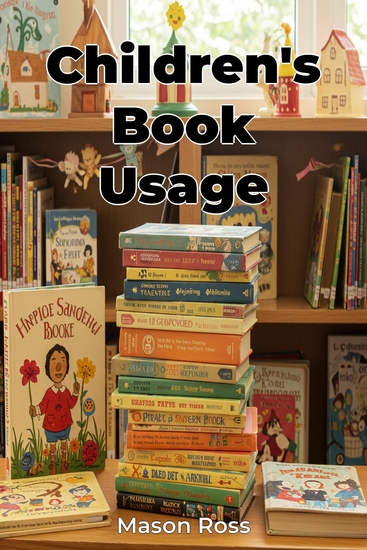
Children's Book Usage - cover

Children's Book Usage

Mason Ross

Translator A AI

Publisher: Publifye

  • 0
  • 0
  • 0

Summary

Children's Book Usage explores the factors influencing the popularity of children's literature in libraries, providing a data-driven analysis essential for those seeking to foster early literacy. This reference work investigates key aspects such as genre trends, the impact of illustrations and design, and the significance of cultural representation in shaping reading preferences. By analyzing library loan statistics, sales figures, and critical reviews, the book demonstrates that a combination of literary merit, visual appeal, cultural relevance, and marketing effectiveness determines a book's success. The book uniquely combines quantitative data analysis with qualitative insights, moving beyond anecdotal evidence to provide a robust understanding of what makes a children's book succeed. For instance, the analysis shows how diversifying cultural representation can dramatically impact a book's circulation. It begins with core concepts in children's literature and library science, progressing through major themes like genre popularity, visual impact, and inclusivity, ultimately offering practical recommendations for publishers and librarians.
Available since: 02/20/2025.
Print length: 76 pages.

Other books that might interest you

  • Wicked Detroit - cover

    Wicked Detroit

    Mickey Lyons

    • 0
    • 0
    • 0
    The Motor City boasts a long and sordid history of scoundrels, cheats, and ne'er-do-wells. The wheeling and dealing prowess of founding father Antoine Cadillac is the stuff of legend. Fur trader and charlatan Joseph Campau grew so corrupt and rambunctious that he was eventually excommunicated by Detroit's beloved Father Gabriel Richard. The slovenly and eccentric Augustus Brevoort Woodward, well known as a judge but better known as a drunkard, renamed himself, reshaped the city streets and then named them after himself, creating a legion of enemies along the way. Local historian and creator of the Prohibition Detroit blog Mickey Lyons presents the stories of the colorful characters who shaped the city we know today.
    Show book
  • The Lakotas and the Black Hills - The Struggle for Sacred Ground - cover

    The Lakotas and the Black Hills...

    Jeff Ostler

    • 0
    • 0
    • 0
    In this enthralling narrative, professor and award-winning author Jeffrey Ostler recounts the Lakota Sioux's loss of their spiritual homeland and their remarkable legal battle to regain it. Moving easily from battlefields to reservations to Supreme Court chambers, Ostler captures the strength that bore the Lakotas through the worst times and kept alive the dream of reclaiming their cherished lands.
    Show book
  • 100 Mind-Blowing Conspiracy Theories - 100 Shocking Claims That Challenge What We Believe - cover

    100 Mind-Blowing Conspiracy...

    Felix Grayson

    • 0
    • 0
    • 0
    Discover more books and audiobooks by Felix Grayson at FelixGrayson.com 
     
    100 Shocking Claims That Challenge What We Believe 
     
    Conspiracy theories aren’t just wild ideas—they’re stories that make you question everything. From secret experiments and ancient mysteries to futuristic tech and hidden agendas, this audiobook reveals 100 strange, unsettling, and fascinating theories that might just change how you see the world. 
     
    Whether you're a late-night deep diver, a lifelong skeptic, or simply love bizarre and thought-provoking content, each chapter will leave you wondering: What if this is actually true? 
     
    In this audiobook, you’ll explore theories like: 
    
    The Moon landing was faked in a Hollywood studio 
    The CIA accidentally created the counterculture using LSD 
    Birds aren’t real—they’re government surveillance drones 
    Celebrities are replaced by clones or body doubles 
    The pyramids weren’t tombs—they were ancient power plants 
    Smart tech is spying on you (and always listening)The Mandela Effect is proof we’ve shifted timelines 
    NASA is hiding evidence of alien life 
    Reality TV was designed as a mass social experiment 
    
     
    From secret societies and hidden messages to tech paranoia and pop culture twists, this is your immersive dive into the weird, the wild, and the what-if. 
     
    Perfect for: 
    
    Curious minds who love the unexplained 
    Fans of true crime, hidden history, and alt-thinking 
    Listeners looking for the ultimate conversation starter 
    Anyone who enjoys short, addictive, bite-sized chapters 
    
     
    Listen straight through—or hit shuffle and drop into a new theory anytime. Either way, you’ll walk away questioning what’s real, what’s hidden, and what’s been in front of you all along.
    Show book
  • Theodor Adorno - A Very Short Introduction - cover

    Theodor Adorno - A Very Short...

    Andrew Bowie

    • 0
    • 0
    • 0
    T. W. Adorno (1903-1969) was a German philosopher and social and cultural theorist. His work has come to be seen as increasingly relevant to understanding the pathologies of contemporary society evident in today's climate emergency, the financial crash, the reappearance of fascism in many countries, and the growing instability of the world order. 


    This Very Short Introduction covers Adorno's work and life, explaining his key philosophical concepts and the philosophical background and historical context of Adorno's thinking. Andrew Bowie shows how Adorno's exploration of why human reason can have irrational consequences led him to rethink basic concepts like 'nature', 'history', and 'freedom', offering alternatives to many ways of thinking about these concepts in contemporary philosophy. The book also examines Adorno's social theory, as well as his highly critical assessments of jazz and modern culture, which he considered threatened by the effects of modern capitalism.
    Show book
  • Buck Baxter and the Disappearing Divas - cover

    Buck Baxter and the Disappearing...

    Robin Knight

    • 0
    • 0
    • 0
    Hard-boiled 1920s private detective Buck Baxter has a new romance to kindle with playboy Holden Hart while at the same time trying to solve a new murder mystery at a seemingly cursed theater on Broadville. But if he doesn't solve this case in time, Buck and Holden might be taking their final bows.Something sinister is occurring at the Maharaja Majestic Theatre on Broadville Boulevard. The domineering actress, Dominique Duprey, has vanished without a trace, the opening night of the theatre’s new production of The Snake Charmer’s Slave is now in jeopardy, and six suspects are about to have the pleasure of meeting Buck Baxter, Private Detective, as he investigates whether there’s a killer on the loose… or a phantom at the opera?Could it be the handsome leading man, Errol Hemingway, who’s responsible for the disappearance of his leading lady… or perhaps it’s that sweet, doe-eyed understudy Olivia Overton? Is it the theatre owner himself, the tall and mysterious Raja Khan who has committed the crime… or the show’s investor, the autocratic aristocrat Serafina Somerset? Or is it possible that the meek and mild stage manager Stanley Small, or the flamboyant and frustrated director Barnabas Blake, is guilty? And what of Buck’s romance with playboy millionaire Holden Hart? Will Buck get a backstage pass to access all areas of his one true love… or will this be the final curtain for Buck and Holden? Follow the clues, and you might just solve… the mystery of the disappearing divas!Buck Baxter and the Disappearing Divas is the second adventure in the Buck Baxter Mysteries. It is a campy, noir, 28k-word detective mystery featuring a tough and troubled leading man, a heartthrob love interest with secrets of his own and a hilarious cast of supporting characters. Enter a world of prohibition, gangsters, speakeasies, jazz clubs, star-crossed romance, brooding heroes and a mystery with a twist.
    Show book
  • Saratoga and Yorktown: The History of the American Revolution’s Most Important Campaigns - cover

    Saratoga and Yorktown: The...

    Editors Charles River

    • 0
    • 0
    • 0
    At the end of 1776, the American war effort was on the verge of collapse, and despite Washington’s success at Trenton, the British were confident that they could quell the rebellion in 1777. That winter, the British planned a complicated campaign in which British armies from Canada and New York would strike out across New England and link up, with the goal of cutting off the Northern colonies. Indeed, 1777 did prove to be the pivotal year of the war, but not in the way the British intended. 
    In December 1776, Benjamin Franklin was sent by Congress to France to attempt to secure a critically needed alliance. Franklin was an ideal choice for Enlightened France, which revered Franklin for his scientific accomplishments and his known reputation as a brilliant man. Franklin had also been a diplomat before the Revolution, spending several years in London on behalf of the colonies. However, the French refused to provide more than arms and money throughout 1777, until they learned in December 1777 about Saratoga and Burgoyne’s surrender. With that news, French King Louis XVI entered into a formal military alliance with the United States, and in February 1778, France joined the war. 
    Yorktown was a former tobacco trading post now in decline, not much bigger than a large village. But Yorktown was tucked away on the northern edge of the York peninsula in rural Virginia, and in 1781 it became the site of a brief siege between two small armies, fought with all the decorum and formality of 18th century European warfare. As he made his dispositions at Yorktown in September 1781, he had every reason to expect another British success. The ensuing siege panned out rather differently. On October 19, 1781, for just the second time during the war (the other at Saratoga), an entire British field army surrendered to the rebel patriots.
    Show book