Join us on a literary world trip!
Add this book to bookshelf
Grey
Write a new comment Default profile 50px
Grey
Subscribe to read the full book or read the first pages for free!
All characters reduced
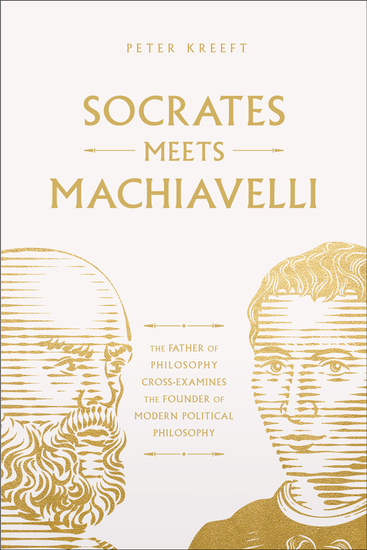
Socrates Meets Machiavelli - The Father of Philosophy Cross-Examines the Father of Modern Political Philosophy - cover

Socrates Meets Machiavelli - The Father of Philosophy Cross-Examines the Father of Modern Political Philosophy

Peter Kreeft

Publisher: Word on Fire

  • 0
  • 0
  • 0

Summary

In the Socrates Meets series, Peter Kreeft revives the classic method of bringing philosophy to life through dialogue. In eight innovative volumes, he uncovers the principles, assumptions, and sometimes dangerous conclusions of some of history’s most influential minds.  Each dialogue imagines a purgatory where we can listen in on conversations between Socrates and the great thinkers who, centuries later, picked up the philosopher’s torch. Each conversation investigates one of the philosopher’s key works, a short, readable classic that raises central questions both for philosophy and for life. In this volume, Socrates cross-examines Niccolò Machiavelli, the father of modern political philosophy and author of The Prince, exploring justice and authority, fortune and power, love and fear, and good and evil.
Available since: 05/05/2025.
Print length: 176 pages.


Other books that might interest you

  • Social Engineering - Manipulating People into Divulging Confidential Information - cover

    Social Engineering -...

    Cito Harder

    • 0
    • 0
    • 0
    Social engineering is the art of manipulating individuals into divulging confidential or personal information by exploiting their psychological vulnerabilities. Unlike traditional forms of hacking, which rely on technical skills to break into systems, social engineering takes advantage of human behavior to gain access to sensitive data. Whether through deceit, persuasion, or psychological manipulation, social engineers often prey on an individual’s trust, emotions, or fear, making it a more subtle yet highly effective form of attack. This introduction will explore what social engineering is, its methods, and why it has become such a significant threat in today’s digital landscape. 
    The core idea behind social engineering is simple: it is the manipulation of people rather than technology. In this approach, an attacker bypasses security measures and instead focuses on exploiting the weakest link in any organization or system—the people. These attacks can take many forms, ranging from phishing emails to impersonating authority figures, all designed to get the victim to willingly provide information, click on malicious links, or take actions that compromise their security. The success of social engineering relies not on breaking through firewalls or hacking encryption systems but on exploiting the trust and naivety of human beings. 
    Social engineering attacks can have serious consequences, especially as more of our personal and professional lives move online. Cybercriminals can gain access to sensitive personal information, financial data, or corporate secrets, leading to identity theft, financial loss, or damage to an organization’s reputation. In the corporate world, social engineering is often used as a gateway to larger cyberattacks. For instance, once an attacker gains access to an employee’s credentials through a phishing scheme, they can infiltrate company systems, potentially compromising valuable data.
    Show book
  • Greek Dark Ages and Greek Renaissance The: The History and Legacy of the Bronze Age Transition to Archaic Greece - cover

    Greek Dark Ages and Greek...

    Editors Charles River

    • 0
    • 0
    • 0
    The Greek Dark Ages, sometimes referred to as the Homeric Age or the Geometric Period, spans the era of Greek history from the end of the Mycenaean civilization around 1100 BCE and the emergence of the Greek poleis in the 9th century BCE. It is an era that has provided little in terms of extant archaeological evidence, which in part explains the name “Dark Ages,” but this lack of evidence has led some archaeologists and historians to make the very great assumption that little of any real significance occurred during these 200 years. Instead, they view it as a sort of hiatus between the collapse of the Mycenaean culture and the emergence of Archaic Greece. As with other so-called “Dark Ages,” this assessment is simplified, and an absence of evidence should never be assumed as evidence of absence. 
    If anything, the collapse of the Mycenaeans was a drawn-out affair, and while the early centuries of the Dark Ages might beseen as a continuation of this trend, even in the worst years, there was a degree of continuity and even some innovations. These changes including the beginnings of the use of iron as an alternative to bronze and some religious practices that continued to be observed. Furthermore, enough remained to form the basis of a recovery in economic, cultural, and artistic aspects of life in the later stage of the era, and in the political sphere, changes necessitated by the collapse in the economic system certainly paved the way for the rise of the polis, which would prove so fundamental in Greece in the centuries that followed.  
    This laid the groundwork for the Greek Renaissance of the 8th century. During that time, the Greek alphabet developed and the earliest surviving Greek literature was composed, while in terms of art and architecture, sculptures and red-figure pottery began. Warfare changed significantly as well when the hoplite became the core infantry.
    Show book
  • Lesbian Erotic Short Story - First-Time BDSM Adventure - cover

    Lesbian Erotic Short Story -...

    Amber Carden

    • 0
    • 0
    • 0
    One is a successful businesswoman; the other is an innocent art lover.  
    Both have a secret desire waiting to be explored.  
    If you are into lesbian and BDSM stories and like podcasts such as: The lesbian romantic, The lesbian supper club, lesbian chronicles, we’re having gay sex, lesbian sex stories, conversations with a dom, and audiobooks such as: priest, chelle bliss, throttle me, piper lawson, good girl, 50 shades, fifty shades, erotic sex stories for adults, deep fingers, irresistibly bound: the complete series, and more, get ready to buckle up! 
    Listen to the sample now.
    Show book
  • The Expanding Circle - Ethics Evolution and Moral Progress - cover

    The Expanding Circle - Ethics...

    Peter Singer

    • 0
    • 0
    • 0
    What is ethics? Where do moral standards come from? Are they based on emotions, reason, or some innate sense of right and wrong? For many scientists, the key lies entirely in biology—especially in Darwinian theories of evolution and self-preservation. But if evolution is a struggle for survival, why are we still capable of altruism? 


    In his classic study The Expanding Circle, Peter Singer argues that altruism began as a genetically based drive to protect one's kin and community members but has developed into a consciously chosen ethic with an expanding circle of moral concern. Drawing on philosophy and evolutionary psychology, he demonstrates that human ethics cannot be explained by biology alone. Rather, it is our capacity for reasoning that makes moral progress possible. In a new afterword, Singer takes stock of his argument in light of recent research on the evolution of morality.
    Show book
  • Symbolism of the Great Seal of the United States - cover

    Symbolism of the Great Seal of...

    M. Doreal

    • 0
    • 0
    • 0
    This message will be a revelation of great importance to every American interested in the ideals, hopes and aspirations of the founders of the United states. It will be found especially interesting to those who have wondered about the outcome of the present world conditions and the future of the American people. 
    To say that the early American founders did not dream of establishing a republic that would endure and eventually grow into the ideal state of the Golden Rule would not do them justice nor would it display an understanding of human nature.
    Show book
  • The Hand of Compassion - Portraits of Moral Choice during the Holocaust - cover

    The Hand of Compassion -...

    Kristen Renwick Monroe

    • 0
    • 0
    • 0
    “[A] fascinating treatise on moral psychology . . . in-depth interviews with five people who risked their lives to rescue Jews during World War II.” —Publishers WeeklyThrough moving interviews with five ordinary people who rescued Jews during the Holocaust, Kristen Monroe casts new light on a question at the heart of ethics: Why do people risk their lives for strangers and what drives such moral choice? Monroe's analysis points not to traditional explanations—such as religion or reason—but to identity. The rescuers' perceptions of themselves in relation to others made their extraordinary acts spontaneous and left the rescuers no choice but to act. To turn away Jews was, for them, literally unimaginable. In the words of one German Czech rescuer, "The hand of compassion was faster than the calculus of reason."At the heart of this unusual book are interviews with the rescuers, complex human beings from all parts of the Third Reich and all walks of life: Margot, a wealthy German who saved Jews while in exile in Holland; Otto, a German living in Prague who saved more than 100 Jews and provides surprising information about the plot to kill Hitler; John, a Dutchman on the Gestapo's "Most Wanted List"; Irene, a Polish student who hid eighteen Jews in the home of the German major for whom she was keeping house; and Knud, a Danish wartime policeman who took part in the extraordinary rescue of 85 percent of his country's Jews.Monroe's analysis of these stories is a dramatic illumination of the power of identity to shape our most basic political acts, including our treatment of others. 
    Show book