Join us on a literary world trip!
Add this book to bookshelf
Grey
Write a new comment Default profile 50px
Grey
Subscribe to read the full book or read the first pages for free!
All characters reduced
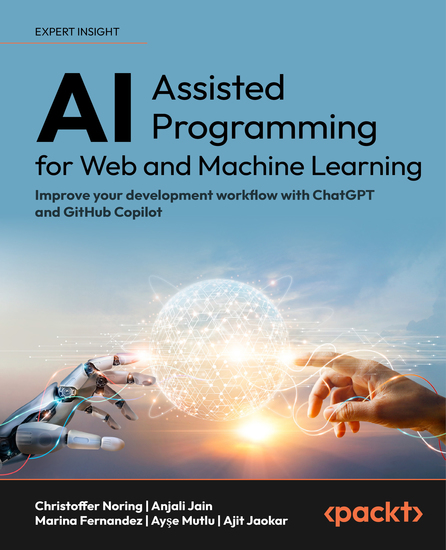
AI-Assisted Programming for Web and Machine Learning - Improve your development workflow with ChatGPT and GitHub Copilot - cover

AI-Assisted Programming for Web and Machine Learning - Improve your development workflow with ChatGPT and GitHub Copilot

Marina Fernández, Anjali Jain, Christoffer Noring, Ajit Jaokar, Ayşe Mutlu

Publisher: Packt Publishing

  • 0
  • 0
  • 0

Summary

AI-Assisted Programming for Web and Machine Learning shows you how to build applications and machine learning models and automate repetitive tasks.Part 1 focuses on coding, from building a user interface to the backend. You’ll use prompts to create the appearance of an app using HTML, styling with CSS, adding behavior with JavaScript, and working with multiple viewports. Next, you’ll build a web API with Python and Flask and refactor the code to improve code readability. Part 1 ends with using GitHub Copilot to improve the maintainability and performance of existing code.Part 2 provides a prompting toolkit for data science from data checking (inspecting data and creating distribution graphs and correlation matrices) to building and optimizing a neural network. You’ll use different prompt strategies for data preprocessing, feature engineering, model selection, training, hyperparameter optimization, and model evaluation for various machine learning models and use cases.The book closes with chapters on advanced techniques on GitHub Copilot and software agents. There are tips on code generation, debugging, and troubleshooting code. You’ll see how simpler and AI-powered agents work and discover tool calling.
Available since: 08/30/2024.
Print length: 602 pages.

Other books that might interest you

  • Addison’s Antidote - cover

    Addison’s Antidote

    Craig Beck

    • 0
    • 0
    • 0
    Millions of people around the world have been diagnosed with incurable autoimmune diseases like Addison’s. Debilitating conditions that make us tired, ill, and miserable. The only solution the medical industry offers are side-effect riddled maintenance drugs such as steroids and painkillers.Getting a formal diagnosis of Addison’s Disease is often a lengthy and challenging process. Many never get a medical confirmation of what is happening to their mind and body at all! Countless individuals live in constant pain and discomfort because they incorrectly assume all their health problems are the natural result of aging.Unfortunately, Craig Beck joined this ill-health demographic at the age of 48. After suffering months of severe symptoms, eventually, he too got handed the autoimmunity life sentence. However, rather than accept the hand as it was dealt. He remembered that the best medicine for a long and healthy life is found at the end of your fork, not the doctor's prescription pad. Craig decided to fall back on his research into natural medicine. He designed a diet and lifestyle that made inflammation the enemy and target. A process that would show amazing success at pushing Addison’s Disease firmly into near-permanent remission. In this special Addison’s addition of the Autoimmune Antidote, you will gain valuable insight into the new, natural approach that can help you prevent and maybe even reverse the life-limiting symptoms of Addison’s Disease and other inflammatory health problems. www.CraigBeck.com
    Show book
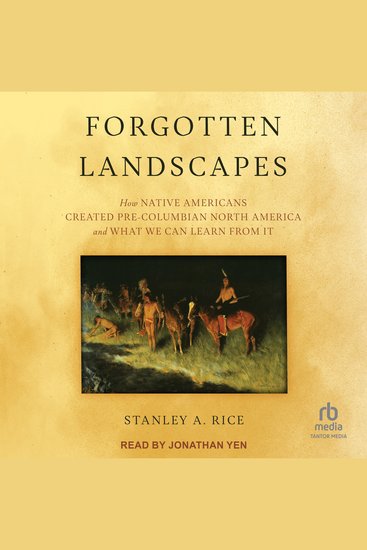
  • Forgotten Landscapes - How Native Americans Created Pre-Columbian North America and What We Can Learn From It - cover

    Forgotten Landscapes - How...

    Stanley A. Rice

    • 0
    • 0
    • 0
    North America was not empty nor were its inhabitants savages when Europeans arrived in 1492. Quite the opposite, North America was thickly populated by indigenous people who lived in clean cities, had a thriving economy, and transformed the landscape into bountiful productivity. Forgotten Landscapes reveals the incredible extent to which Native Americans manipulated and shaped their surrounding environs through agricultural practices and urban engineering, resulting in one of the most prosperous civilizations of their time.Well before European contact, North American cities and villages were bound together by an intricate trade network. Today, Spiro Mound in rural Oklahoma is a few piles of dirt, not on the road to anywhere. But at the time of the Mississippian civilization, about a thousand years ago, it was one of the largest cities in the world. With the controlled use of fire, Native Americans had transformed thick forests into open woodlands and expanded the ranges of prairies. Through organized hunting, Natives controlled the populations of prey animals such as passenger pigeons, and when Native populations grew large enough, they developed agriculture including irrigated crops, and even orchards. In this fascinating and overdue book, author Stanley A. Rice shows his audience the Pre-Columbian landscape of America that has been largely forgotten.
    Show book
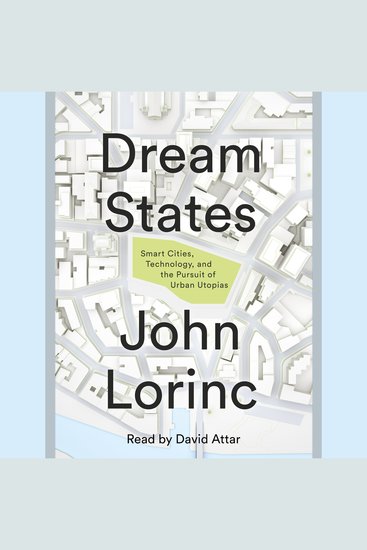
  • Dream States - Smart Cities Technology and the Pursuit of Urban Utopias - cover

    Dream States - Smart Cities...

    John Lorinc

    • 0
    • 0
    • 0
    WINNER OF THE 2022 WRITERS’ TRUST BALSILLIE PRIZE FOR PUBLIC POLICY
    		 
    Is the ‘smart city’ the utopia we’ve been waiting for?
    		 
    The promise of the so-called smart city has been at the forefront of urban planning and development since the early 2010s, and the tech industry that supplies smart city software and hardware is now worth hundreds of billions a year.
    		 
    But the ideas and approaches underpinning smart city tech raise tough and important questions about the future of urban communities, surveillance, automation, and public participation. The smart city era, moreover, belongs firmly in a longer historical narrative about cities — one defined by utopian ideologies, architectural visions, and technological fantasies.
    		 
    Smart streetlights, water and air quality tracking, autonomous vehicles: with examples from all over the world, including New York, Los Angeles, Boston, Portland, and Chicago, Dream States unpacks the world of smart city tech, but also situates this important shift in city-building into a broader story about why we still dream about perfect places.
    		 
    “John Lorinc’s incisive analysis in Dream States reminds us that the search for urban utopia is not new. Throughout the book, Lorinc underscores the fact that a gamut of urban innovations – from smart city megaprojects to e-government to pandemic preparedness tools – only provide promise when scrutinized together with the political, economic, social, and physical complexities of urban life.” – Shauna Brail, University of Toronto
    		 
    “Dream States: Smart Cities, Technology, and the Pursuit of Urban Utopias takes us on a fascinating journey across world cities to show how technology has shaped them in the past and how smart city technology will reshape them in the future. This book is essential reading for policy makers, researchers, and practitioners interested in understanding the opportunities and challenges of smart city technology and what it means for city building.” – Enid Slack, University of Toronto School of Cities
    		 
    “Utopia may be the oldest grift in the city-building business, but Dream States shows that technology is a timeless tool for turning the most ordinary of urban dreams – clean air and water, safe streets, and decent homes – into reality. As digital dilettantes try to sell us on a software overhaul, John Lorinc provides us an indispensable and flawless guide to the must-haves and never-agains of the smart city.” – Anthony Townsend, Urbanist in Residence, Cornell Tech, author of Smart Cities
    Show book
  • AI with Intention - Principles and Action Steps for Teachers and School Leaders - cover

    AI with Intention - Principles...

    Tony Frontier

    • 0
    • 0
    • 0
    Make sure your tech initiatives put students first with this robust guide for teachers and school leaders. 
     
    With new artificial intelligence tools sweeping into districts and schools, educators must be able to assess the tools' benefits and limitations and determine if and how they might serve students. Teaching and leadership expert Tony Frontier provides the insight and knowledge necessary to use these tools effectively and responsibly. 
     
    AI with Intention presents guiding principles and action steps that address both the issues and the opportunities that come with artificial intelligence. School leaders will learn how to cultivate a schoolwide understanding of AI, implement student-centered practices that support academic integrity, and ensure that effective teaching and learning remain the school’s top priority. Teachers will learn how to efficiently and effectively use AI tools to help their students engage in the productive struggle necessary for learning. 
     
    New and evolving technologies can be exciting, but as Frontier points out, how we respond to innovation is more important than the innovation itself. This book is a roadmap for all educators looking to better understand and incorporate AI in ways that support—rather than undermine—effective teaching and learning. 
     
    This audiobook is expertly read and engineered by Peter Coates. It was produced and published by Echo Point Books & Media, an independent bookseller in Brattleboro, Vermont. 
     
    PLEASE NOTE: The audiobook includes a supplemental PDF. It will be provided on purchase.
    Show book
  • Sand Stories - Surprising Truths about the Global Sand Crisis and the Quest for Sustainable Solutions - cover

    Sand Stories - Surprising Truths...

    Kiran Pereira

    • 0
    • 0
    • 0
    Sand is the hidden foundation of our society. In Sand Stories, Kiran Pereira maps out why it is the most consumed commodity on the planet after water. The book examines the impacts of our seemingly insatiable demand for sand on people, wildlife and our ecosystems. 
    The concern is that sand is a non-renewable resource in human timescales and not every kind of sand is useful to industry. The good news is that there are solutions to this alarming global problem, including those that foster a circular economy. 
    Show book
  • The Living History of Medicine - cover

    The Living History of Medicine

    Dr Patrick Treacy

    • 0
    • 0
    • 0
    The history of medicine is a living one and involves much more than reflecting on the battles that have been won or lost in the ever-changing struggle against disease. The living history really lies within man himself and too often the human side of this story is neglected. As doctors, we have been trained to focus on the signs of disease and consequently, we pay little attention to the people who discovered them. When we read in our pathology texts about the interesting triad of defects in an illness such as Hand-Schuller-Christian disease, we tend to forget about the doctors who faced great personal hardships to bring us the information we now use to treat the disorder. Dr Treacy is recognised as one of the most influential aesthetic practitioners in the world. He was awarded 'Top Aesthetic Practitioner in the World' (2019) and 'Doctor of the Year' UK & Ireland (2019). In this fascinating book, he takes us on a journey with Osler's famed 'Goddess of Medicine' and explains how she is continually on the move, fleeing from battles, tyranny, and oppression, seeking to find a home where man can have study pathology in peace. She has moved from Edinburgh to Dublin, from London to Vienna, from Berlin to Maryland, then onwards to California to guide doctors in the wonders of new technologies, translating the genetic blueprint, manipulating defects in the data code of our existence and help us all fight the more complex diseases like the coronaviruses of the new millennium.
    Show book