Join us on a literary world trip!
Add this book to bookshelf
Grey
Write a new comment Default profile 50px
Grey
Subscribe to read the full book or read the first pages for free!
All characters reduced
Popcorn Trade Routes - cover

Popcorn Trade Routes

Marcus Blackwell

Publisher: Publifye

  • 0
  • 0
  • 0

Summary

'Popcorn Trade Routes' presents a fascinating journey through the 6,500-year history of one of the world's most beloved snack foods, weaving together agricultural science, global commerce, and cultural anthropology.Beginning with the discovery of ancient popcorn kernels in Peru's Moche civilization, this comprehensive work explores how a specialized corn variety evolved from a local Native American crop into a global phenomenon that influenced societies across continents. The book uniquely combines three interconnected narratives: the biological evolution of popping corn, the development of international trade routes that facilitated its spread, and the diverse cultural practices that emerged around its consumption.Through careful analysis of archaeological findings, agricultural records, and trade documents, readers discover how specific genetic characteristics and environmental conditions contributed to the development of different popping corn strains, while maritime trade records reveal its journey from the Americas to Europe, Asia, and Africa. The narrative progresses from scientific foundations through historical distribution patterns to cultural impact, examining how different societies incorporated popcorn into their traditions – from religious ceremonies in pre-Columbian civilizations to its role in American temperance movements.Drawing from Native American oral histories, European trade documents, and agricultural records, the book presents a meticulously researched yet accessible account that challenges common assumptions about popcorn's distribution patterns while providing new evidence for early trans-oceanic trade routes.
Available since: 01/12/2025.
Print length: 98 pages.


Other books that might interest you

  • The Book of Lambspring - A Noble Ancient Philosopher Concerning the Philosophical Stone - cover

    The Book of Lambspring - A Noble...

    Nicolas Barnaud

    • 0
    • 0
    • 0
    The Book of Lambspring is one of the few real-life cases of a centuries-old book on alchemy. Nicolas Barnaud was a French Protestant writer, physician and alchemist, from Crest, in Dauphiné, from which he took the name Delphinas. He was a member of the Monarchomaques. He is associated with a number of mysteries.  
    His 1597 collection Commentariolum in Aenigmaticum quoddam Epitaphium, on the Aelia Laelia Crispis puzzle inscription, included the alchemical Mass of Nicholas Melchior, still of disputed authorship. The 1599 Triga Chemica: De Lapide Philosophico Tractatus Tres was the first publication of the Book of Lambspring.
    Show book
  • Untangling The: Volume 2 - Essays - cover

    Untangling The: Volume 2 - Essays

    Tiffany Chu

    • 0
    • 0
    • 0
    Some griefs have names. Others don't. 
    There are five dates Tiffany Chu carries like stones in her chest. A best friendship that ended not with a fight, but with silence. A mother's apology that came thirty years too late. A faith dismantled by the very church that built it. 
    And underneath all of it: a son who existed for eighteen years, and then didn't. 
    The Untangling, Volume 2 is for everyone who has sat in the rubble of something they loved—a person, a belief, a relationship—and had to figure out what to do next. In essays that move from miscarriage to purity culture to the slow death of a grandmother who still asks have you eaten?, Tiffany writes with the kind of unflinching tenderness that makes you feel less alone at 2 a.m. 
    This is not a book that ties grief into a bow. It is a book that stays in the room with you. 
    For readers of The Year of Magical Thinking, When Breath Becomes Air, and Crying in H Mart—and for anyone who has ever loved someone they couldn't save.
    Show book
  • Three Heads Are Better Than Two - cover

    Three Heads Are Better Than Two

    Rod Mandelli

    • 0
    • 0
    • 0
    Splooge gets to relive the Christmas night that Jack and Bob took home a hot blond twink and engaged in a ménage a trois (threesome) with him.
    Show book
  • The History of Nazi Germany’s Legendary Tank Commanders - cover

    The History of Nazi Germany’s...

    Charles River Editors

    • 0
    • 0
    • 0
    One of his biographers called him “a complex man: a born leader, a brilliant soldier, a devoted husband, a proud father; intelligent, instinctive, brave, compassionate, vain, egotistical, and arrogant.” As that description suggests, every account of Erwin Rommel’s life must address what appears to be its inherent contradictions. Fittingly, and in the same vein, he remains one of the best remembered generals of World War II and history at large, despite the fact he was on the losing side, and he was defeated at the most famous battle of his career, the decisive Battle of El Alamein. Nonetheless, the Desert Fox has been a legend on both sides of the Atlantic for over 70 years, thanks to the crucial role he played in history’s deadliest conflict.  While there is a great division when it comes to historical opinion with respect to Rommel’s merits as a general as well as the moral choices he made, both historians and the public continue to be intrigued by this man who has been dead for over 80 years. People at large continue to consider Rommel one of the greatest generals of the 20th century, an opinion shared by many of his contemporaries on both sides of World War II.  
    Heinz Wilhelm Guderian was one of the most respected commanders and theoreticians of World War II. An innovative tank commander, he was a pioneer of German Blitzkrieg tactics and therefore, a hugely influential figure in the way the war was fought. Guderian's profile was not always what might have been expected for a man of his abilities and influence warrant due to the shape of his career. As a German commander during the war, Guderian fought for one of the most appalling regimes in history, so while his skills are respected, it is hard to celebrate a man who led the troops of the Reich, especially to such success. 
    Show book
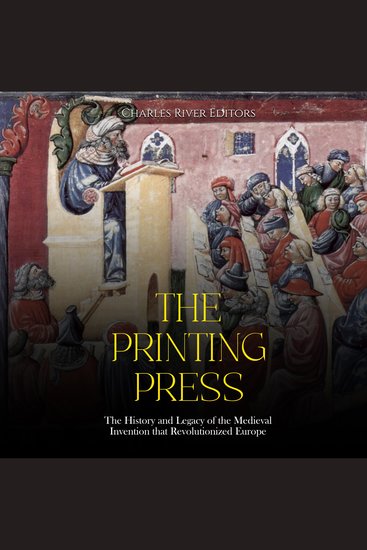
  • Printing Press The: The History and Legacy of the Medieval Invention that Revolutionized Europe - cover

    Printing Press The: The History...

    Editors Charles River

    • 0
    • 0
    • 0
    The history of printing was for ancient Asia an advancement in culture and communication, but for Europe in the 15th century, it was much more, plunging the continent into a new paradigm and aligning it for the modern world. Its importance is often overlooked, but the timeliness of the printing machine was equivalent to the invention of alphabets in antiquity and ranks up there with the digital revolution and the introduction of the internet. Put simply, it made the Renaissance possible and led to the modernization of Europe. 
    Long before the emergence of the modern world, paper was unknown in the West, and all documents were transcribed by hand onto clay, papyrus, and parchment. More importantly, few were allowed to express themselves through written media. Writing was for the most part theological in nature, reserved for scribes mostly living and working in monasteries. Books in the Middle Ages were owned almost exclusively by monasteries and educational institutions, and with reading material being such a rarity, content remained narrow and difficult to access. 
    	Based on earlier Asian principles, Johannes Gutenberg’s movable type printing press propelled an industry that led to the education of the West and ultimately removed the tight grip of the Vatican from daily European life. Within less than a century of Gutenberg’s device appearing on the scene, printing presses had churned out tens of millions of copies of books of all types, and as more people became educated, lower classes became wealthier while revolutionary principles spread across borders like wildfire. In addition to ushering in the Renaissance, the printing press also made the Reformation possible, and just as gunpowder was revolutionizing medieval warfare, the printing press led to battles over ideas and the rise of nationalism. For better and worse, after Gutenberg’s printing press became available, the world would never be the same.
    Show book
  • Mastering the Art of Reinvention - Adapting to life AI and other big changes - cover

    Mastering the Art of Reinvention...

    Gary Waldon

    • 0
    • 0
    • 0
    Gary Waldon, author of best seller Sort Your Sh!t Out, is back to help you Master the Art of Reinvention at a time when we need it the most. Life is always changing, but big changes like relationships, work, winning lotto, or even the rise of AI can disrupt everything whether we like it or not.  
    Mastering the Art of Reinvention delivers a humorous, vulnerable, and practical insight into human resilience to help you: 
    •      Grab the steering wheel of life and reinvent yourself like a pro. 
    •      Turn life’s curveballs into growth opportunities you can’t miss. 
    •      Get ready for AI changes and plan how to make it work for you. 
    •      Create a mindset that keeps you adaptable and moving forward, always. 
    •      Unlock your true potential and build the life that actually matches your dreams (and values). 
    Change is inevitable, but reinvention should be intentional.
    Show book