Join us on a literary world trip!
Add this book to bookshelf
Grey
Write a new comment Default profile 50px
Grey
Subscribe to read the full book or read the first pages for free!
All characters reduced
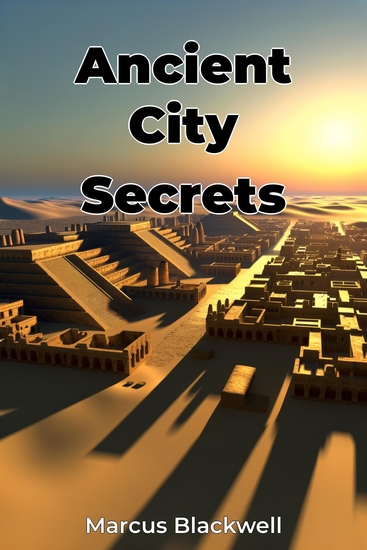
Ancient City Secrets - cover

Ancient City Secrets

Marcus Blackwell

Publisher: Publifye

  • 0
  • 0
  • 0

Summary

"Ancient City Secrets" presents a groundbreaking exploration of how architectural innovation and urban design influenced the rise and fall of major civilizations throughout history. Drawing from cutting-edge archaeological research, including laser-mapping data and geological surveys, the book reveals fascinating connections between architectural achievements and societal resilience across cultures from Mesopotamia to Mesoamerica.

 
The narrative skillfully weaves together three fundamental themes: engineering principles of monumental structures, social organization required for large-scale construction, and environmental factors affecting urban sustainability. Through detailed case studies of five major civilizations, the book unveils how ancient societies transformed natural landscapes into complex urban environments, while demonstrating how architectural choices reflected broader societal values and challenges.

 
Of particular interest are the newly documented architectural sites that showcase how ancient builders integrated climate science, sociology, and engineering in their designs. Structured in three comprehensive sections, the book progresses from establishing common architectural principles across ancient cultures to examining specific case studies, before synthesizing these findings to identify patterns in urban development and decline.

 
The work stands out for its interdisciplinary approach, combining architectural analysis with anthropological perspectives to demonstrate how built environments influenced cultural longevity. This fascinating synthesis makes complex architectural concepts accessible to general readers while maintaining scholarly rigor, offering valuable insights for modern urban planning challenges.
Available since: 01/08/2025.
Print length: 102 pages.
Other books that might interest you

  • The American Operations in WW2: Normandy - 6 June–24 July 1944 - cover

    The American Operations in WW2:...

    U.S. Army Center of Military...

    • 0
    • 0
    • 0
    World War II was the largest and most violent armed conflict in the history of mankind. Highly relevant today, World War II has much to teach us, not only about the profession of arms, but also about military preparedness, global strategy, and combined operations in the coalition war against fascism. This book follows military operations of the US Army in Normandy from 6 June to 24 July 1944. 
    A great invasion force stood off the Normandy coast of France as dawn broke on 6 June 1944: 9 battleships, 23 cruisers, 104 destroyers, and 71 large landing craft of various descriptions as well as troop transports, minesweepers, and merchantmen—in all, nearly 5,000 ships of every type. The naval bombardment that began at 0550 that morning detonated large minefields along the shoreline and destroyed a number of the enemy's defensive positions. To one correspondent, reporting from the deck of the cruiser HMS Hillary, it sounded like "the rhythmic beating of a gigantic drum" all along the coast. In the hours following the bombardment, more than 100,000 fighting men swept ashore to begin one of the epic assaults of history, a "mighty endeavor," as President Franklin D. Roosevelt described it to the American people, "to preserve . . . our civilization and to set free a suffering humanity."
    The attack had been long in coming. From the moment British forces had been forced to withdraw from France in 1940 in the face of an overwhelming German onslaught, planners had plotted a return to the Continent. Only in that way would the Allies be able to confront the enemy's power on the ground, liberate northwestern Europe, and put an end to the Nazi regime...
    Show book
  • A Taste of Joy and Liberty - A Philosopher Encounters the Gospel of Jesus - cover

    A Taste of Joy and Liberty - A...

    Jeffrey Wattles

    • 0
    • 0
    • 0
    “The magnum opus of one of today's most important Christian philosophers.”  —Stephen Post, PhD, author, Dignity for Deeply Forgetful People and Pure, Unlimited Love “A compelling exploration that brings out the joy and spiritual growth central to the gospel.”—Stephen Finlan, PhD, United Church of Christ pastor; noted biblical scholar “Seekers of all backgrounds—and especially independent thinkers—will find Jesus living on these pages as we’ve never seen him before.”—Angie Thurston, Harvard Fellow in Spirituality and Leadership Discover anew the living Jesus—our world’s greatest teacher—in this riveting work of short, lucid chapters that explore his life and legacy. And learn why Jesus was the supreme example of his own teaching: the gospel of love in the kingdom of God, and the joy of serving in God's universal family. Authored by a retired university professor and gospel evangelist, this unique depiction shows us how to live like Jesus: fresh, alive, original, spontaneous—and as a wellspring of love, mercy, and service. You’ll also discover a Jesus who was a scientist, philosopher, healer, friend, and humorist, a divine son who shows us how to move beyond the present chaos into the dawn of a worldwide spiritual renaissance. Walk with Jesus as he shows the way to a new era of unity among his followers and the path to worldwide cooperation among equals in the family of religions. “A rare work of grace and love that embodies the virtues it seeks to communicate.”—Matthew T. Lee, PhD, Professor of the Social Sciences and Humanities, Baylor University   “This book is saturated with hope. Jesus's promise of joy, love, and freedom is palpable on every page." —Rev. Paul McKenna, golden rule educator; interfaith pioneer
    Show book
  • How to Think Differently: 7 Easy Steps to Master Mental Models Critical Thinking Decision Making & Problem Solving - cover

    How to Think Differently: 7 Easy...

    Troye Bates

    • 0
    • 0
    • 0
    Do you wish you could think differently and develop better problem-solving skills for those crucial moments when you need it most? 
      
    The ability to think differently is one of the most valuable assets any individual could possess, yet it remains one of our most underdeveloped abilities. 
      
    If you are ready to be that one person who sees the world from a different perspective, this easy to follow 7-step solution to master mental models to make better decisions is the essential guide you need. 
      
    YOU WILL LEARN: 
    • How to become the master of your choices. 
    • How to develop your critical thinking abilities. 
    • How to think logically and reasonably. 
    • How to learn to see the bigger picture. 
    • How to become a master strategist by thinking like one. 
    • Understanding the abundance and scarcity mindset. 
    • Why reflection before action matters. 
      
    7-Steps is all you need to start bringing about a shift in your mindset for the better. Begin your journey now!
    Show book
  • Pompey the Great: The Life and Legacy of the Legendary Roman General Who Lost the Civil War to Julius Caesar - cover

    Pompey the Great: The Life and...

    Editors Charles River

    • 0
    • 0
    • 0
    Thanks to Caesar’s victory in the civil war, Pompey is mostly remembered not for being one of Rome’s greatest generals, but for being defeated by Caesar and then ignominiously murdered after he fled to Egypt, where the boy pharaoh Ptolemy XIII decapitated Pompey and offered his head to Caesar as a gift. Although Caesar was there chasing Pompey’s men, he quickly became involved in Egypt’s own civil war. As a consequence of Ptolemy’s barbarity, Caesar impulsively decided to side with his sister Cleopatra in her bid for the throne of Egypt, escalating what was rapidly becoming an all-out civil war.  
    	Of course, before the civil war, Pompey was one of the most powerful men in Rome. Gnaeus Pompeius was born on September 29, 106 BCE and went on to become regarded as one of the greatest statesmen and generals of the late Roman Republic. He was given the title “the Great” by his troops in Africa in 82 BCE and assumed the cognomen Magnus after 81 BCE. Pompey belonged to the senatorial nobility, the Pompeii, and the family had its first consul in 141 BCE. He loved all things Greek and spoke the language fluently. He gained much of his early military experience working on the staff of his father Pompeius Strabo, and the family base was in Picenum in eastern Italy. Strabo had significantly increased the family’s clients when he was consul in 88 BCE.  
    	In time, Pompey played a role in defeating many of Rome’s enemies across the world, from Africa to Spain, and he even helped put down Spartacus’ uprising. He had built his military power and acumen by participating in Rome’s previous civil war between Gaius Marius and Sulla, sharpening both his political and military skills, and he used them to great effect for decades during one of ancient Rome’s most chaotic – and important – periods. Perhaps just as importantly, following his successes in Africa, he demanded a triumph and refused to disband his army.
    Show book
  • The Monroe Doctrine - cover

    The Monroe Doctrine

    Various Various

    • 0
    • 0
    • 0
    This program is read by an AI-based synthesized voice.
    Show book
  • Raffles Renounced: Towards a Merdeka History - cover

    Raffles Renounced: Towards a...

    Alfian Sa'at, Faris Joraimi, Sai...

    • 0
    • 0
    • 0
    Why did independent Singapore celebrate two hundred years of its founding as a British colony in 2019? What does Merdeka mean for Singaporeans? And what are the possibilities of doing decolonial history in Singapore? Raffles Renounced: Towards a Merdeka History presents essays by historians, literary scholars and artists which grapple with these questions. The volume also reproduces some of the source material used in the play Merdeka / 獨立 / சுதந்திரம் (Wild Rice, 2019). Taken together, the book shows how the contradictions of independent nationhood haunt Singaporeans' collective and personal stories about Merdeka. It points to the need for a Merdeka history: an open and fearless culture of historical reckoning that not only untangles us from colonial narratives, but proposes emancipatory possibilities.
    Show book