Join us on a literary world trip!
Add this book to bookshelf
Grey
Write a new comment Default profile 50px
Grey
Subscribe to read the full book or read the first pages for free!
All characters reduced
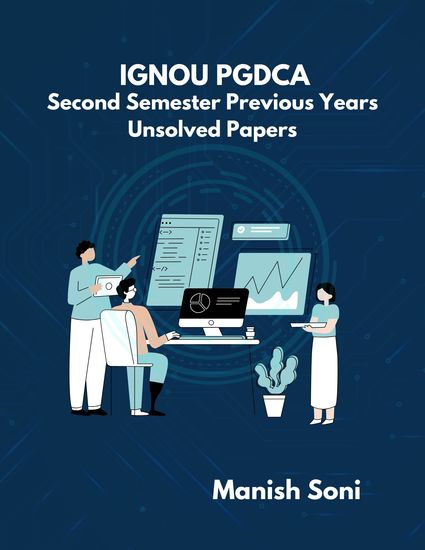
IGNOU PGDCA Second Semester Previous Years Unsolved Papers - cover

IGNOU PGDCA Second Semester Previous Years Unsolved Papers

Manish Soni

Publisher: Poorav Publications

  • 0
  • 0
  • 0

Summary

The Book has been carefully curated to serve as an essential resource for students enrolled in the Post Graduate Diploma in Computer Applications (PGDCA) program at IGNOU. This book is a comprehensive compilation of previous years' theory papers for all Semester 2 subjects, designed to offer students a practical and thorough preparation tool for their exams.
 
The PGDCA program is known for its rigorous curriculum, covering fundamental and advanced topics in computer science, programming, software development, and applications. With the growing demand for skilled professionals in the field of information technology, this diploma equips students with the knowledge and skills required to excel in the industry. However, mastering the concepts and successfully navigating through the examinations is no easy feat, and that is where this book aims to assist. The primary goal of this book is to help students gain a deeper understanding of the core subjects taught in Semester 2 of the PGDCA program. By providing access to unsolved theory papers from previous years, this book serves as a valuable tool for students to practice and refine their problem-solving skills, improve their understanding of key concepts, and become familiar with the format and structure of the IGNOU examinations.
 
Unsolved papers play a crucial role in exam preparation, as they offer students the opportunity to engage with real questions that have appeared in past exams. This helps in reinforcing theoretical knowledge, as well as in testing one's ability to apply concepts in a practical, exam-oriented setting. The unsolved format encourages independent study and self-assessment, allowing students to identify areas where they need more focus and improvement. Each chapter in this book corresponds to a different subject taught in Semester 2 of the PGDCA program. The chapters begin with an introduction to the subject, outlining the key concepts and topics that students should focus on. Following this introduction, the unsolved theory papers are presented. These papers are arranged in a sequential manner, with questions from different years placed together for ease of reference.
Available since: 11/13/2024.
Print length: 40 pages.
Other books that might interest you

  • Real Near-Death Stories NDE Afterlife - cover

    Real Near-Death Stories NDE...

    Tales Of Afterlife

    • 0
    • 0
    • 0
    This audiobook is narrated by an AI Voice.  
    What if consciousness continues beyond clinical death, and ordinary people have returned with extraordinary proof of an afterlife? Journey through meticulously documented near-death experiences that challenge everything science tells us about consciousness and mortality. These aren't folklore or religious tales—they're verified accounts from credible witnesses whose lives were forever transformed by their encounters with death and return. Discover the remarkable story of Tom Sawyer, who survived 33,000 volts of electricity for twenty minutes, experiencing clinical death while witnessing profound revelations about existence, interconnectedness, and the nature of reality itself. Follow Dr. Lloyd Rudy's impossible surgical case that shattered a veteran heart surgeon's materialist worldview. Each account features extensive research, medical documentation, and follow-up studies that validate these extraordinary experiences. Explore detailed life reviews where experiencers relive every moment from multiple perspectives, understanding the ripple effects of their actions across time and space. Witness dramatic personality transformations, enhanced psychic abilities, and the complete loss of death anxiety that characterizes authentic near-death experiences. These stories offer compelling evidence for consciousness survival, featuring truck drivers, medical professionals, and ordinary individuals who encountered something beyond physical reality. Whether you're seeking comfort about mortality, exploring consciousness research, or investigating evidence for an afterlife, these thoroughly investigated cases provide profound insights into humanity's greatest mystery—what happens when we die.
    Show book
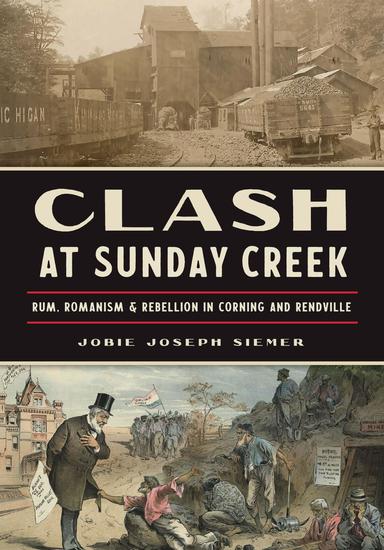
  • Clash at Sunday Creek: Rum Romanism & Rebellion in Corning and Rendville - cover

    Clash at Sunday Creek: Rum...

    Jobie Joseph Siemer

    • 0
    • 0
    • 0
    The Tombstone of Early Ohio   Southeast Ohio's Little Cities of Black Diamonds was a rugged region in the 1800s. Nowhere was this truer than in Corning and Rendville, mining towns reminiscent of the Wild West era. Gun duels, scandals, lynchings, and murders plagued these places, as intrepid European immigrants and tenacious Black miners relied on raw grit to survive rowdy saloons and perilous coal mines. These impoverished workers also took bold stands against affluent mine operators, leading to intense clashes with the Ohio National Guard./ Author and former Green Beret Jobie Siemer reveals stories of formidable union conflicts and the unyielding resilience of miners whose faith was a beacon in a chaotic struggle to restore order to Sunday Creek./
    Show book
  • Randomness Explained - cover

    Randomness Explained

    Introbooks Team

    • 0
    • 0
    • 0
    Randomness is a concept used (and less formally) in mathematics to imply that there is no way to accurately predict an event (to know what will happen before it takes place) or to sense a trend. Anything that is randomly selected for no conscious purpose can be assumed to be simply by chance factor. An illustration of an occurrence random event is a financial windfall, a lottery win. A computer can generate lists of seemingly random numbers. It is difficult for humans to do the same, since the brain functions in patterns.  
    If someone is asked to keep repeating heads or tails at random, a considerate human observer or a reasonably programmed computer may eventually tell which one the person is likely to say next because the computer recognizes the patterns. The user can click on Random Page on a website such as English Wikipedia to get a random article. The odds of being on anyone's webpage are the same as on every other webpage.
    Show book
  • The Indisputable Existence of Santa Claus - The Mathematics of Christmas - cover

    The Indisputable Existence of...

    Thomas Oléron Evans, Hannah Fry

    • 0
    • 0
    • 0
    How do you apply game theory to select who should be on your Christmas shopping list? What equations should you use to decorate the Christmas tree? Will calculations show Santa is getting steadily thinner—shimmying up and down chimneys for a whole night—or fatter—as he munches on cookies and milk in billions of houses across the world?In The Indisputable Existence of Santa Claus, distinguished mathematicians Hannah Fry and Thomas Oléron Evans demonstrate, with eminent clarity, how applied mathematics are so thoroughly interwoven throughout our everyday lives by explaining mathematical concepts through one very merry motif: Christmas. In their quest to provide mathematical proof for the existence of Santa, the authors take listeners on a festive journey through a traditional holiday season, wherein every activity, from wrapping presents to playing board games to cooking the perfect turkey, is painstakingly and hilariously analyzed. Because who hasn't always wondered how to set up a mathematically perfect Secret Santa?Lighthearted and diverting with Christmasy equations, Markov chains, and matrices, The Indisputable Existence of Santa Claus brightens up the bleak midwinter with a stockingful of mathematical marvels.
    Show book
  • The Future of Packaging - From Linear to Circular - cover

    The Future of Packaging - From...

    Tom Szaky

    • 0
    • 0
    • 0
    Tom Szaky sets out to do the impossible - eliminate all waste. This book paints a future of a "circular economy" that relies on responsible reuse and recycling to propel the world towards eradicating overconsumption and waste. 
     
     
    The Future of Packaging provides a straightforward solution to tackling the daunting issues of waste in the packaging industry by returning to a "circular economy." Beginning with a critique of the irresponsibility of the packaging industry and its contributions to wastefulness, Tom Szaky and his coauthors illuminate the path towards a waste-free future with lessons from the past. The goal of this book is to serve as a guide for designing a circular economy, showcasing how the world has moved away from circular systems of consumption (i.e. refillable milk/water/beer) to largely linear systems (i.e. milk bags/plastic bottles/plastic kegs). Objects were circular up until the 1940s, after which complex materials and a culture of consumerism began to create waste that nature couldn't handle. The way to get back to more circular systems starts with design and, after that, implementing systems. With the support and experiences of industry leaders in sustainable development, Szaky helps readers make the shift from a linear economy, which depends on extracting resources and overconsumption, to a circular economy that allows for growth.
    Show book
  • Machine Learning Pipelines - A Comprehensive Guide to Building and Deploying Intelligent Systems - cover

    Machine Learning Pipelines - A...

    Chuck Sherman

    • 0
    • 0
    • 0
    "Machine Learning Pipelines: A Comprehensive Guide to Building and Deploying Intelligent Systems" is a detailed, hands-on guide that equips data scientists, machine learning engineers, and AI practitioners with the knowledge and skills needed to build, optimize, and deploy robust machine learning pipelines. This book takes you through every step of the pipeline development process, from data collection to model deployment, ensuring that your intelligent systems are efficient, scalable, and production-ready. 
    The book also features real-world examples, code snippets, and case studies that demonstrate how to apply these concepts in practical settings, allowing you to build intelligent systems that are reliable, maintainable, and capable of evolving with new data and requirements. 
    "Machine Learning Pipelines" will provide you with the tools and frameworks necessary to efficiently build and deploy machine learning solutions at scale. With this comprehensive guide, you’ll be empowered to create intelligent systems that deliver high-quality, actionable insights in real time.
    Show book