Join us on a literary world trip!
Add this book to bookshelf
Grey
Write a new comment Default profile 50px
Grey
Subscribe to read the full book or read the first pages for free!
All characters reduced
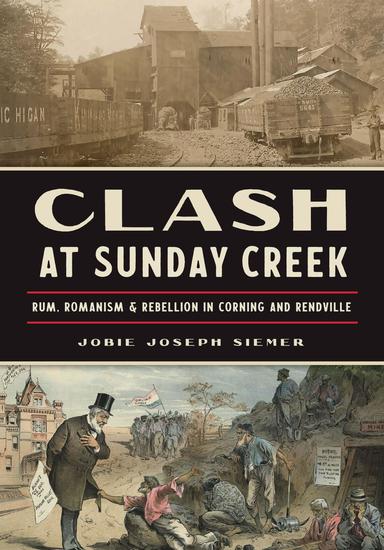
Clash at Sunday Creek: Rum Romanism & Rebellion in Corning and Rendville - cover

Clash at Sunday Creek: Rum Romanism & Rebellion in Corning and Rendville

Jobie Joseph Siemer

Publisher: The History Press

  • 0
  • 0
  • 0

Summary

The Tombstone of Early Ohio   Southeast Ohio's Little Cities of Black Diamonds was a rugged region in the 1800s. Nowhere was this truer than in Corning and Rendville, mining towns reminiscent of the Wild West era. Gun duels, scandals, lynchings, and murders plagued these places, as intrepid European immigrants and tenacious Black miners relied on raw grit to survive rowdy saloons and perilous coal mines. These impoverished workers also took bold stands against affluent mine operators, leading to intense clashes with the Ohio National Guard./ Author and former Green Beret Jobie Siemer reveals stories of formidable union conflicts and the unyielding resilience of miners whose faith was a beacon in a chaotic struggle to restore order to Sunday Creek./
Available since: 04/15/2024.
Print length: 192 pages.

Other books that might interest you

  • Nature of Genius The: Looking Beyond IQ and Talent - cover

    Nature of Genius The: Looking...

    One Day University

    • 0
    • 0
    • 0
    Learn from four remarkable professors in this set of One Day University presentations on history’s great geniuses. It may be true that everyone is born with equal potential, however there are some people who develop a level of ability or skill that defies belief, and display the characteristics of a genius. A genius is defined as a person who has remarkable intellectual or creative function, or other natural ability. So, what exactly makes a genius? And what common characteristics do they share? To find out, we’re taking an in-depth look at five geniuses.
    Show book
  • How We Think - Digital Media and Contemporary Technogenesis - cover

    How We Think - Digital Media and...

    N. Katherine Hayles

    • 0
    • 0
    • 0
    “How do we think?” N. Katherine Hayles poses this question at the beginning of this bracing exploration of the idea that we think through, with, and alongside media. As the age of print passes and new technologies appear every day, this proposition has become far more complicated, particularly for the traditionally print-based disciplines in the humanities and qualitative social sciences. With a rift growing between digital scholarship and its print-based counterpart, Hayles argues for contemporary technogenesis—the belief that humans and technics are coevolving—and advocates for what she calls comparative media studies, a new approach to locating digital work within print traditions and vice versa.Hayles examines the evolution of the field from the traditional humanities and how the digital humanities are changing academic scholarship, research, teaching, and publication. She goes on to depict the neurological consequences of working in digital media, where skimming and scanning, or “hyper reading,” and analysis through machine algorithms are forms of reading as valid as close reading once was. Hayles contends that we must recognize all three types of reading and understand the limitations and possibilities of each. In addition to illustrating what a comparative media perspective entails, Hayles explores the technogenesis spiral in its full complexity. She considers the effects of early databases such as telegraph code books and confronts our changing perceptions of time and space in the digital age, illustrating this through three innovative digital productions—Steve Tomasula’s electronic novel, TOC; Steven Hall’s The Raw Shark Texts; and Mark Z. Danielewski’s Only Revolutions. Deepening our understanding of the extraordinary transformative powers digital technologies have placed in the hands of humanists, How We Think presents a cogent rationale for tackling the challenges facing the humanities today.
    Show book
  • Scramble for Africa The: A Captivating Guide to European Expansion Colonial Conflicts the Berlin Conference and Its Impact on Modern Times - cover

    Scramble for Africa The: A...

    Captivating History

    • 0
    • 0
    • 0
    Step into the riveting saga of the Scramble for Africa and learn about the dramatic reshaping of the African continent. 
    This audiobook offers a lens into the pivotal moments that saw Africa carved and claimed by European powers. Explore the technological revolution that was occurring in the backdrop, as well as the indomitable spirit of the Africans who resisted colonial rule. 
    The Berlin Conference: Discover how a meeting in Berlin under Otto von Bismarck’s guidance led to the division of Africa. 
    King Leopold II’s Reign of Terror: Uncover the harrowing exploitation under Belgium King Leopold II in the Congo Free State, marking one of history’s darkest chapters. 
    Technological Advancements: Learn how innovations like the iron-hulled steamboat, the machine gun, and quinine made colonization possible. 
    Resistance Heroes: Be inspired by leaders like Cetshwayo, Samori Toure, and others who valiantly fought against colonial forces, showcasing the resilience and courage of African peoples. 
    Plundered Heritage: Reflect on the tragic loss of African cultural artifacts and human remains to European museums. 
    Literary Impact: Discover Arthur Conan Doyle’s influential critique of the Congo Free State, a testament to the power of the pen against injustice. 
    Add this compelling narrative to your collection and delve into the stories that have shaped the world. Click the “add to cart” button to learn more about the Scramble for Africa!
    Show book
  • Beyond Neoliberalism and Neo-illiberalism - Economic Policies and Performance for Sustainable Democracy - cover

    Beyond Neoliberalism and...

    Markus Gabriel, Anna Katsman,...

    • 0
    • 0
    • 0
    In many countries, the political backlash against neoliberalism has mainly been a retreat from democracy, with a decline in independence of the judiciary and the monetary authorities, increased control of the media, and manipulation of elections for purposes of authoritarian control. The economic dynamics and the impact of neoliberalism, i.e. deregulation and liberalized markets, is just one cause of this authoritarian shift. The contributors to this volume examine the impact of neoliberal economic policies in relation to cultural and political factors and how these have promoted the recent authoritarian turn, as well as probing the economic policies and performance of the illiberal regimes.
    Show book
  • Between Two Worlds - Jewish War Brides after the Holocaust - cover

    Between Two Worlds - Jewish War...

    Robin Judd

    • 0
    • 0
    • 0
    Facing the harrowing task of rebuilding a life in the wake of the Holocaust, many Jewish survivors, community and religious leaders, and Allied soldiers viewed marriage between Jewish women and military personnel as a way to move forward after unspeakable loss. Proponents believed that these unions were more than just a ticket out of war-torn Europe: they would help the Jewish people repopulate after the attempted annihilation of European Jewry. Historian Robin Judd, whose grandmother survived the Holocaust and married an American soldier after liberation, introduces us to the Jewish women who lived through genocide and went on to wed American, Canadian, and British military personnel after the war.
    Show book
  • 24 Hours in Ancient Egypt - A Day in the Life of the People Who Lived There - cover

    24 Hours in Ancient Egypt - A...

    Donald P. Ryan

    • 0
    • 0
    • 0
    Spend twenty-four hours with the ancient Egyptians. 


    Ancient Egypt wasn't all pyramids, sphinxes and gold sarcophagi. For your average Egyptian, life was tough, and work was hard, conducted under the burning gaze of the sun god Ra. 


    During the course of a day in the ancient city of Thebes (modern-day Luxor), Egypt's religious capital, we meet twenty-four Egyptians from all strata of society—from the king to the bread-maker, the priestess to the fisherman, the soldier to the midwife—and get to know what the real Egypt was like by spending an hour in their company. We encounter a different one of these characters every hour and in every chapter, and through their eyes see what an average day in ancient Egypt was really like.
    Show book