Join us on a literary world trip!
Add this book to bookshelf
Grey
Write a new comment Default profile 50px
Grey
Subscribe to read the full book or read the first pages for free!
All characters reduced
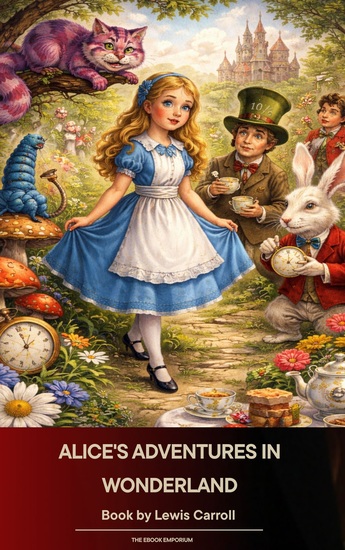
Alice's Adventures in Wonderland - cover

Alice's Adventures in Wonderland

Lewis Carroll

Publisher: The Ebook Emporium

  • 0
  • 0
  • 0

Summary

What if curiosity led you into a world where nothing makes sense—and everything matters?

First published in 1865, Alice's Adventures in Wonderland is one of the most beloved and imaginative books ever written. When young Alice follows a white rabbit down a rabbit hole, she enters a fantastical world filled with curious creatures, absurd logic, and unforgettable characters.

From the Mad Hatter's tea party to the Queen of Hearts' croquet ground, Lewis Carroll's playful language and inventive storytelling create a dreamlike journey that delights readers of all ages. Beneath the nonsense lies sharp wit, wordplay, and gentle satire that continues to fascinate both children and adults.

This timeless classic celebrates imagination, curiosity, and the joy of seeing the world differently.

Inside this eBook, you'll experience:

One of the most famous fantasy stories of all time

Whimsical characters and unforgettable scenes

Clever wordplay and playful logic

A foundational work of children's and fantasy literature

Read aloud to children, rediscovered by adults, and studied worldwide, Alice's Adventures in Wonderland remains a magical journey that never grows old.

Fall down the rabbit hole and rediscover a story that has enchanted generations. Buy now and enjoy one of the greatest classics in world literature.
Available since: 01/23/2026.
Print length: 86 pages.
Other books that might interest you

  • Les Misérables: Volume 1: Fantine - Book 7: The Champmathieu Affair (Unabridged) - cover

    Les Misérables: Volume 1:...

    Victor Hugo

    • 0
    • 0
    • 0
    Victor-Marie Hugo (26 February 1802 - 22 May 1885) was a French poet, novelist, essayist, playwright, and dramatist of the Romantic movement. During a literary career that spanned more than sixty years, he wrote abundantly in an exceptional variety of genres: lyrics, satires, epics, philosophical poems, epigrams, novels, history, critical essays, political speeches, funeral orations, diaries, and letters public and private, as well as dramas in verse and prose.
    BOOK 7: THE CHAMPMATHIEU AFFAIR: The incidents the reader is about to peruse were not all known at M. sur M. But the small portion of them which became known left such a memory in that town that a serious gap would exist in this book if we did not narrate them in their most minute details. Among these details the reader will encounter two or three improbable circumstances, which we preserve out of respect for the truth.
    Show book
  • Escape of the American Frigate Alliance The (Unabridged) - cover

    Escape of the American Frigate...

    James Fenimore Cooper

    • 0
    • 0
    • 0
    James Fenimore Cooper (September 15, 1789 - September 14, 1851) was an American writer of the first half of the 19th century. His historical romances depicting colonist and Indigenous characters from the 17th to the 19th centuries created a unique form of American literature. He lived much of his boyhood and the last fifteen years of life in Cooperstown, New York, which was founded by his father William Cooper on property that he owned. Cooper became a member of the Episcopal Church shortly before his death and contributed generously to it. He attended Yale University for three years, where he was a member of the Linonian Society.
    THE ESCAPE OF THE AMERICAN FRIGATE ALLIANCE: We cannot detain the narrative, to detail the scenes which busy wonder, aided by the relation of divers marvellous feats, produced among the curious seamen who remained in the ship, and their more fortunate fellows who had returned glory from an expedition to the land.
    Show book
  • The Perfumed Garden - cover

    The Perfumed Garden

    Sheikh Nefzaoui

    • 0
    • 0
    • 0
    The Perfumed Garden of Sensual Delight (Arabic: الروض العاطر في نزهة الخاطر Al-rawḍ al-ʿāṭir fī nuzhaẗ al-ḫāṭir) is a fifteenth-century Arabic sex manual and work of erotic literature by Muhammad ibn Muhammad al-Nefzawi, also known simply as "Nefzawi".
    The book presents opinions on what qualities men and women should have to be attractive and gives advice on sexual technique, warnings about sexual health, and recipes to remedy sexual maladies. It gives lists of names for the penis and vulva, has a section on the interpretation of dreams, and briefly describes sex among animals. Interspersed with these there are a number of stories which are intended to give context and amusement.
    Show book
  • Bernard Capes - A Short Story Collection - Well regarded Victorian author who was supremely popular in his day - cover

    Bernard Capes - A Short Story...

    Bernard Capes

    • 0
    • 0
    • 0
    Bernard Edward Joseph Capes was born on the 30th August 1854 in London.  He was one of 11 children. 
     
    His early work was as a journalist and this developed into writing many short stories for the periodicals of the time including Blackwood's, Cassell's, Cornhill Magazine, Illustrated London News, Macmillan's Magazine, Mall Magazine, Pearson's Magazine, The Idler, and The Queen. 
     
    It took him many years to decide that writing full-time could be a sustainable career path.  His initial success came with ‘The Mill of Silence’.  As well as being published it garnered second prize at a competition sponsored by the Chicago Record.  He exceeded that by winning it the following year with ‘The Lake of Wine’.   
     
    Capes quickly became both prolific and popular.  As well as his stories and articles for the periodicals he wrote around 40 volumes across novels, poetry, history as well as romance and mystery novels. 
     
    Bernard Capes died on 2nd November 1918 in the flu epidemic. 
     
    1 - Bernard Capes - A Short Story Collection - An Introduction 
    2 - A Danse Macabre by Bernard Capes 
    3 - A Voice From The Pit by Bernard Capes 
    4 - Bullet-Proof by Bernard Capes 
    5 - The Strength of the Rope by Bernard Capes 
    6 - The Thing in the Forest by Bernard Capes 
    7 - An Ugly Customer by Bernard Capes 
    8 - Dark Dignum by Bernard Capes 
    9 - The Voice by Bernard Capes
    Show book
  • Two Tales From Thomas Hood - cover

    Two Tales From Thomas Hood

    Thomas Hood

    • 0
    • 0
    • 0
    Thomas Hood (May 23, 1799 - May 3, 1845) was an English poet, author and humorist. Hood wrote regularly for the magazines, The London Magazine, Athenaeum, and Punch. He later published a magazine largely consisting of his own works. Hood, never robust, lapsed into invalidism by the age of 41, and died at the age of 45. The following includes Hood's short stories: The Widow of Galicia and The Golden Cup and The Dish of Silver.
    Show book
  • Candide - cover

    Candide

    Voltaire

    • 0
    • 0
    • 0
    Candide is characterised by its sarcastic tone, as well as by its erratic, fantastical and fast-moving plot. A picaresque novel with a story similar to that of a more serious bildungsroman, it parodies many adventure and romance clichés, the struggles of which are caricatured in a tone that is mordantly matter-of-fact. Still, the events discussed are often based on historical happenings, such as the Seven Years' War and the 1755 Lisbon earthquake. As philosophers of Voltaire's day contended with the problem of evil, so too does Candide in this short novel, albeit more directly and humorously.    Voltaire ridicules religion, theologians, governments, armies, philosophies, and philosophers through allegory; most conspicuously, he assaults Leibniz and his optimism. Voltaire's men and women point his case against optimism by starting high and falling low. A modern could not go about it after this fashion. He would not plunge his people into an unfamiliar misery. He would just keep them in the misery they were born to. But such an account of Voltaire's procedure is as misleading as the plaster cast of a dance.    Look at his procedure again. Mademoiselle Cunégonde, the illustrious Westphalian, sprung from a family that could prove seventy-one quarterings, descends and descends until we find her earning her keep by washing dishes in the Propontis. The aged faithful attendant, victim of a hundred acts of rape by negro pirates, remembers that she is the daughter of a pope, and that in honor of her approaching marriage with a Prince of Massa-Carrara all Italy wrote sonnets of which not one was passable. We do not need to know French literature before Voltaire in order to feel, although the lurking parody may escape us, that he is poking fun at us and at himself. His laughter at his own methods grows more unmistakable at the last, when he caricatures them by casually assembling six fallen monarchs in an inn at Venice.    A modern assailant of optimism would arm himself with social pity. There is no social pity in "Candide." Voltaire, whose light touch on familiar institutions opens them and reveals their absurdity, likes to remind us that the slaughter and pillage and murder which Candide witnessed among the Bulgarians was perfectly regular, having been conducted according to the laws and usages of war. Had Voltaire lived today he would have done to poverty what he did to war. Pitying the poor, he would have shown us poverty as a ridiculous anachronism, and both the ridicule and the pity would have expressed his indignation.
    Show book