Join us on a literary world trip!
Add this book to bookshelf
Grey
Write a new comment Default profile 50px
Grey
Subscribe to read the full book or read the first pages for free!
All characters reduced
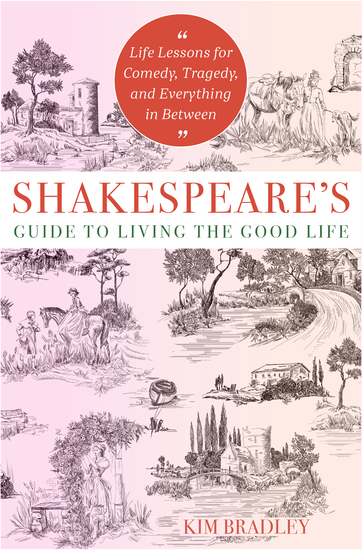
Shakespeare's Guide to Living the Good Life - Life Lessons for Comedy Tragedy and Everything in Between - cover

Shakespeare's Guide to Living the Good Life - Life Lessons for Comedy Tragedy and Everything in Between

Kim Bradley

Publisher: Hierophant Publishing

  • 0
  • 0
  • 0

Summary

“Virtue is bold, and goodness never fearful.” —Measure for Measure, act 3, scene 1   Shakespeare’s plays and poems remain as beloved in the twenty-first century as they were in the sixteenth. For all the years between us, the world he inhabited was much like our own—afflicted by political turmoil, divisiveness, war, extreme weather, recurrent plagues, the fouling of natural resources on which everyone relied, and discrimination against people who were different. The bard’s remedy for these troubles was to offer respite and inspiration to his audience through his writing.   In this book, author Kim Bradley teases out the inspirational messages in Shakespeare’s works. Every chapter is a journey through one of his most notable plays, each with actionable life lessons to be learned from his writing. Explore the power of acts of service with Twelfth Night, or the joy of forgiveness with The Tempest. From the importance of hospitality to the benefits of communing with nature, Shakespeare’s wise instruction can help you master the art of living.   “Yes, there is sickness, death, conflict, and division in today’s world,” Bradley writes. “More important, however, there are sunrises, starry skies, friendships, and love. Shakespeare invites us to enjoy the latter while remembering the former and shows how balancing an appreciation for both is key to living the good life.”
Available since: 04/15/2025.
Print length: 216 pages.

Other books that might interest you

  • Doomsday: The End Is Near - cover

    Doomsday: The End Is Near

    Raphael Terra

    • 0
    • 0
    • 0
    This audiobook has been recorded using Text to speech (TTS). 
     
    According to the Doomsday Clock, we, as a planet populated by humans with nowhere else to go, have 100 seconds left to live. 
     
    Humanity teeters on the brink of self-destruction. While this sounds like the start of an apocalyptic disaster movie, it is in fact, reality. This is the worrying fact of life in the 21st Century. 
     
    The Doomsday Clock is a warning of man’s ability to create something that could destroy everything - humanity’s very existence. It is a count-down timer to the point of no return – humanity’s doomsday. 
     
    It symbolizes how close we, as a species, have come to destroying the world with dangerous man-made technologies. The deadline of Midnight represents the moment of apocalypse, and how close the clock is set to that deadline warns how close humanity is to ultimate disaster. 
     
    With the intention of warning the public and inspiring action, the clock’s hands are set in accordance to how great is the threat of destruction. 
     
    Now, in the 21st century we are closer to Doomsday than ever before.
    Show book
  • Sunan an Nasai English Audio - cover

    Sunan an Nasai English Audio

    Imam An-Nasa'i,...

    • 0
    • 0
    • 0
    Sunan an-Nasa'i is a collection of hadith compiled by Imam Ahmad an-Nasa'i (rahimahullah). His collection is unanimously considered to be one of the six canonical collections of hadith (Kutub as-Sittah) of the Sunnah of the Prophet Muhammad (ﷺ). It contains roughly 5700 hadith (with repetitions) in 52 books.
    Show book
  • Lord Byron and Ada Lovelace: The Lives of the Father and Daughter Who Scandalized Victorian Britain - cover

    Lord Byron and Ada Lovelace: The...

    Charles River Editors

    • 0
    • 0
    • 0
    Lord Byron’s very name conjures up visions of the Romantic movement and outlandishly dressed bohemians, for if Alfred, Lord Tennyson was the poetic darling of the masses, Byron was the hero of the hedonists. While the traditional English literary hero was a nobleman rescuing a damsel in distress, Byron created the anti-hero, a man plagued by self-doubt and hidden sorrow. At the same time, his hero was also capable of facing reality once he had wrestled through his own angst, and even of occasionally acting nobly in the great tradition of the author’s Puritan forebears.  
    If Byron himself was eclectic in his tastes and character, his poetry was even more so, for he could feature satiric pieces poking fun at the status quo and historical renditions of ancient battles fought with nobility and valor, all in the same volume. Like so many other writers, he used poetry to explore his own most deeply guarded secrets, in one poem playing in first person the dramatic hero and in another the troubled penitent. He was sometimes funny, sometimes lyrical, and sometimes verbose, but he was always interesting, and that is what allowed him to become one of the most famous writers of all time, almost against his own will, and despite his premature death. 
    	Charles Babbage and Ada Lovelace were the first to conceive the notion of a programmable and automatic universal computer, which, on top of its ability to calculate any mathematical equation at an unmatched speed, could also be used for a seemingly infinite number of other applications. In other words, they envisioned the precursor to the modern computer. It was certainly an unusual path for any woman, and she managed to do so before an incredibly premature death. Augusta Ada King, Countess of Lovelace, died in 1852 at the age of 36, but during her short and tumultuous life, she was one of the first to recognize that computers could do far more than complex calculations.
    Show book
  • The New Science of Politics - An Introduction - cover

    The New Science of Politics - An...

    Eric Voegelin

    • 0
    • 0
    • 0
    “Thirty-five years ago few could have predicted that The New Science of Politics would be a best-seller by political theory standards. Compressed within the Draconian economy of the six Walgreen lectures is a complete theory of man, society, and history, presented at the most profound and intellectual level. . . . Voegelin’s [work] stands out in bold relief from much of what has passed under the name of political science in recent decades. . . . The New Science is aptly titled, for Voegelin makes clear at the outset that a ’return to the specific content’ of premodern political theory is out of the question. . . . The subtitle of the book, An Introduction, clearly indicates that The New Science of Politics is an invitation to join the search for the recovery of our full humanity.”—From the new Foreword by Dante Germino“This book must be considered one of the most enlightening essays on the character of European politics that has appeared in half a century. . . . This is a book powerful and vivid enough to make agreement or disagreement with even its main thesis relatively unimportant.”—Times Literary Supplement“Voegelin . . . is one of the most distinguished interpreters to Americans of the non-liberal streams of European thought. . . . He brings a remarkable breadth of knowledge, and a historical imagination that ranges frequently into brilliant insights and generalizations.”—Francis G. Wilson, American Political Science Review“This book is beautifully constructed . . . his erudition constantly brings a startling illumination.”—Martin Wright, International Affairs
    Show book
  • From Hormones to Neurons - Understanding Puberty's Role in Adolescent Brain Evolution And The Role of Technology - cover

    From Hormones to Neurons -...

    Brian Gibson

    • 0
    • 0
    • 0
    This audiobook is narrated by an AI Voice.   
    In the tumultuous landscape of adolescence, a period marked by profound transformation and discovery, the interplay between hormones and brain development forms the cornerstone of human growth. "From Hormones to Neurons: Understanding Puberty's Role in Adolescent Brain Evolution And The Role of Technology" delves into the intricate biological processes that shape the adolescent mind and explores how modern technology influences this critical stage of life. This book aims to unravel the complexities of puberty, illustrating how hormonal changes trigger a cascade of neural developments that underpin emotional, cognitive, and social maturation. 
    Physical changes and significant reconfigurations of brain structure and function mark the journey from childhood to adulthood. Moreover, in an era where technology permeates every aspect of life, understanding its role in adolescent development is more critical than ever. This book addresses how digital engagement — from social media and video games to educational platforms — interacts with the brain's evolving landscape. The dual influence of biology and technology presents a unique framework for comprehending the contemporary adolescent experience.
    Show book
  • Propaganda Girls - The Secret War of the Women in the OSS - cover

    Propaganda Girls - The Secret...

    Lisa Rogak

    • 0
    • 0
    • 0
    “Naeymi's mesmerizing narration takes listeners into the heart-stopping intrigue and action of nations at war and into the souls of women with cool demeanors and spines of steel.” —AudioFileThe incredible untold story of four women who spun the web of deception that helped win World War II.Betty MacDonald was a 28-year-old reporter from Hawaii. Zuzka Lauwers grew up in a tiny Czechoslovakian village and knew five languages by the time she was 21. Jane Smith-Hutton was the wife of a naval attaché living in Tokyo. Marlene Dietrich, the German-American actress and singer, was of course one of the biggest stars of the 20th century. These four women, each fascinating in her own right, together contributed to one of the most covert and successful military campaigns in WWII. As members of the OSS, their task was to create a secret brand of propaganda produced with the sole aim to break the morale of Axis soldiers. Working in the European theater, across enemy lines in occupied China, and in Washington, D.C., Betty, Zuzka, Jane, and Marlene forged letters and “official” military orders, wrote and produced entire newspapers, scripted radio broadcasts and songs, and even developed rumors for undercover spies and double agents to spread to the enemy. And outside of a small group of spies, no one knew they existed. Until now. In Propaganda Girls, bestselling author Lisa Rogak brings to vivid life the incredible true story of four unsung heroes, whose spellbinding achievements would change the course of history.A Macmillan Audio production from St. Martin’s Press.
    Show book