Unisciti a noi in un viaggio nel mondo dei libri!
Aggiungi questo libro allo scaffale
Grey
Scrivi un nuovo commento Default profile 50px
Grey
Iscriviti per leggere l'intero libro o leggi le prime pagine gratuitamente!
All characters reduced
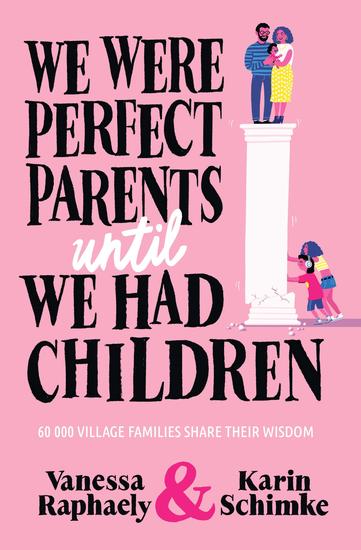
We Were Perfect Parents Until We Had Children - 60 000 Village Families Share Their Wisdom - cover

We Were Perfect Parents Until We Had Children - 60 000 Village Families Share Their Wisdom

Karin Schimke, Vanessa Raphaely

Casa editrice: Jonathan Ball

  • 0
  • 0
  • 0

Sinossi

'I straighten her little tiara every morning – I lift her chin and remind her that she is meant for greater things than playground bullies.'

'Everything shines in its own time. There is no timetable for life. Timetables are for classrooms, not for people.'
These are just some of the wisdoms shared on The Village, South Africa's beloved Facebook group for parents raising tweens, teens and young adults.
Having kids is a baffling endeavour beset with sulk, meltdowns, anxiety and disappointment – and that's just the parents! When you get that call to the principal's office? When the school acceptances don't come? When the bedroom door slams and you hear your child sobbing behind it? All awful but it's also a precious time.
The trick? To find a way to enjoy our families, love our children and believe in them and ourselves despite the daily challenges. And laugh . . .
In this book, Vanessa Raphaely and Karin Schimke have gathered together life lessons and insights from The Village members. It contains the gems and remedies from the real parenting experts – the parents – to help you raise your family in your own perfectly imperfect way.
Disponibile da: 02/08/2024.
Lunghezza di stampa: 216 pagine.

Altri libri che potrebbero interessarti

  • Nuclear Revolution - Powering the Next Generation - cover

    Nuclear Revolution - Powering...

    Jack Spencer

    • 0
    • 0
    • 0
    “Jack Spencer tells it the way it is and needs to be to make nuclear energy an affordable choice for America. Read this thoughtful and provocative book written by one of America’s great conservative thinkers.” — William Martin, Former Deputy Energy Secretary; Chair, Nuclear Energy Advisory Committee
    		 
    Skyrocketing energy prices are placing downward pressure on economic growth throughout the world. There seems to be no relief in sight, with hundreds of millions without access to reliable energy and with global energy consumption expected to grow by 50 percent over the next 30 years. Some would impose energy rationing―or in other words, slow human progress. But with nearly 46 percent of the world’s population living on less than $5.50 per day, slowing human progress is unacceptable. The only solution is more energy and lots of it.
    		 
    Jack Spencer, in his upcoming book, Nuclear Revolution: Powering the Next Generation, argues that nuclear energy offers real answers to power our homes and industries, clean our air and water, and maybe even take us to Mars. However, we have been getting nuclear power wrong for decades.
    		 
    Skeptics say that nuclear energy is too expensive and threatens the world with the proliferation of nuclear weapons material and radioactive waste. Proponents say that nuclear power needs and deserves the support of the state and the taxpayer, cradle to grave. The time has come, Spencer argues, to think big nuclear energy and pull it out of the time capsule that pop culture, environmental activists, lobbyists, peaceniks, and policymakers are all too content to leave nuclear in.
    		 
    Spencer writes that while the government-industry partnership that defined the early years of America’s commercial nuclear rise was essential to the nation’s security, reluctance to modernize that relationship has prevented the American nuclear industry from reaching its full potential. In its place, Spencer offers an alternative that shatters how we think about nuclear energy policy and realigns the responsibilities of government and industry with the incentives that will drive America to success.
    		 
    Nuclear Revolution describes why government intervention in the nuclear industry is a problem, how to move from the status quo to something new, and why such reforms will kick off an era of nuclear entrepreneurship and innovation. Over 70 years ago, nuclear energy entered the scene with great promise. Now more than ever, the world needs that promise delivered, and America can lead the way.
    Mostra libro
  • Secret Societies: We Are Controlled - cover

    Secret Societies: We Are Controlled

    Phil G

    • 0
    • 0
    • 0
    Secret societies exist for one purpose – creating power, maintaining power and growing power. In-order to do so they have to control you and me. They have to manipulate markets, media, government and religion. This is how they do it.
    Mostra libro
  • The Brain Revolution - Elevate Your Brain! Access game-changing audio lessons tailored for your ultimate success - cover

    The Brain Revolution - Elevate...

    Jackson Everett Floyd

    • 0
    • 0
    • 0
    The Brain Revolution: ⭐⭐ Simplified Guide & Explanations Included ⭐⭐ 
    Are you aiming to advance in your career and solidify your knowledge by successfully unlocking evolution's secrets and embracing future intelligence? 
    Looking for a comprehensive guide that offers everything you need to decode the secrets of cognitive evolution and future intelligence? 
    Your search ends here! 
    This guide is your ultimate companion for deepening your understanding, applying your skills, and engaging in hands-on exercises. With this, you're primed for success. 
    Updated for the evolution of cognitive intelligence 2024-2025. 
    Key features of this enriched guide: 
    - Profound insights on unlocking evolution's secrets and embracing future intelligence 
    - Detailed explanation of future intelligence breakthroughs 
    - Effective strategies for preparation and mastery 
    Our guide stands out with comprehensive coverage, crucial for your success. Concepts aren't just skimmed; they are delved into with precision. 
    Please note that this guide is not affiliated with any official entity and is purely an independent resource for your benefit. 
    Designed with a clear structure and easy-to-understand language, our Cognitive Evolution Guide 2024-2025 ensures smooth transitions between topics. Say goodbye to dense jargon and welcome clear, precise, and technically accurate content. 
    So, why wait? Click the BUY NOW button, secure your guide, and begin your journey to unlocking evolution's secrets and embracing future intelligence success!
    Mostra libro
  • Sikhism - The Teachings of Guru Nanak and the Principles of Equality and Service - cover

    Sikhism - The Teachings of Guru...

    Amman Hirsch

    • 0
    • 0
    • 0
    Sikhism, one of the world's youngest major religions, has roots that stretch deep into the socio-political and spiritual fabric of South Asia. Founded in the late 15th century by Guru Nanak Dev Ji in the Punjab region, Sikhism emerged as a response to the spiritual needs and social injustices of the time. It champions the principles of equality, justice, and service, inviting individuals from all walks of life to join in a collective pursuit of truth and devotion to one God.  
    At its core, Sikhism is a monotheistic faith that emphasizes the importance of a personal relationship with the divine. The teachings of the ten Gurus, recorded in the Guru Granth Sahib, the sacred scripture of Sikhism, serve as a guiding light for millions around the world. This scripture not only contains hymns and poetry that extol the virtues of love, compassion, and humility but also reflects the rich cultural diversity of its origins, incorporating elements from various religious and philosophical traditions. 
    Sikhism's distinct identity is marked by its unique practices, such as the wearing of the Five Articles of Faith (the Five Ks), community kitchen (Langar), and the commitment to social justice and equality. The faith’s communal spirit, reflected in the Gurdwara—a place of worship and gathering—fosters a sense of belonging and collective responsibility among Sikhs.  
    As we delve deeper into the teachings, rituals, and historical development of Sikhism in this book, we will explore the faith's contributions to the global religious landscape and its impact on contemporary society. We will examine how Sikh values resonate in today’s world, addressing critical issues such as religious tolerance, community service, and social equity. 
    Mostra libro
  • Egyptian Wisdom and the Hebrew Genesis - Ancient Egypt the Light of the World Book 7 - cover

    Egyptian Wisdom and the Hebrew...

    Gerald Massey

    • 0
    • 0
    • 0
    [I]t was not the genesis of the universe that is imaged in astronomical mythology. The firmament was there; already waiting to be distinguished as upper and lower, and divided into the domains of night and day, or Sut and Horus, or Ansar and Kisar. The constellations were not created from nothing when they were figured out of stars. The firmamental water was not created by being divided into upper and lower. The earth was not created because distinguished from water as ground to go upon…. Heaven and earth existed when these were nameless, and did not come into existence on account of being named. –from “Egyptian Wisdom and the Hebrew Genesis” It goes unappreciated by modern Egyptologists, but it is embraced by those who savor the concept of a “hidden history” of humanity, and those who approach all human knowledge from the perspective of the esoteric. Gerard Massey’s massive Ancient Egypt: The Light of the World–first published in 1907 and the crowning achievement of the self-taught scholar–redefines the roots of Christianity via Egypt, proposing that Egyptian mythology was the basis for Jewish and Christian beliefs. Here, Cosimo proudly presents Book 7 of Ancient Egypt, in which Massey explains how Egyptian wisdom–which greatly concerns itself with matters of the womb and birth, water, and the offspring of gods–was appropriated by the Hebrew holy books, and explains how the Hebrew account of creation is a clear repetition of Egyptian mythology. Peculiar and profound, this work will intrigue and delight readers of history, religion, and mythology. British author GERALD MASSEY (1828-1907) published works of poetry, spiritualism, Shakespearean criticism, and theology, but his best-known works are in the realm of Egyptology, including A Book of the Beginnings and The Natural Genesis.
    Mostra libro
  • Ancient Rome’s Provinces: The History of the Foreign Lands Ruled by the Roman Empire in Antiquity - cover

    Ancient Rome’s Provinces: The...

    Editors Charles River

    • 0
    • 0
    • 0
    It can be argued that Roman culture was, indeed, Graeco-Roman rather than Roman. It was the Greek language that served as the lingua franca in the Eastern Empire and much of the west including Italy. Many Greek intellectuals, including Galen, were based in Rome and the Roman aristocracy more and more came to embrace Greek literature and philosophy. Homer’s epics inspired Virgil’s Aeneid and Seneca wrote in Greek. Earlier, Scipio Africanus (236 – 183 B.C.), the epitome of the Roman martial hero, studied Greek philosophy and regarded Greek culture as the benchmark against which all others had to be judged. The Roman poet and philosopher Horace studied in Athens during the Principate and, in common with many of his class, saw that city as the intellectual centre of the world. 
    In the minds of most people today, Gaul equates to modern France. However, the vast geographical area that Caesar named Gaul, in fact, was made up of a number of very distinct regions and covered, in addition to modern-day France, Belgium, Luxembourg, parts of the Netherlands, Germany, Switzerland and Northern Italy. The Romans called the northern area of the Italian peninsula, which is now part of modern Italy, Cisalpine Gaul, or Gaul on this side of the Alps. Early Romans did not even consider this region as part of Italy and repeated incursions southwards, and the sacking of Rome itself in 390 B.C., resulted in Rome taking full control of the area in 221 B.C. and thoroughly Romanizing it to the extent that even the Celtic language totally disappeared and was replaced by Latin. The region was initially a province but by the beginning of the 1st century B.C., it had become fully integrated into the Roman heartland and became an administrative region of Italy rather than a province. 
    Mostra libro