Join us on a literary world trip!
Add this book to bookshelf
Grey
Write a new comment Default profile 50px
Grey
Subscribe to read the full book or read the first pages for free!
All characters reduced
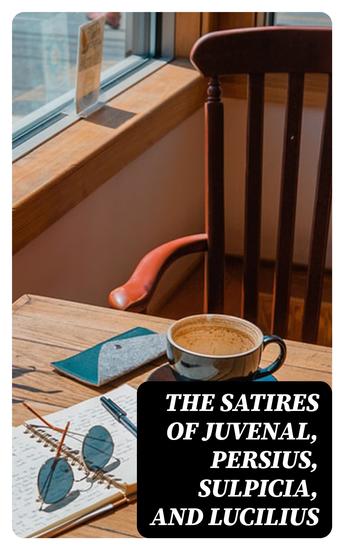
The Satires of Juvenal Persius Sulpicia and Lucilius - Literally translated into English prose with notes chronological tables arguments &c - cover

The Satires of Juvenal Persius Sulpicia and Lucilius - Literally translated into English prose with notes chronological tables arguments &c

Persius, Gaius Lucilius, Juvenal, Sulpicia

Translator Lewis Evans, William Gifford

Publisher: DigiCat

  • 0
  • 0
  • 0

Summary

The Satires of Juvenal, Persius, Sulpicia, and Lucilius presents a compelling anthology exploring the multifaceted nature of Roman satire. This collection captures the nuanced social critique and rich literary traditions of ancient Rome through a diverse range of voices and styles. With works ranging from scathing denunciations of moral decay to insightful reflections on personal and societal values, each piece offers a unique perspective on the human condition, blending wit and wisdom. Standout satires in the collection push the boundaries of literary forms, encouraging readers to consider the enduring relevance of these classical themes. The contributing authors, hailing from different periods of the Roman Empire, collectively enrich the tapestry of this anthology. Juvenal and Persius deliver biting political and social commentaries, while Lucilius, as a pioneer of Roman satire, offers foundational insights into the genre. Sulpicia adds a rare feminine perspective, adding depth to the traditionally male-dominated narrative of satire. Together, these authors engage with the philosophical currents of Stoicism and Epicureanism, creating a dialogue that transcends their individual works to encompass the broader cultural and historical contexts of their time. This anthology is an indispensable treasure for readers eager to immerse themselves in Roman literary tradition. The expertly curated selection provides a rare opportunity to engage with a spectrum of perspectives and styles, making it an invaluable resource for those studying classical literature, history, or philosophy. By examining the satires' societal critiques, readers gain a deeper understanding of their timeless relevance, fostering dialogue between ancient wisdom and modern inquiry.
Available since: 05/28/2022.
Print length: 639 pages.

Other books that might interest you

  • Seen Loved and Heard - A Guided Journal for Feeding the Soul - cover

    Seen Loved and Heard - A Guided...

    Tabitha Brown

    • 0
    • 0
    • 0
    In Feeding the Soul (Because It’s My Business), Tabitha Brown made readers feel seen, loved and heard, sharing the knowledge she gained from her own journey in life. Now, in this gorgeous journal, Tabitha invites readers to think more deeply about their own life paths, and how to bring more love and happiness into them. Readers will be drawn to contemplate their lives with each uplifting page, with:Dozens of thought-provoking prompts in Tabitha’s encouraging voicePlenty of inspirational quotes and charming TabismsEncouragement for listeners to talk about their own stories, hopes, and dreams and make the journal their own! 
    This soul-healing book encourages readers to take a few minutes and reflect on their own sources of joy and hope, spirituality, self-image, and peace, and to look back on when they want to appreciate how far they’ve come and what insights they’ve gained in their own journeys.
    Show book
  • A Sound So Very Loud - The Inside Story of Every Song Oasis Recorded - cover

    A Sound So Very Loud - The...

    Ted Kessler, Hamish MacBain

    • 0
    • 0
    • 0
    There has never been a definitive, forensically detailed history of Oasis and their music; a book that takes listeners to the heart of the band's work and what lay behind it in the kind of deeply researched, knowledgeable detail that has been afforded The Beatles, perhaps most notably with Ian MacDonald's Revolution In the Head, which examined every Beatles song in chronological detail. The authors' intention is to write the book that satisfies the many millions of fans globally similarly obsessed with Oasis's music, but who currently only have scattered social media pages to turn to add depth to the story. Leading music journalists Hamish MacBain and Ted Kessler deliver the definitive, chronological history of the songs of Oasis that will appeal to fans old and new, in doing so, bringing the wider Oasis story into play in glorious color.The pair have interviewed both Gallaghers dozens of times between 1994 and 2024, and no other journalists can claim more—or more lively—encounters with Liam and Noel. The book will also revisit each interview in the first-person, chronologically throughout, to add unique perspective and texture to the wider story. MacBain and Kessle will also dissect sleeve-art with the designers and photographers, delving into each detail surrounding the band. This is a veritable Oasis treasure trove! 
     
    This audiobook includes an exclusive conversation between the authors not included in the print edition.
    Show book
  • The Beauty of the Husband - A Fictional Essay in 29 Tangos - cover

    The Beauty of the Husband - A...

    Anne Carson

    • 0
    • 0
    • 0
    The Beauty Of The Husband is an essay on Keats's idea that beauty is truth, and is also the story of a marriage. It is told in twenty-nine tangos. A tango (like a marriage) is something you have to dance to the end.This clear-eyed, brutal, moving, darkly funny book tells a single story in an immediate, accessible voice–twenty-nine "tangos" of narrative verse that take us vividly through erotic, painful, and heartbreaking scenes from a long-time marriage that falls apart. Only award-winning poet Anne Carson could create a work that takes on the oldest of lyrical subjects–love–and make it this powerful, this fresh, this devastating.
    Show book
  • Bubsie and the Boys - The first journey around Australia by car - cover

    Bubsie and the Boys - The first...

    David Riley

    • 0
    • 0
    • 0
    In the winter of 1925, a pair of 21-year-old men drove out of Perth in a small second-hand Citroen nicknamed “Bubsie” headed for Darwin. At the time, no motor vehicle had ever drive to Darwin from Perth and their borrowed Citroen had less horsepower than a modern-day lawn mower. There were no serviced roads north of Meekatharra and few petrol stations. With most of the routes north unmapped cattle station tracks, the boys—Nevill Westwood and Greg Davies—would need to rely on the generosity of cattle station managers for food and fuel. 
    Getting to Darwin was adventure enough, but their journey took an unexpected turn when a car dealer encouraged them to keep driving to the east coast instead of returning to Perth via steam ship. It was a journey that would make Australian motoring history—the first car to drive around Australia—and the original vehicle is now housed at the National Museum as a vehicle of national significance.
    Show book
  • Running Wolf - Set in the Canadian wilderness this is a gripping supernatural tale with Native American elements - cover

    Running Wolf - Set in the...

    Algernon Blackwood

    • 0
    • 0
    • 0
    Algernon Blackwood was born on 14th March 1869 in Shooter’s Hill, South East London, to a religious middle-class family. His mother was a widowed Duchess and his father was a Post Office administrator.  
     
    Blackwood was interested in the paranormal and the supernatural at an early age, and had a thirst for anything on Buddhism, other Oriental philosophies, mysticism and occultism.  In his writings the weaving of the supernatural into his various works, from ghost stories and children’s stories to plays and long novels is clearly seen, his writings beautifully enriched by his long and diversified life experience.  
     
    After leaving university and visiting parts of Europe, mainly Switzerland, the young writer went to Canada and the United States where he took on jobs including work as a farmer, a bartender, a secretary, a journalist, a reporter, running a hotel and teaching the violin.  He was voracious in meeting new people and absorbing new ideas.  
     
    In his late thirties, he returned to England where he published two of his supernatural stories in Pall Mall Magazine. As more of his highly entertaining stories were published so did his reputation and his bank balance.  All those years of curiosity and experiences were starting to emerge from his writing. 
     
    In 1906, ‘The Empty House & Other Ghost Stories’ was published with tremendous success.  Further volumes of short stories followed and with it a larger audience and bigger paydays. He also published children’s stories. 
     
    Blackwood also had ideas for novels and to explore on a larger canvas the paranormal world and the relationship between man and metaphysical powers including, in 1911, ‘The Centaur’.  
     
    With the outbreak of the First World War, Blackwood was assigned to British intelligence to write propaganda to support the war effort. 
     
    He was a prolific author with a quite staggering output which was also to include many plays. The exact number of his works is unknown as he would frequently write a story for a newspaper or periodical at very short notice.  
     
    In 1949, Blackwood was made a Commander of the Order of the British Empire in recognition of his literary talents and his services during the First World War.  
     
    Algernon Blackwood died on 10th December 1951 after a series of strokes.  
     
    The mysteries of the natural world are enhanced by those of the Native American spirit world in this wonderfully descriptive short story of a man’s fishing expedition to Medicine Lake.
    Show book
  • Sharpen Your Bayonets - A Biography of Lieutenant General John Wilson “Iron Mike” O'Daniel Commander 3rd Infantry Division in World War II - cover

    Sharpen Your Bayonets - A...

    Timothy R. Stoy, Anthony A. Cucolo

    • 0
    • 0
    • 0
    The first full-length biography of World War II general and Cold Warrior John Wilson "Iron Mike" O’Daniel, featuring "the very essence of the man… who spent more time under fire with his front-line troops than behind the safety of his office desk." — ARGunners.comJohn Wilson “Iron Mike” O’Daniel was one of the U.S. Army’s great fighting generals of the 20th century. He began his military career with the Delaware Militia in 1914, served on the Mexican border in 1916, received a Distinguished Service Cross in World War I, was Mark Clark’s man for hard jobs in the early days of World War II, and commanded the storied 3rd Infantry Division from Anzio to the end of the war in Europe, ending the war in Salzburg after liberating Munich, and Hitler’s Berghof and Eagle’s Nest on the Obersalzberg, Bavaria, Germany. “Iron Mike “commanded I Corps in Korea 1951–1952 and ended his career as the Chief of the Military Assistance Advisory Group in Vietnam in the early days of American involvement there.  LTC Stoy paints a vivid picture of this great American warrior who played an important role in World War II, became an ardent anti-Communist crusader after duty in Moscow as Military Attaché 1948–1950 as the Cold War intensified, laid the foundation for the Army of the Republic of Vietnam, and remained an ardent supporter of President Ngo Dinh Diem while serving as Chairman of the American Friends of Vietnam from his retirement in 1956 until 1963, shortly before Diem’s assassination.
    Show book