Join us on a literary world trip!
Add this book to bookshelf
Grey
Write a new comment Default profile 50px
Grey
Subscribe to read the full book or read the first pages for free!
All characters reduced
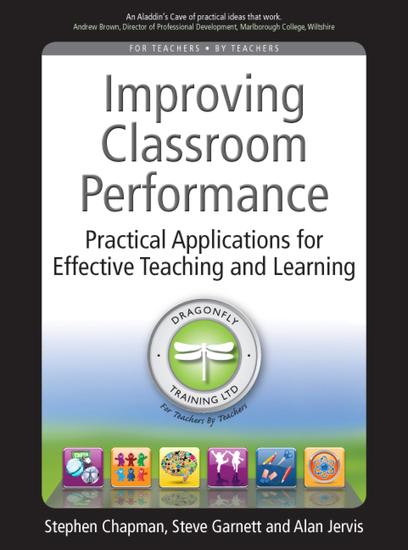
Improving Classroom Performance - Spoon Feed No More Practical Applications For Effective Teaching and Learning - cover

Improving Classroom Performance - Spoon Feed No More Practical Applications For Effective Teaching and Learning

Stephen Chapman, Steve Garnett, Alan Jervis

Publisher: Crown House Publishing

  • 0
  • 1
  • 0

Summary

A Long awaited first book from one of the biggest teacher training companies in the UK. Dragonfly Training was founded in 1999 and has established an excellent reputation internationally for providing inspiring, realistic and practical training courses for teachers. In this, their first book, three of their top trainers provide some of the very best hands-on approaches to teaching. Dragonfly's six key principles are: Promote effective starters and plenaries; Provide constant reinforcement as a means of embedding knowledge and provide on-going revision; Introduce a variety of ideas; Do first, teach after - whenever possible; Encourage students to create teaching materials themselves; Demonstrate and articulate success by modelling the desired outcomes.
Available since: 04/28/2011.
Print length: 200 pages.

Other books that might interest you

  • The Art of Asking Better Questions - Pursuing Stronger Relationships Healthier Leadership and Deeper Faith - cover

    The Art of Asking Better...

    J.R. Briggs

    • 0
    • 0
    • 0
    What if the key to a deeper, more meaningful life lies in the questions you ask? 
     
    In The Art of Asking Better Questions, J. R. Briggs offers a thoughtful exploration of how intentional, well-crafted questions can transform relationships, leadership, and spiritual growth. Guided by the wisdom of Jesus as the ultimate question-asker, this book introduces four levels of questions designed to address different purposes and provide practical tools to improve your conversations. 
     
    If you want information, Google it. But if you want wisdom and connection, you need to become a person who asks better questions. Briggs argues that the quality of your life is determined by the quality of the questions you ask God, yourself, and others. There's not a single area where improving the quality of your questions won't improve your life and the lives of those around you. In this book, you'll: 
    Explore why questions are so important (but why we don't ask them very much).Discover how questions affect our faith.Study how questions influence our ability to lead.Learn simple, practical ways to ask better questions.
    Show book
  • Bilingual book in English Spanish for Intermediate Learners - A Thrilling Crime Mystery - cover

    Bilingual book in English...

    Ariel Sanders

    • 0
    • 0
    • 0
    This audiobook is narrated by an AI Voice. 🔥 Murder, madness, and a secret that should have stayed buried… 
    London, 1888. Fog cloaks the streets. Fear rules the city. And Jack the Ripper is still out there. 
     
    Inspector Edmund Harrow thought he’d seen it all—until an informant is killed before naming the Ripper. His last word: Ashdown. 
     
    The trail leads to a crumbling mansion, a secret lab, and Evelyn Carstairs, a woman with chilling knowledge. Her father, long thought dead, may be alive—and far more terrifying than the Ripper. 
     
    As corpses pile up, Harrow and Evelyn must uncover a horror that science should never have touched. 
     
    đź’€ Some monsters are born. Others are built. 
     
    âś… A gripping thriller that keeps you turning pages. 
    ✅ Perfect for English & Spanish learners—read in both languages! 
    âś… Immerse yourself in a chilling mystery filled with gothic horror. 
     
    📖 Get your copy today and step into the fog—if you dare.
    Show book
  • Campaign for Open Science with Spirituality without a Big Bang - cover

    Campaign for Open Science with...

    John Kapp

    • 0
    • 0
    • 0
    This groundbreaking book invites world leaders to follow science, yet urges an open dialogue in the pursuit of truth, steering clear of Big Pharma's marketing propaganda. John delves into how the universe perpetually reinvents itself in a Steady State, eschewing the traditional big bang theory, through his father's concept of 'symmetrical impermanence' (SI). He posits that Jupiter was once a binary twin to the sun, which, after collapsing in a supernova, gave birth to the planets.
    
    John tackles Chalmers' 'hard' problem of consciousness using the wave-particle interchangeability (WPI) principle found in electromagnetic fields—the same principle that powers cell phones. He theorizes that the music of life emanates from primary energy as electromagnetic waves, which coalesce into a 'One Mind' comprising a nested hierarchy of sub-minds. According to his theory, our brains transform these waves into protons, constructing our bodies with conscious awareness and enabling us to experience and adapt to hostile environments.
    
    He advocates for a Campaign for Open Science and Medicine (COSAM) to foster a shift towards holistic thinking, aiming to safeguard humanity's future.
    Show book
  • Eurotrash - Why America Must Reject the Failed Ideas of a Dying Continent - cover

    Eurotrash - Why America Must...

    David Harsanyi

    • 0
    • 0
    • 0
    Why should America try to be more like countries that are worse in nearly every way?  
    Europe has been declining under the weight of its antiquated institutions, economic fatigue, moral anemia and cultural surrender. Yet American politicians, technocrats, academics, and pundits argue, with increasing popularity, that Americans should look across the Atlantic for solutions to the nation’s problems, including on issues like health care, the welfare state, immigration, and a bloated bureaucracy. 
    In Eurotrash, David Harsanyi argues we are looking in the wrong place. By every economic and societal measure, the United States is more tolerant than Europe. It is more welcoming of immigrants, but also far more successful at assimilating them. Minorities do far better in United States. Our economy is dominant. Only one European company appears in top 10 corporate powerhouses in the world and only seven in the top 50. Americans make up nearly half of the list. 
    Americans are far more charitable and happier than Europeans. Our slightly lower life expectancy and our slightly higher infant mortality rate are not a result of substandard care, but a statistical misunderstanding based on the fact we treat every life as one worth saving. 
    In this biting, fast-moving, and well-researched polemic, Harsanyi debunks prevailing notions about European supremacy and makes an unapologetic case for American exceptionalism, offering insight and reasoned arguments to counter current policy prescriptions.
    Show book
  • Kaiser Wilhelm II - Biography of the Last German Emperor and King of Prussia - cover

    Kaiser Wilhelm II - Biography of...

    Kelly Mass

    • 0
    • 0
    • 0
    Wilhelm II, the last German Emperor (Kaiser) and King of Prussia, ruled from June 15, 1888, until his abdication on November 9, 1918, marking the end of the German Empire. His reign was tumultuous, characterized by grand ambitions and disastrous decisions that not only reshaped Germany but also contributed to the broader context of global conflict. Although Wilhelm's creation of a powerful navy and his drive to position Germany as a dominant world power earned him recognition, his erratic public statements and volatile foreign policy alienated many, making him a central figure in the lead-up to World War I. 
    Born in 1859 to Prince Frederick William of Prussia and Victoria, Princess Royal of the United Kingdom, Wilhelm II was part of a deeply interconnected European royal family. His mother, Queen Victoria’s eldest daughter, brought him into a web of political alliances that spanned several major European nations. Wilhelm’s father, Frederick III, briefly held the throne for only 99 days in 1888 before his untimely death, making it a year of remarkable transitions. Just months after his father’s passing, Wilhelm succeeded to the throne during what historians refer to as the "Year of the Three Emperors," as Wilhelm’s grandfather, Wilhelm I, had also died earlier that year.
    Show book
  • A Dignified Life - Revised and Expanded: The Best Friends™ Approach to Alzheimer’s Care: A Guide for Care Partners - cover

    A Dignified Life - Revised and...

    MPH David Troxel, MSW Virginia Bell

    • 0
    • 0
    • 0
    More than 5 million Americans are currently living with Alzheimer's disease or a related form of dementia. By the year 2030, experts estimate that as many as 66 million people will be faced with this life-altering disease. These statistics impact millions of caregivers. Compared with all types of caregivers, those who assist someone with dementia experience the highest levels of burnout, depression, poor health, and premature death. A Dignified Life, Revised and Expanded offers hope and help. 


    Ten years ago, the first edition of A Dignified Life changed the way the caregiving community approached Alzheimer's disease by showing caregivers how to act as a Best Friend to the person. Firmly grounded in the latest knowledge about dementia, this expanded edition offers a wealth of tips and advice. 


    While medical treatment of the disease hasn't changed, our understanding and awareness of treating people in a more caring way has changed. With no cure, respectful care by effective and compassionate care partners is the only real "treatment" available. The Best Friends Approach is successful because it sustains people's connection to their world, their loved ones, and themselves. A Dignified Life shows how to bring dignity, meaning, and peace of mind to the lives of both those who have Alzheimer's and dementia and those who care for them.
    Show book