Join us on a literary world trip!
Add this book to bookshelf
Grey
Write a new comment Default profile 50px
Grey
Subscribe to read the full book or read the first pages for free!
All characters reduced
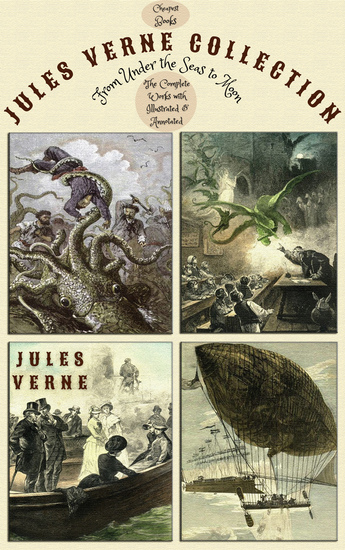
Jules Verne Collection "From Under the Seas to Moon" - (The Complete Works with Illustrated & Annotated) - cover

Jules Verne Collection "From Under the Seas to Moon" - (The Complete Works with Illustrated & Annotated)

Jules Verne

Publisher: E-Kitap Projesi & Cheapest Books

  • 0
  • 0
  • 0

Summary

This Excellent Collection brings together Jules Verne's longer, major books and a fine selection of shorter pieces and Science-Fiction Books. These Books created and collected in Jules Verne's Most important Works illuminate the life and work of one of the most individual writers of the XX century - a man who elevated political writing to an art. Jules Verne (1828Ŕ1905) was a French writer. He was one of the first authors to write science fiction. Some of his books include Journey To The Centre Of The Earth (1864), From the Earth to the Moon (1865), Twenty Thousand Leagues Under the Sea (1870), and Around the World in Eighty Days (1873).

Jules Verne has earned a place in the history of literature as one of the most important writers of adventure novels of recent history. But his novels contain more than just entertainment. Their pages contain hidden scientific data, descriptions of inventions and, above all, a love of technological innovations and the progress of humanity. From his perspective as a nineteenth-century man, Verne shocked the world will tales of gadgets and vehicles that, years later, would eventually take shape outside fiction, just as Isaac Asimov did years later. His influence has been such that it has come to serve as an inspiration to an entire cultural and aesthetic movement.

This Collection included:

1. Five Weeks in a Balloon
2. The Adventures of Captain Hatteras
3. A Journey into the Center of the Earth
4. From the Earth to the Moon
5. Around the Moon
6. In Search of the Castaways
7. 20,000 Leagues Under the Sea
8. A Floating City
9. The Fur Country
10. Around the World in Eighty Days
11. The Mysterious Island
12. The Survivors of the Chancellor
13. Michael Strogoff, or the Courier of the Czar
14. Off on a Comet
15. The Underground City, or the Child of the Cavern
16. Dick Sand, a Captain at Fifteen
17. The Begum's Millions
18. Tribulations of a Chinaman in China
19. The Steam House
20. Eight Hundred Leagues on the Amazon
21. Godfrey Morgan
22. The Green Ray
23. Kéraban the Inflexible
24. The Vanished Diamond
25. The Archipelago on Fire
26. Mathias Sandorf
27. The Lottery Ticket
28. Robur the Conqueror
29. Texar's Revenge, or, North Against South
30. The Flight to France
31. Two Years' Vacation
32. Family Without a Name
33. The Purchase of the North Pole, or Topsy-Turvy
34. César Cascabel
35. Mistress Branican
36. Carpathian Castle
37. Claudius Bombarnac
38. Foundling Mick
39. Captain Antifer
40. Propeller Island
41. Facing the Flag
42. Clovis Dardentor
43. An Antarctic Mystery
44. The Will of an Eccentric
45. Master of the World
Available since: 01/21/2024.
Print length: 8000 pages.

Other books that might interest you

  • Off the Chain (Unabridged) - cover

    Off the Chain (Unabridged)

    H. G. Wells

    • 0
    • 0
    • 0
    Herbert George Wells (21 September 1866 - 13 August 1946) was an English writer. Prolific in many genres, he wrote dozens of novels, short stories, and works of social commentary, history, satire, biography and autobiography. His work also included two books on recreational war games. Wells is now best remembered for his science fiction novels and is often called the "father of science fiction", along with Jules Verne and the publisher Hugo Gernsback.
    OFF THE CHAIN: (December, 1910) I was ill in bed, reading Samuel Warren's "Ten Thousand a Year," and noting how much the world can change in seventy years.
    Show book
  • Gentle Breathing - From their pens to your ears genius in every story - cover

    Gentle Breathing - From their...

    Ivan Bunin

    • 0
    • 0
    • 0
    Ivan Alekseyevich Bunin was born on 22nd October 1870 in Voronezh province, in the South-West of the Russian Empire. 
    His early life was plagued by his Father’s gambling habits which caused his education to be erratic and the family to lose most of their wealth. 
    Bunin published his first poem in 1887 in St Petersburg and later in Oryol he worked for the local paper and became its editor, handily allowing him to publish his own poems and short stories.  There he met and married Varvara Pashchenko.  Ivan Bunin's debut book of poetry ‘Poems (1887–1891)’ was published in 1891. 
    This poetry and his translation of Longfellow garnered him his first Pushkin Prize.  Now he switched to writing prose and his novella ‘Antonov Apples’ is regarded as his first masterpiece.  Many more would follow. 
    The October Revolution of 1905 found Bunin in the Crimea.  Scenes of ‘class struggle’ he saw more as the oppressed people's craving for anarchy and destruction. 
    In November 1906 he began a passionate affair with Vera Muromtseva, within a few months they were touring through Egypt and Palestine.  ‘The Bird's Shadow’ collection was the result.   
    His second Pushkin Prize came in 1909 for Poems (1903–1906) and further translations.  He was now elected to the prestigious Russian Academy. 
    More widespread fame came in 1910 with ‘The Village’, a controversial and bleak portrayal of Russian country life.  Travel too beckoned them back to the Middle East, Ceylon (now Sri Lanka) and for winters in Capri with their friend Maxim Gorky.  
    That friendship suddenly ended in April 1917 as the revolution began to ferment in war-ravaged Russia.  After the Bolsheviks took power and the upheavals continued, he decided to leave Russia, finally achieving that in early 1920.  
    It would take some time to heal the wounds and stress he had been under and for his writing to begin again.  Settled in France, Bunin published many of his previous works and collections of novellas.  He also made regular contributions to the Russian emigre press.  
    Although reluctant to become involved in politics, Bunin was now feted as both a writer and the figurehead of non-Bolshevik Russian values and traditions.  In 1933 he became the first Russian to be awarded the Nobel Prize for Literature ‘for following through and developing with chastity and artfulness the traditions of Russian classic prose.’  
    In 1938 Bunin began working on the celebrated cycle of nostalgic, and erotically themed stories known Dark Avenues (or Dark Alleys).  
    As World War II broke out he chose to remain in Grasse spending the war at his remote Villa Jeanette, high in the mountains.  
    Ivan Bunin was a staunch anti-Nazi, and often, under difficult conditions, sheltered fugitives after Vichy was occupied by the Germans.  He wrote but did not publish during these years until on August 23rd the Nazi’s fled Grasse without a fight.  The next day the Americans came.  
    In May 1945 he returned to Paris and, apart from convalescing at times in Juan-les-Pins, he stayed for the rest of his life. 
    After 1948, with his health deteriorating, Bunin concentrated upon writing his memoirs and a book on Chekhov.  His last years were overshadowed by bitterness and despair at the situation in Russia and the treatment of its peoples.  He was suffering now from asthma, bronchitis and chronic pneumonia. 
    Ivan Alekseyevich Bunin died in a Paris attic flat on 8th November 1953.  Heart failure, cardiac asthma and pulmonary sclerosis were given as the causes of death.  He was 83.
    Show book
  • Man Who Was Thursday The - A Nightmare (Unabridged) - cover

    Man Who Was Thursday The - A...

    G. K. Chesterton

    • 0
    • 0
    • 0
    G. K. Chesterton's surreal masterpiece is a psychological thriller that centers on seven anarchists in turn-of-the-century London who call themselves by the names of the days of the week. Chesterton explores the meanings of their disguised identities in what is a fascinating mystery and, ultimately, a spellbinding allegory.
    Show book
  • Sherlock Holmes: The Copper Beeches - cover

    Sherlock Holmes: The Copper Beeches

    Arthur Conan Doyle

    • 0
    • 0
    • 0
    Immerse yourself in the mysterious world of The Adventure of the Copper Beeches, the twelfth part of the Sherlock Holmes Short Story collection, narrated by Jake Urry. In this enthralling tale by Sir Arthur Conan Doyle, a young governess named Violet Hunter seeks Holmes's counsel after receiving an unusual job offer with peculiar conditions. As Holmes investigates, he uncovers a sinister secret hidden within the seemingly tranquil Copper Beeches estate. 
    Jake Urry's evocative narration brings the suspense and intrigue of this story to life, making this audiobook a captivating experience for both long-time Sherlock Holmes fans and new listeners. Explore the enigmatic atmosphere and witness Holmes's unparalleled detective skills in The Adventure of the Copper Beeches with this exceptional recording.
    Show book
  • Romeo and Juliet - Audiobook - cover

    Romeo and Juliet - Audiobook

    William Shakespeare, Classic...

    • 0
    • 0
    • 0
    Romeo and Juliet is an iconic tragedy written by William Shakespeare, telling the story of forbidden love between Romeo and Juliet, two young members of the rival Montague and Capulet families in Verona. From the moment they meet, they fall deeply in love, unaware of the longstanding hatred that divides their families. Their sincere love drives them to defy social expectations and dream of a life together.However, a cruel twist of fate and a series of misunderstandings lead to a tragic end, highlighting the destructive consequences of family conflicts and intolerance. Secondary characters, such as Mercutio and Juliet's Nurse, add depth to the plot, bringing moments of lightness and tension that enrich the story.Through this poignant narrative, Shakespeare explores timeless themes of forbidden love, sacrifice, and fate, which continue to resonate with audiences today. Romeo and Juliet remains a powerful and enduring work, reminding us of love's strength in the face of prejudice and the human cost of hatred.
    Show book
  • Gone Astray - cover

    Gone Astray

    Anton Chekhov

    • 0
    • 0
    • 0
    "Gone Astray" is one of Chekhov's earlier comedic short stories that is a light-hearted romp about two drunken lawyers trying to find their way home at night. Chekhov's masterful use of irony is present here as one of the lawyers, Kozyavkin, accidentally violates the law by breaking into a house he believes to be his own.
    Show book