Join us on a literary world trip!
Add this book to bookshelf
Grey
Write a new comment Default profile 50px
Grey
Subscribe to read the full book or read the first pages for free!
All characters reduced
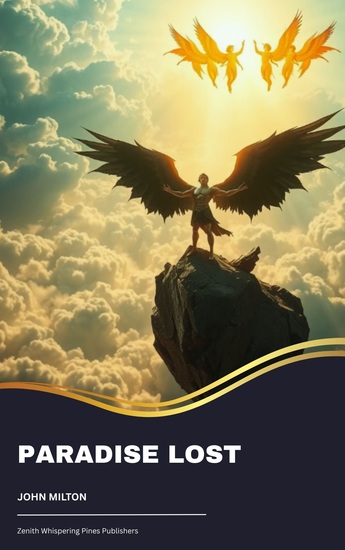
Paradise Lost - cover

Paradise Lost

John Milton

Publisher: Zenith Whispering Pines Publishers

  • 0
  • 0
  • 0

Summary

An angel's rebellion. A world newly created. A choice that changes everything.
In this towering epic, Milton brings to life the cosmic struggle between Heaven and Hell, led by the proud and compelling figure of Satan. Through breathtaking verse, we witness the creation of Earth, the innocence of Adam and Eve, and the tragic temptation that reshapes human destiny forever. The poem's grandeur, emotion, and moral complexity have made it a cornerstone of world literature.

Celebrated as "the greatest English poem ever written," Paradise Lost combines drama, theology, mythology, and unforgettable imagery into a work that continues to inspire awe centuries later.

If you love epic storytelling, powerful language, and timeless battles between freedom, obedience, pride, and love, this masterpiece is essential reading.

Open the book—and enter the epic realm where Heaven trembles and humanity begins.
Available since: 12/11/2025.
Print length: 402 pages.

Other books that might interest you

  • Fifty Women on the Great War - Beautiful poems about a horrible subject - cover

    Fifty Women on the Great War -...

    Sara Teasdale

    • 0
    • 0
    • 0
    In the 20th Century War enveloped the globe on two occasions.  Myriad other wars erupted, spent themselves in fury or rumbled on, decaying into untold misery and pain. 
    Whilst The War Poets were heralded, the women poets were not much spoken of.  True, their role was not on the front lines directly, in the heat and line of battle, but they were there, just behind, witnessing the wholesale slaughter of a generation in the ‘War to end all wars’.   
    In this volume we hear just how their verse is equally as telling, as emotional and as insightful and now, hopefully, as respected.
    Show book
  • The Kingdom of Surfaces - Poems - cover

    The Kingdom of Surfaces - Poems

    Sally Wen Mao

    • 0
    • 0
    • 0
    In The Kingdom of Surfaces, award-winning poet Sally Wen Mao examines art and history—especially the provenance of objects such as porcelain, silk, and pearls—to frame an important conversation on beauty, empire, commodification, and violence. In lyric poems and wide-ranging sequences, Mao interrogates gendered expressions such as the contemporary “leftover women,” which denotes unmarried women, and the historical “castle-toppler,” a term used to describe a concubine whose beauty ruins an emperor and his empire. These poems also explore the permeability of object and subject through the history of Chinese women in America, labor practices around the silk loom, and the ongoing violence against Asian people during the COVID-19 pandemic. 
     
    At its heart, The Kingdom of Surfaces imagines the poet wandering into a Western fantasy, which covets, imitates, and appropriates Chinese aesthetics via Chinamania and the nineteenth-century Aesthetic Movement, while perpetuating state violence upon actual lives. The title poem is a speculative recasting of Through the Looking-Glass, set in a surreal topsy-turvy version of the eponymous China-themed 2015 Metropolitan Museum of Art Gala. The Kingdom of Surfaces is a brilliantly conceived call for those who recognize the horrors of American exceptionalism to topple the empire that values capital over lives and power over liberation.
    Show book
  • The Poetry of John Dryden - England's first Poet Laureate that turned literature in Restoration England into "the Age Of Dryden" - cover

    The Poetry of John Dryden -...

    John Dryden

    • 0
    • 0
    • 0
    John Dryden was born on August 9th, 1631 in the village rectory of Aldwincle near Thrapston in Northamptonshire and grew up in a nearby village.  In 1644 he was sent to Westminster School as a King's Scholar and then obtained his BA in 1654, graduating top of the list for Trinity College, Cambridge that year.  
    Returning to London during The Protectorate, Dryden found work with Cromwell's Secretary of State, John Thurloe.  At Cromwell's funeral on November 23rd 1658 he found company with the Puritan poets John Milton and Andrew Marvell.  The setting was to be a sea change in English history. From Republic to Monarchy and from one set of lauded poets to what would soon become the Age of Dryden. Later that year he published the first of his great poems, Heroic Stanzas (1658), a eulogy on Cromwell's death.  
    With the Restoration of the Monarchy in 1660 Dryden celebrated in verse with Astraea Redux, an authentic royalist panegyric and with the re-opening of the theatres he began to also write plays. His first, The Wild Gallant, appeared in 1663 and whilst not successful, he was contracted to produce three plays a year for the King's Company, in which he became a shareholder. During the 1660s and '70s, theatrical writing was his main source of income.    
    In 1667, he published Annus Mirabilis, a lengthy historical poem which described the English defeat of the Dutch naval fleet and the Great Fire of London.  This work established him as the pre-eminent poet of his generation, and was crucial in his attaining the posts of Poet Laureate in 1668 and a couple of years later, historiographer royal (1670) as his talent encompassed many forms; from Poetry to Plays to translations. 
    In 1694 he began work on what would be his most ambitious and defining work as translator, The Works of Virgil (1697), which was published by subscription. It was a national event.  
    John Dryden died on May 12th, 1700, and was initially buried in St. Anne's cemetery in Soho, before being exhumed and reburied in Westminster Abbey ten days later. 
     This volume comes to you from Portable Poetry, a specialized imprint from Deadtree Publishing.  Our range is large and growing and covers single poets, themes, and many compilations.
    Show book
  • The Complete Poems of Guy Wetmore Carryl - cover

    The Complete Poems of Guy...

    Guy Wetmore Carryl

    • 0
    • 0
    • 0
    Come and experience this delightfully humorous collection of satirical fables that playfully subvert traditional moral lessons, entitled "Fables for the Frivolous" by Guy Wetmore Carryl. Each fable presents a witty and whimsical tale featuring talking animals, mythical creatures, and foolish humans, all navigating absurd situations with clever wordplay and unexpected twists. If you or your child (but especially you) need a collection of stories that poke fun at human foibles and societal conventions while offering a lighthearted perspective on life's absurdities, then this is the book for you! 
    "Mother Goose for Grown-Ups" is a delightful reinvention of classic nursery rhymes tailored for a more mature audience. In this witty and irreverent collection, Carryl puts a humorous spin on beloved childhood favorites such as "Humpty Dumpty," "Jack and Jill," and "Mary Had a Little Lamb," with each rhyme being transformed into a clever and comical tale. If nostalgia is calling your name, but the intellectual side of your brain won't let you be whimsical, throw this on your headphones and let Guy Wetmore Carryl appeal to both sides of your fancy with "Mother Goose for Grown-Ups!" 
    "Grimm Tales Made Gay" is a hilarious reinterpretation of classic Grimm fairy tales infused with humor and irreverence. In this collection, each Brother's Grimm tale is transformed into a witty and whimsical narrative, featuring absurd situations, clever wordplay, and unexpected plot developments. From Cinderella's sassy stepsisters to Little Red Riding Hood's encounter with a cunning wolf, Carryl's reinterpretations offer a fresh and entertaining take on beloved childhood favorites. With its charm, wit, and laugh-out-loud humor, "Grimm Tales Made Gay" is sure to delight readers of all ages! 
    (Illustrations by Albert Levering)
    Show book
  • The Prophet - cover

    The Prophet

    Kahlil Gibran

    • 0
    • 0
    • 0
    I go with the wind, people of Orphalese, but not down into emptiness; And if this day is not a fulfilment of your needs and my love, then let it be a promise till another day.” 
      
    The beloved prophet Almustafa (meaning “The Chosen One”) has lived within the city walls of Orphalese for twelve years. He has walked among the people and formed a deep connection to the place, but he knows this is not where he ultimately belongs. On the seventh day of Ielool (“the month of reaping”), Almustafa climbs a hill beyond the boundaries of the city wall and gazes out across the misty sea. He is filled with joy as he catches sight of the ship that has come to free him from exile. As he bids farewell to the people of Orphalese, Almustafa speaks with them on the topics closest to their hearts. His series of sermons form the 28 prose poems of this book. 
      
    The Prophet is a work of fiction, written by Lebanese-American artist, poet, and philosopher Kahlil Gibran. Gibran was a key figure in Arabic literary modernist movement, which spanned the first half of the twentieth century. As a product of his culturally-rich upbringing, Gibran’s work beautifully blends religious traditions and philosophies from around the world.
    Show book
  • Twelfth Night - cover

    Twelfth Night

    William Shakespeare

    • 0
    • 0
    • 0
    As the generating force of its plot, Twelfth Night uses a device which has since become a staple in comedy: gender confusion. Viola and her twin brother Sebastian, are shipwrecked on the coast of Illyria, a country ruled by the melancholy Duke Orsino. The twins are separated and Viola is led to believe that her brother has perished. She disguises herself as a male under the name of Cesario and makes her way to the ducal court, where Orsino employs her as a messenger, to communicate his love to the reclusive lady, Olivia—who is not willing to return his affection. Olivia is also the target of two other romantic schemes. Her pompous steward, Malvolio, has persuaded himself that Olivia has fallen for him but is too diffident to reveal her passion. Her dissipated uncle, Sir Toby Belch, has plans to set up a match for her with Sir Andrew Aguecheek, a feeble-minded squire. Viola/Cesario falls in love with Orsino and Olivia with Cesario, but all of the parties are obliged to hide their feelings. Having survived the shipwreck, Sebastian now appears on the scene and contracts a secret marriage with Olivia, who believes him to be Cesario. In the final act, Viola reveals her true identity … 
    Featuring Emma Faye as Viola, Kendra Murray as Olivia, Cate Barratt as Sir Toby Belch, Alan Weyman as Sir Andrew Aguecheek, Lillian Rachel as Malvolio, Marty Krz as Feste and Laura Richcreek as Orsino. Also featuring the voices of Claudia Anglade, Linda Barrans, PJ Morgan, Denis Daly and John Burlinson. 
    Songs arranged by Alan Weyman and Marty Krz 
    Audio edited by Denis Daly 
    Text kindly provided by playshakespeare.com
    Show book