Join us on a literary world trip!
Add this book to bookshelf
Grey
Write a new comment Default profile 50px
Grey
Subscribe to read the full book or read the first pages for free!
All characters reduced
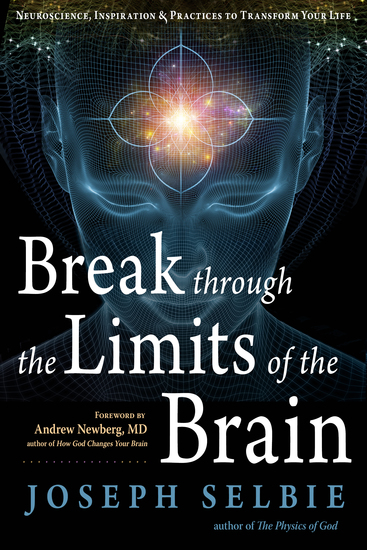
Break Through the Limits of the Brain - Experience Superconscious Awareness Intuition Vitality Creativity and Fulfilling Divine Joy - cover

Break Through the Limits of the Brain - Experience Superconscious Awareness Intuition Vitality Creativity and Fulfilling Divine Joy

Joseph Selbie

Publisher: New Page Books

  • 1
  • 1
  • 0

Summary

A life-changing guide to understanding your brain and how to change it—for good.Break Through the Limits of the Brain explores the neuroscience of sacred, superconscious experience. It offers proven ways to break through the brain’s limits into a life-changing, life-enhancing awareness that is beyond our everyday consciousness; an awareness that is intuitive, creative, energized, joyful, and spirit-filled. Selbie explains how and why the brain’s neural circuits reinforce thoughts, emotions, and behaviors that keep us immersed in limited conscious awareness—and how radical neuroplasticity enables our innate ability to rewire the brain to break through to unlimited superconscious awareness. The book offers many practices: the Hong Sau technique of meditation for deepening concentration, energization exercises for increasing life-force and vitality, methodical introspection techniques for identifying neurally reinforced negative patterns of thought, emotion, and behavior and affirmations for directly rewiring them. These practices will help you bring superconscious awareness into your life that enables, awakens, and supports success, vitality, creativity, health, peace of mind, and lasting, fulfilling happiness.Break Through the Limits of the Brain provides strong scientific support for superconscious awareness; scientific support provided by quantum physics and M-theory for the existence of a subtle, nonlocal reality; a reality in which we exist simultaneously with physical reality; a reality of which we can become aware by breaking through the limits of the brain. The book debunks scientific materialism’s brain-based explanation for consciousness and intelligence—the brain-as-supercomputer model—and explains the view of many prominent and open-minded scientists that an all-pervading intelligent consciousness is not only the source of our own consciousness but also the foundation of reality—an age-old sacred belief shared by saints, sages, mystics, and those who’ve had near-death experiences.Meditation is a central theme of the book—what it is; how to do it; why it works; its physical, mental, and emotional benefits as measured by neuroscientists; and how it rewires the brain for us to experience superconscious awareness and to achieve whatever we put our mind to.
Available since: 09/01/2022.
Print length: 256 pages.

Other books that might interest you

  • Benito Mussolini - Facist Terror - cover

    Benito Mussolini - Facist Terror

    Geoffrey Giuliano

    • 0
    • 0
    • 0
    “It’s better to live one day as a lion than 100 years as a sheep.” 
     
    "I am the most terrible animal that's ever existed." 
     
    "Democracy is beautiful in theory; in practice, it is a fallacy. You in America will see that someday." 
     
    "It's good to trust others but, not to do so is much better." 
     
    “I feel, when we have no friends upon whom to lean, or to look for moral guidance." (Mussolini) 
     
    Benito Amilcare Andrea Mussolini, born on July 29, 1883, who went by the nickname “Il Duce” (“the Leader”), was a deeply unbalanced tyrannical Italian dictator who created the dreaded Fascist Party in 1919. Eventually, he held all power in Italy as the country’s prime minister from 1922 to 1943. An ardent socialist as a youth, Mussolini followed in his father's political footsteps but was expelled by the party for his overt support of World War I. As an evil dictator during World War II (even murdering his own son by lethal injection) he greatly overextended his forces and was eventually killed by his own people in Mezzegra, Italy. Here, for the first time, are the words of the great dictator himself in his twisted manifesto on the political movement he started and is still so feared to this very day.
    Show book
  • Fight for Free Speech The: Rock Icon Dee Snider Addresses a 1985 US Senate Hearing On Music Content Labeling - cover

    Fight for Free Speech The: Rock...

    Dee Snider

    • 0
    • 0
    • 0
    On September 19, 1985, a US Senate hearing was instigated by the Parents Music Resource Center (PMRC)--founded by Tipper Gore, wife of Senator and later Vice President Al Gore; and Susan Baker, wife of Treasury Secretary James Baker--who wanted to introduce a parental warning system that would label all music albums containing alleged offensive material. The system was to include letters identifying the type of objectionable content to be found in each album (O for occult themes, S for sex, D for drugs, V for violence, etc.).


    Dee Snider, lead singer and primary songwriter for the rock band Twisted Sister, John Denver, and Frank Zappa all testified against censorship and the proposed warning system. Such a system was never implemented, but the result of the hearing brought about what was known as the "Parental Advisory: Explicit Content" label.
    Show book
  • Serving Up - Essays on food identity and culture - cover

    Serving Up - Essays on food...

    Zoe Adjonyoh

    • 0
    • 0
    • 0
    A groundbreaking collection of essays about food and its powerful link to identity, culture and community, from twenty exciting voices around the world.
    We hear about a family ritual of drying mango and pickling limes in India, and the search for a father's favourite hotdog in North Carolina. We investigate Latino food in cinema and vegetarianism in Buddhist diets, the cultural appropriation of Chinese food and the effect of gentrification on Black communities. And, we learn about the grassroots organisations fighting for change, for equality for farmers and for better mental health provisions in kitchens, where toxicity and microaggressions are rife.
    Edited by chef and activist Zoe Adjonyoh, and featuring a foreword by acclaimed author and broadcaster Yasmin Khan, Serving Up is an electric, urgent anthology campaigning for representation around our dinner tables, wherever that dinner table may be. 
    Includes essays from: Abigail Koffler, Apoorva Sripathi, Chris Nigro, Cynthia Greenlee, Duron Chavis, Fatima Tarkleman, Hassel Aviles, Izzie Ramirez, Lee Tran Lam, Lenore Adkins and others.
    Show book
  • The Shortest History of The Crown - cover

    The Shortest History of The Crown

    Stephen Bates

    • 0
    • 0
    • 0
    'There have been scores of books about the monarchy but few, if any, as fearless and perceptive as this is... Bates tells it like it is, covering every aspect with rare humour and intelligence. I couldn't recommend it more highly.' LITERARY REVIEW on ROYALTY INCAmidst the turbulence and invasions, upheaval and dissent that characterise British history, one thing has remained remarkably stable. Although there are other monarchies, Britain's Crown stands out due to the continuity of its traditions, and its ability to adapt.There's a reason why schoolchildren still learn about the Kings and Queens: it's their power struggles and subtle compromises that have shaped the nation we inhabit today. When members of the Royal family go on 'walkabouts', they do so because monarchs stretching back to King Alfred understood the need to be seen by their subjects, and the dire consequences of remaining aloof (or abroad). When they give interviews, or accept taxes, they do so as part of a long series of engagements with other, almost-equally powerful operators: Church, Parliament, the nobility.In this sprightly commentary on the Crown's 1,800-year-long story, Stephen Bates provides a dazzling insight into Royal custom and ritual, whilst depicting the individuals behind the myth with compassion and wit. And as our ageing Queen prepares to pass the baton, he asks us all to consider: could we ever do without the Crown?
    Show book
  • What I Wish I Said - Confessions of a Columnist - cover

    What I Wish I Said - Confessions...

    Jaime Watt

    • 0
    • 0
    • 0
    Just as they do on those television cooking contests when the bell rings and the contestants’ hands go up, at four o’clock on Friday afternoon, the column is filed—ready or not—to the columnist’s horror, discomfort, or self-satisfaction. Regardless, one exigent and unrelenting thought remains: what you wish you’d said.
    		 
    Such is the life of a weekly newspaper columnist.
    		 
    Unable to ignore the urge any longer, in What I Wish I Said: Confessions of a Columnist, author Jaime Watt has collected forty-eight of his most eye-opening, illuminating, and provocative Toronto Star columns and with humour, candour, and wit, he’s responded to each with what he wishes he’d said. The collection also features contributions from former senator and columnist André Pratte and from journalist and former editor-in-chief of the Toronto Star Michael Cooke.
    		 
    Widely regarded as Canada’s leading high-stakes communications strategist and the architect of groundbreaking campaigns that transformed politics with their boldness and creativity, Watt brings his insight to bear on some of the most vexing and consequential issues in Canadian life by reappraising his past work.
    		 
    Across six topical subject areas—civil liberties and human rights, portraits of leaders, the Liberal Party in power, the Conservative Party in opposition, the Donald Trump presidency, and the COVID-19 crisis—this subtle yet accessible collection offers a distinctive look at recent times. Whether he got it right or wrong, Watt pulls no punches when it comes to critiquing—and at times lambasting—his past columns.
    		 
    Revisiting his best and worst takes, Watt and his co-author Breen Wilkinson look at what might have been said in the columns he has been writing for more than seven years. And as he does, Watt challenges with new perspectives and ideas, inviting readers to consider what they wish they might have said, to consider how their points of views, and even their values, may have changed with time.
    Show book
  • Home Away Elsewhere - cover

    Home Away Elsewhere

    Vaughan Rapatahana

    • 0
    • 0
    • 0
    A poetry collection in three parts. Home is events, situations, descriptions, and attitudes about Hong Kong, which is now Vaughan's home. Away contains poems about events, situations, descriptions, and attitudes about Aotearoa (New Zealand), in particular from a Maori (marginalised) perspective and also about all the other places where Vaughan has lived – The Republic of Nauru, Brunei Darussalam, The People's Republic of China, Australia, The United Arab Emirates (UAE), The Philippines. Elsewhere is emotions (the entire gamut), relationships (marriages, family, friends), deaths (parents, children), reflections – some wry, etcetera – not specifically tied to physical locations. Vaughan does not write to any set forms/formats but attempts to utilise type-face/shape/what a poem looks like on a page to reflect what he attempts to say. He writes to stay sane. "These poems express what I am, and what I also think people I see are, within. They are not mere academic or literary exercises. They are lived experiences, I guess." 
     Poems with attitude. … passionate, uncompromising and sardonic. …there is darkness here … also wit in abundance and a playfulness in language and thought … at times laugh-out-loud funny…. a compelling voice and Vaughan uses it skillfully to tell us his stories, make his often pungent points, and take us places few of us have seen. — James Norcliffe, Robert Burns Fellow (2000), Aotearoa-New Zealand. 
     These poems are pieces of an intricately interlinked multi-cultural and multi-lingual world, in which the poet must learn to live. In fact the poet relishes this confusing richness. His verses celebrate the graphic possibility of words, their visual appearance and sounds. So one must come to them with big eyes, big ears and a limitless imagination. — Muhammad Haji Salleh, National Laureate, Malaysia.
    Show book