Begleiten Sie uns auf eine literarische Weltreise!
Buch zum Bücherregal hinzufügen
Grey
Einen neuen Kommentar schreiben Default profile 50px
Grey
Jetzt das ganze Buch im Abo oder die ersten Seiten gratis lesen!
All characters reduced
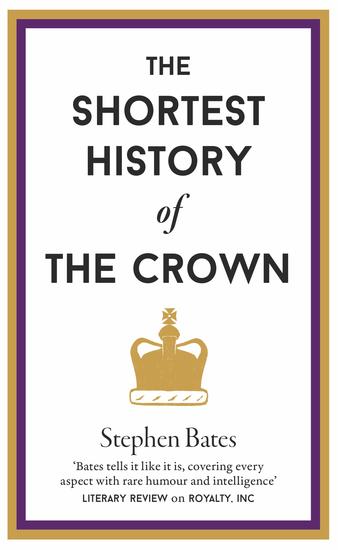
The Shortest History of The Crown - cover

The Shortest History of The Crown

Stephen Bates

Verlag: Old Street Publishing

  • 0
  • 0
  • 0

Beschreibung

'There have been scores of books about the monarchy but few, if any, as fearless and perceptive as this is... Bates tells it like it is, covering every aspect with rare humour and intelligence. I couldn't recommend it more highly.' LITERARY REVIEW on ROYALTY INCAmidst the turbulence and invasions, upheaval and dissent that characterise British history, one thing has remained remarkably stable. Although there are other monarchies, Britain's Crown stands out due to the continuity of its traditions, and its ability to adapt.There's a reason why schoolchildren still learn about the Kings and Queens: it's their power struggles and subtle compromises that have shaped the nation we inhabit today. When members of the Royal family go on 'walkabouts', they do so because monarchs stretching back to King Alfred understood the need to be seen by their subjects, and the dire consequences of remaining aloof (or abroad). When they give interviews, or accept taxes, they do so as part of a long series of engagements with other, almost-equally powerful operators: Church, Parliament, the nobility.In this sprightly commentary on the Crown's 1,800-year-long story, Stephen Bates provides a dazzling insight into Royal custom and ritual, whilst depicting the individuals behind the myth with compassion and wit. And as our ageing Queen prepares to pass the baton, he asks us all to consider: could we ever do without the Crown?
Verfügbar seit: 04.10.2022.
Drucklänge: 288 Seiten.

Weitere Bücher, die Sie mögen werden

  • Dreyfus Affair and the Leo Frank Trial The: The History of the Most Notorious Antisemitic Cases in France and America - cover

    Dreyfus Affair and the Leo Frank...

    Editors Charles River

    • 0
    • 0
    • 0
    In September 1890, among a pile of torn-up documents delivered by Mme. Bastian was found a note handwritten in French which, when pieced together, proved to be a list of French military secrets handed over to the Germans by an unknown French officer of the General Staff. This discovery, which proved the existence of a traitor in the department, triggered a ferment in the corridors of the Conseil Supérieur de la Guerre, and the hunt was on for the culprit. By a process of elimination, officers of the military intelligence were able to narrow down a list of probable traitors, among whom was a young Jewish staff officer, Captain Alfred Dreyfus, who was immediately earmarked as the chief suspect.  
    	These are the essential facts of the “Dreyfus Affair,” as it came to be known, an episode that in many respects defined French anti-Semitism in the late 19th century. A case was built with the central objective of protecting the integrity of French military establishment, and in the process, the relatively muted anti-Semitism in France (at least compared to other European nations) was transformed into an era of virulent and violent Jew-hatred that characterized and sullied the final decade of the 19th century in France. Even today, as many of the affair’s nuances and facets have faded from memory, its political importance and anti-Semitic elements continue to be well-known and quite relevant today.  
    In 1913, Mary Phagan, a young Georgia factory girl and the daughter of tenant farmers, was raped and killed, and suspicion fell upon Leo Frank, the Jewish-American factory manager, who was subsequently arrested, tried, and convicted of her murder based on the thinnest of circumstantial evidence. The entire case against Frank rested on the testimony of the factory janitor, Jim Conley, despite the fact Conley had been arrested almost immediately after Frank when he was spotted washing what appeared to be blood off his clothes. 
    Zum Buch
  • Quantum Shift The: How to Upgrade Your Mind Like a Supercomputer - Unlocking Your Brain’s True Potential with Science and Strategy - cover

    Quantum Shift The: How to...

    JOSEPH ALLEN

    • 0
    • 0
    • 0
    Do you ever feel like your mind is stuck in an outdated operating system? What if you could upgrade it? 
    The Quantum Shift is your guide to reprogramming your brain, unlocking peak performance, and achieving breakthrough thinking. Through neuroscience, cognitive psychology, and cutting-edge strategies, this book will teach you how to:*Rewire your brain for success using neuroplasticity.Master the art of focus and deep work.Enhance memory and learning with proven techniques.Develop unshakable mental resilience and emotional intelligence.Tap into your superconscious mind for creative problem-solving.Upgrade your mind. Upgrade your life. The shift starts now.
    Zum Buch
  • Tamed by the Prison Gang (Gay Puppy Play Erotica) - cover

    Tamed by the Prison Gang (Gay...

    Archer Vale

    • 0
    • 0
    • 0
    The “Collaring Ceremony” is the most infamous prison ritual. 
    I wanted to join the prison gang, but these dangerous inmates had different plans for me. I hope my girlfriend never finds out about this… 
    They got me on my knees, wrapped a leather collar around my neck, and made me swear an oath of absolute loyalty. I’m their property now. 
    I serve. I worship. I obey. 
    Within this cold, testosterone-fueled universe, I’m passed around from one aggressive alpha male to the next. 
    I’ve become the prison boytoy. 
    --- 
    CONTAINS EXPLICIT GAY SEXUAL CONTENT. 
    For exclusive stories, visit www.ArcherVale.com.
    Zum Buch
  • Fridays of Rage - Al Jazeera the Arab Spring and Political Islam - cover

    Fridays of Rage - Al Jazeera the...

    Sam Cherribi

    • 0
    • 0
    • 0
    Fridays of Rage provides a glimpse into how Al Jazeera strategically cast its journalists as martyrs in the struggle for Arab freedom while promoting itself as the mouthpiece and advocate of the Arab public. 


    In addition to heralding a new era of Arab democracy, Al Jazeera has become a major influence over Arab perceptions of American involvement in the Arab World, the Arab-Israeli conflict, the rise of global Islamic fundamentalism, and the expansion of the political far right. Al Jazeera's blueprint for "Muslim-democracy" was part of a vision announced by the network during its earliest broadcasts. The network embarked upon a mission to reconstruct the Arab mindset and psyche. Al Jazeera introduced exiled Islamist leaders to the larger Arab public while also providing Muslim feminists a platform. 


    The inclusion and consideration of Westerners, Israelis, Hamas, secularists, and others earned the network a reputation for pluralism and inclusiveness. Al Jazeera presented a mirror to an Arab world afraid to examine itself and its democratic deficiencies. But rather than assuming that Al Jazeera is a monolithic force for positive transformation in Arab society, Fridays of Rage examines the potentially dark implications of Al Jazeera's radical re-conceptualization of media as a strategic tool or weapon.
    Zum Buch
  • Japanese Mythology - Kami Demons Spirits and Myths of Japan - cover

    Japanese Mythology - Kami Demons...

    Matthew Fillard

    • 0
    • 0
    • 0
    Japanese mythology is a rich tapestry woven from the threads of ancient stories, religious beliefs, and cultural practices that have evolved over centuries. At its core, this mythology provides a window into the Japanese worldview, where nature, spirituality, and humanity are deeply interconnected. It reveals how the Japanese people have understood their place in the universe, the origins of their land, and the divine forces that shape their existence. 
    Central to Japanese mythology is the concept of kami, which are spirits or deities that embody natural elements, ancestral spirits, and forces of nature. Unlike many Western interpretations of divinity, kami are not omnipotent or detached from the world; they exist alongside humanity, influencing daily life and requiring respect through rituals and offerings. This spiritual symbiosis between humans and kami has profoundly shaped Japanese cultural identity and continues to manifest in traditional practices and beliefs. 
    The two primary sources of Japanese mythology, the Kojiki (Records of Ancient Matters) and the Nihon Shoki (Chronicles of Japan), are texts that blend myth, history, and legend. Compiled in the 8th century, these works serve as foundational narratives for understanding the creation of Japan, the lineage of its emperors, and the values upheld by society. From the celestial plains of Takamagahara to the mysterious underworld of Yomi, these texts introduce readers to a vivid cosmology populated by gods, demons, and legendary heroes.
    Zum Buch
  • The Arts in Jewish Culture - Music Literature and Visual Arts Contributions - cover

    The Arts in Jewish Culture -...

    Joseph Arston

    • 0
    • 0
    • 0
    Jewish artistic expression has evolved over centuries, shaped by religious traditions, historical experiences, and cultural exchanges. From ancient biblical times to the modern era, Jewish creativity has flourished in music, literature, and visual arts, reflecting both continuity and adaptation. Despite periods of persecution and displacement, Jewish artists have found ways to preserve and redefine their cultural identity, using art as a means of storytelling, worship, and resistance. 
    Religious tradition has played a central role in shaping Jewish artistic expression. In early Jewish history, art was often intertwined with religious observance, as seen in the intricate designs of synagogues, illuminated manuscripts, and Torah decorations. The prohibition against graven images, derived from the Second Commandment, led to a focus on symbolic and abstract representation rather than figurative depictions. This influenced the development of decorative arts, such as calligraphy, textiles, and ritual objects, which incorporated elaborate geometric patterns and Hebrew inscriptions. Music also became an integral part of worship, with ancient melodies passed down through generations in synagogue chanting and liturgical songs. 
    The Jewish diaspora further enriched artistic traditions by exposing Jewish communities to diverse cultural influences. As Jews migrated across different regions, they absorbed elements from the surrounding societies while maintaining distinct artistic styles. In medieval Europe, Jewish scholars and poets contributed to the Golden Age of Hebrew literature, particularly in Spain, where they engaged with Islamic and Christian intellectual traditions. In Eastern Europe, Yiddish theater and folk music flourished, blending local influences with Jewish themes. Meanwhile, in the Middle East and North Africa, Jewish artisans adapted their crafts to fit regional aesthetics while preserving religious symbolism.
    Zum Buch