Join us on a literary world trip!
Add this book to bookshelf
Grey
Write a new comment Default profile 50px
Grey
Subscribe to read the full book or read the first pages for free!
All characters reduced
Paradise Lost - cover

Paradise Lost

John Milton

Publisher: The Ebook Emporium

  • 0
  • 0
  • 0

Summary

"Better to reign in Hell, than serve in Heaven."

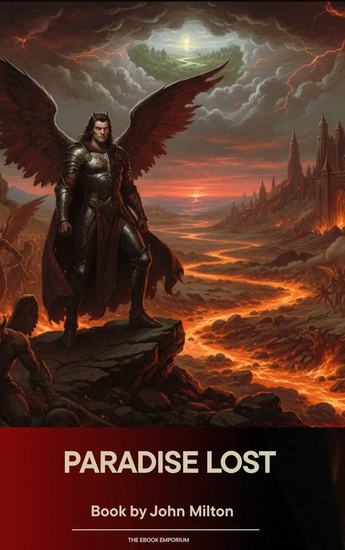
In the wake of a failed cosmic rebellion, the fallen archangel Satan awakens on a burning lake of fire. Undefeated in spirit, he rallies his legions of demons to build the palace of Pandemonium and plots a subtle revenge against the Almighty. His target? God's newest and most beloved creation: Humanity. Milton's masterpiece takes us from the depths of Tartarus to the heights of the Empyrean, and finally to the lush, innocent borders of the Garden of Eden. Here, we witness the tragic temptation of Adam and Eve, a choice that changes the course of human history forever.

The Greatest Antagonist in Literature: Milton's Satan is a character of terrifying complexity. He is a charismatic leader, a tormented intellectual, and a "tragic hero" whose pride leads to his inevitable ruin. His journey from a shining angel to a crawling serpent is one of the most powerful character arcs ever written, influencing centuries of "Byronic heroes" and anti-heroes.

The Beauty of the Fall: While Satan's rebellion provides the spectacle, the emotional heart of the poem lies in Book IX, where Adam and Eve face the serpent. Milton portrays their relationship with profound psychological depth, exploring themes of free will, reason, and the heavy burden of knowledge. The final lines of the poem, as the pair walks hand-in-hand out of Eden into a "subject world," are among the most moving in all of literature.

The Power of Blank Verse: Discarding the "bondage of rhyming," Milton used unrhymed iambic pentameter (blank verse) to create a sense of vast, architectural scale. The language is dense, musical, and filled with classical allusions, creating a reading experience that feels truly "epic."

Step into the cosmic theater. Purchase "Paradise Lost" today and witness the struggle for the soul of the world.
Available since: 01/12/2026.
Print length: 402 pages.

Other books that might interest you

  • Greekling - cover

    Greekling

    Kostya Tsolakis

    • 0
    • 0
    • 0
    Greekling,the much-anticipated debut poetry collection by Kostya Tsolakis, celebrates and commemorates damaged and rejected Greek bodies, be they of flesh and blood, made of marble, or natural bodies. In intertwining Greek culture, history and poetic influences with the contemporary queer experience, this collection is perceptive, lyrical, and deeply evocative of time and place. From an Athenian childhood to a closeted adolescence in the shadow of the AIDS epidemic, towards sexual self-discovery, maturity and freedom – Tsolakis charts the pursuit of unconditional happiness.
    These poems explore queer joy on dance floors, darkrooms and bedsits, but also the risks of crossing strangers' thresholds or in encountering the violent machismo and hypermasculine expectations of the society you grow up in. And ever-present through the collection is Athens – the city the poet once turned his back on at eighteen but has come to love again. Moving between lament and celebration, Greekling reflects on a changing and often misrepresented country, the nature of motherlands and mother tongues; it is a voyage out – and a return.
    Show book
  • Man and Superman - cover

    Man and Superman

    George Bernard Shaw

    • 0
    • 0
    • 0
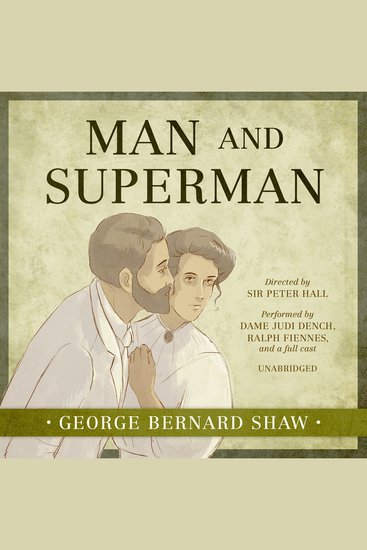
    Man and Superman was the first drama to be broadcast on the BBC’s Third Program on October 1, 1946. To celebrate Radio 3’s fiftieth anniversary, the play was directed by Sir Peter Hall, and preserved for all time in this lush audio dramatization. 
    “A comedy and a philosophy,” Man and Superman is based on the Don Juan theme, and using all the elements from Mozart’s Don Giovanni, Shaw reordered them so that Don Juan becomes the quarry instead of the huntsman. 
    Boasting an outstanding cast including Ralph Fiennes, Juliet Stevenson, Dame Judi Dench, John Wood, Nicholas Le Prevost, and Paul Merton, this release includes an exclusive interview with director Sir Peter Hall.
    Show book
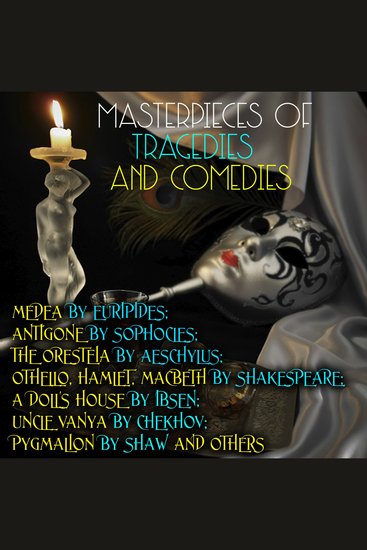
  • Masterpieces of Tragedies and Comedies - Medea by Euripides; Antigone by Sophocles; The Oresteia by Aeschylus; Othello Hamlet Macbeth by Shakespeare; A Doll's House by Ibsen; Uncle Vanya by Chekhov; Pygmalion by Shaw and others - cover

    Masterpieces of Tragedies and...

    Euripides, Sophocles, ...

    • 0
    • 0
    • 0
    This collection contains the following works:
    Euripides: Medea
    Sophocles: Antigone
    Aeschylus: Agamemnon
    Aeschylus: Eumenides
    Aeschylus: The Choephori
    William Shakespeare: The Tragedy of Othello, the Moor of Venice
    William Shakespeare: The Tragedy of Romeo And Juliet
    William Shakespeare: The Tragedy of Hamlet, Prince of Denmark
    William Shakespeare: The Tragedy of Macbeth
    William Shakespeare: A Midsummer Night's Dream
    William Shakespeare: The Tragedy of King Lear
    William Shakespeare: Antony and Cleopatra
    William Shakespeare: The Tragedy of Coriolanus
    William Shakespeare: The Tragedie of Julius Caesar
    William Shakespeare: Cymbeline, King of Britain
    William Shakespeare.: The Life of Tymon of Athens
    William Shakespeare: Titus Andronicus
    William Shakespeare: Troilus and Cressida
    Henrik Ibsen: A Doll's House
    Anton Chekhov: Uncle Vanya
    Bernard Shaw: Pygmalion
    Show book
  • Jerusalem - cover

    Jerusalem

    William Blake

    • 0
    • 0
    • 0
    LibriVox volunteers bring you 9 recordings of Jerusalem by William Blake. This was the fortnightly poetry project for November 30th, 2008.
    Show book
  • Impure thoughts - cover

    Impure thoughts

    Golnoosh Nour

    • 0
    • 0
    • 0
    Riotous and fizzing with language, the poetry of Golnoosh Nour boldly explores what it is to be utterly alive and ecstatically, yet complicatedly, in desire. –Richard Scott
    Impure Thoughts is a dizzying dance through impurity's several selves. Half bal masqué, half Grand Guignol, Nour confronts the limits of desire with an almost uncanny intensity of focus. Even at their most tender and elegiac these poems tremble with the white-hot heat of libidinal energy and gleam with oracular fury. –Fran Lock
    Show book
  • Duino Elegies - cover

    Duino Elegies

    Rainer Maria Rilke

    • 0
    • 0
    • 0
    We have a marvelous, almost legendary image of the circumstances in which the composition of this great poem began. Rainer Maria Rilke was staying at Duino Castle, on a rocky headland of the Adriatic Sea near Trieste. 
    One morning, he walked out onto the battlements and climbed down to where the cliffs dropped sharply to the sea. From out of the fierce wind, Rilke seemed to hear a voice: Wer, wenn ich schriee, horte mich denn aus der Engel Ordnungen? (If I cried out, who would hear me up there, among the angelic orders?). 
    He wrote these words, the opening of the first Duino Elegy, in his notebook, then went inside to continue what was to be his major opus—completely only after another ten, tormented years of effort—and one of the literary masterpieces of the century.  
    Duino Elegies speaks in a voice that is both intimate and majestic on the mysteries of human life and our attempt, in the words of the translator David Young, “to use our self-consciousness to some advantage: to transcend, through art and the imagination, our self-deception and our fear.”
    Show book