Join us on a literary world trip!
Add this book to bookshelf
Grey
Write a new comment Default profile 50px
Grey
Subscribe to read the full book or read the first pages for free!
All characters reduced
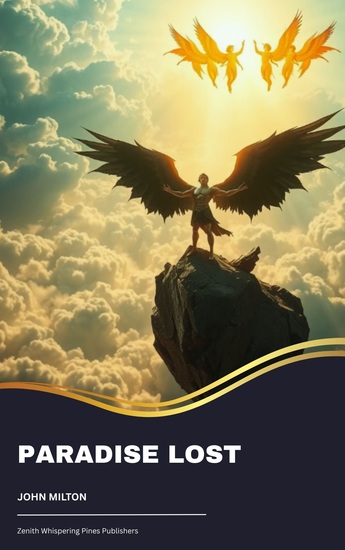
Paradise Lost - cover

Paradise Lost

John Milton

Publisher: Zenith Whispering Pines Publishers

  • 0
  • 0
  • 0

Summary

An angel's rebellion. A world newly created. A choice that changes everything.
In this towering epic, Milton brings to life the cosmic struggle between Heaven and Hell, led by the proud and compelling figure of Satan. Through breathtaking verse, we witness the creation of Earth, the innocence of Adam and Eve, and the tragic temptation that reshapes human destiny forever. The poem's grandeur, emotion, and moral complexity have made it a cornerstone of world literature.

Celebrated as "the greatest English poem ever written," Paradise Lost combines drama, theology, mythology, and unforgettable imagery into a work that continues to inspire awe centuries later.

If you love epic storytelling, powerful language, and timeless battles between freedom, obedience, pride, and love, this masterpiece is essential reading.

Open the book—and enter the epic realm where Heaven trembles and humanity begins.
Available since: 12/11/2025.
Print length: 402 pages.
Other books that might interest you

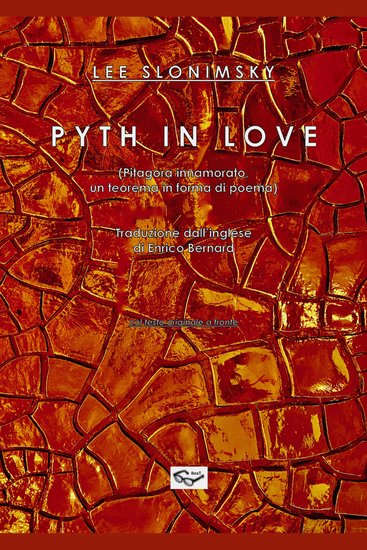
  • Pyth in love - A poem in form of a theorem - cover

    Pyth in love - A poem in form of...

    Lee Slonimsky

    • 0
    • 0
    • 0
    In the poems, Pythagoras is always searching for meaning in patterns—in the caws of crows, the flight of geese—but he is also visited by the random.  “But then, without a sign, the crow departs; this randomness of fate gives him a chill./He sees the beauty of wings merged with night …”  Was it a random coincidence that I was at the same time writing a book set on an estate with Italianate gardens?  Inspired by Lee, I created a poet named Zalman Bronsky who wandered through the Italian gardens composing sonnets, which Lee graciously agreed to write.  Immersed in researching the Italian gardens, we traveled to Rome and Sorrento in the summer of 2004.  While walking in the Roman Forum Lee discovered a bust of Pythagoras and was inspired to write “Counting Toward the End,” in which “Pythagoras divides the summer dawn/into the cosmos, multiplies by breeze/and quality of drifting yellow light/to calculate how many roses  thrive/within the boundary of circling sight.”  His calculation conflicts with what he sees and yet his “faith in truth of math endures despite/this failure.”
    Show book
  • Rhyme A Dozen A - Paintings - 12 Poets 12 Poems 1 Topic - cover

    Rhyme A Dozen A - Paintings - 12...

    Edith Wharton, Madox Ford, Anne...

    • 0
    • 0
    • 0
    ‘A dime a dozen’ as known in America, is perhaps equal to the English ‘cheap as chips’ but whatever the lingua franca of your choice in this series we hereby submit ‘A Rhyme a Dozen’ as 12 poems on many given subjects that are a well-rounded gathering, maybe even an essential guide, from the knowing pens of classic poets and their beautifully spoken verse to the comfort of your ears. 
     
    01 - A Rhyme A Dozen - 12 Poems, 12 Poets, 1 Topic - Paintings - An Introduction 
    02 - Portrait d'une Femme by Ezra Pound 
    03 - Botticlelli’s Madonna in the Louvre by Edith Wharton 
    04 - To a Beautiful Female Portrait by Henry Alford 
    05 - Before a Painting by James Weldon Johnson 
    06 - The Portrait by Ford Madox Ford 
    07 - Her Portrait Immortal by Richard Le Gallienne 
    08 - On a Portrait of Dante by Giotto by James Russell Lowell 
    09 - Sonnet 83 - I Never Saw That You Did Painting Need by William Shakespeare 
    10 - An Inscription for Zheng Shujin's Painting by Qiu Jin 
    11 - I Would Not Paint a Picture by Emily Dickinson 
    12 - To the Painter, To Draw Him a Picture by Robert Herrick 
    13 - To the Painter of an Ill Drawn Picture of Cleone by Anne Kingsmill-Finch
    Show book
  • Accessioning - cover

    Accessioning

    Charlotte Wetton

    • 0
    • 0
    • 0
    Through poems about fossilised fruit seeds and the sofa where Emily Brontë died, Wetton questions how we curate the lives of those living and dead in a pamphlet about looking, processing, and memorialising. Whether considering preserved wedding-cakes, a non-existent art exhibition or a human scream, these poems speak to the impossibility of containment and question our ability to map and categorise.
    This is a pamphlet of poems about the stories that we tell ourselves, the memories that we construct, and the ways that we value and devalue people, animals and objects alike.
    Show book
  • Song of the Shingle-Splitters - cover

    Song of the Shingle-Splitters

    Henry C. Kendall

    • 0
    • 0
    • 0
    LibriVox volunteers bring you 7 recordings of Song of the Shingle-Splitters by Henry C. Kendall. This was the weekly poetry project for June 7th, 2009.
    Show book
  • In Memoriam - cover

    In Memoriam

    Ewart Alan Mackintosh

    • 0
    • 0
    • 0
    LibriVox volunteers bring you 18 recordings of In Memoriam by Ewart Alan Mackintosh. This was the Weekly Poetry project for November 7th, 2010.This week's poem has been chosen for this time of remembrance. Lieutenant Ewart Alan Mackintosh M.C. was a war poet and an officer in the Seaforth Highlanders. His best poetry has been said to be comparable in quality to that of Rupert Brooke. In 1916 he led a raid in which several of his men were killed, one of whom inspired this poem. Mackintosh was himself killed on 21 November 1917. (Summary by Ruth Golding)
    Show book
  • Tithonus - cover

    Tithonus

    Alfred Lord Tennyson

    • 0
    • 0
    • 0
    Alfred Tennyson, 1st Baron Tennyson, FRS was Poet Laureate of Great Britain and Ireland during much of Queen Victoria's reign and remains one of the most popular British poets."Tithonus" doesn't mean a whole lot without the knowledge that the speaker is a mythological character who was loved by a goddess and was granted immortality, but not immortal youth. Since the gods could not take back their gifts, he was doomed to slowly suffer the extremes of decay as he grew ever older and older. (Summary by Leonard Wilson)
    Show book