Join us on a literary world trip!
Add this book to bookshelf
Grey
Write a new comment Default profile 50px
Grey
Subscribe to read the full book or read the first pages for free!
All characters reduced
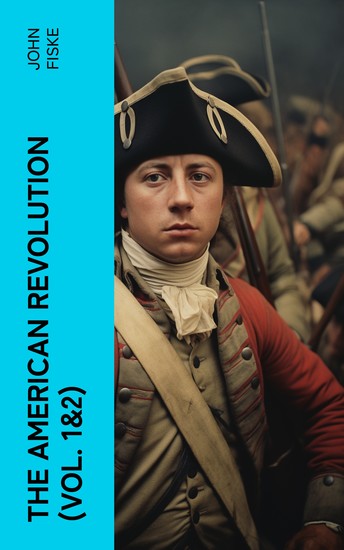
The American Revolution (Vol 1&2) - Battle for American Independence: From the Rejection of the Stamp Act Until the Final Victory - cover

The American Revolution (Vol 1&2) - Battle for American Independence: From the Rejection of the Stamp Act Until the Final Victory

John Fiske

Publisher: e-artnow

  • 0
  • 0
  • 0

Summary

This book is a thorough history of the American Revolution from the beginning of the crisis between American colonies and the British government until the final victories in the War which brought independence to America.  Contents: The Beginnings The Crisis The Continental Congress Independence First Blow at the Centre Second Blow at the Centre Saratoga The French Alliance Valley Forge Monmouth and Newport War on the Frontier War on the Ocean A Year of Disasters Benedict Arnold Yorktown
Available since: 12/15/2023.
Print length: 441 pages.
Other books that might interest you

  • Biggest Tank Battles of the World Wars The: Tank Warfare in History’s Deadliest Conflicts - cover

    Biggest Tank Battles of the...

    Charles River Editors

    • 0
    • 0
    • 0
    World War I was the first truly industrial war, and it created a paradigm which reached its zenith with World War II and towards which virtually all equipment, innovation and training were dedicated throughout the Cold War and the remainder of the 20th century. To this day, modern warfare remains synonymous with tanks and mass infantry battles, although a confrontation of this nature has not occurred (except briefly during Operation Desert Storm) since World War II.  
    	One of the most important breakthroughs in military technology associated with World War I, and certainly the one that continues to capture the public imagination, was the introduction of a war machine that came to dominate the face of land battles throughout most of the 20th century: the tank. As a concept, it was not revolutionary; in fact, it harkened back to classical antiquity and to the Middle Ages, such as the covered battering rams and testudos which had made frequent appearances on ancient battlefields. In essence, it was designed to solve the age-old problem of protecting infantry from enemy projectiles while remaining mobile.  
    	The development of both modern artillery and machine guns, as well as the stalemate engendered by heavy fortifications and entrenchments, had hamstrung the mobility of infantry and cavalry and also left them both utterly vulnerable to defensive firepower. Since they were incapable of replying in kind, the tank was designed to bridge that gap. The tank’s armor, thick enough to withstand lateral fragmentation from exploding shells (although not direct hits) also made it virtually invulnerable to enemy rifle and machine gun fire, and its large tread meant that it could bridge trenches which would, at the very least, have delayed infantry substantially. As for the barbed wire entanglements and obstacles that severely delayed infantry and exposed them to enemy fire, tanks could simply drive right through it. 
    Show book
  • 1000 Motivational Statements - Learn Portuguese While Transforming Your Life - cover

    1000 Motivational Statements -...

    Science-Based Language Learning Lab

    • 0
    • 0
    • 0
    Unlock the power of dual-language learning with "1000 Motivational Statements: Learn Portuguese While Transforming Your Life." This innovative book offers a seamless way to master Portuguese while fueling your journey of self-improvement. 
     
    Inside, you'll discover 1000 motivational statements presented in Portuguese, followed by English translations. By reading and repeating these statements, you can integrate language learning into your daily routine, making the process both enjoyable and inspiring. 
     
    Why This Book? 
     
    - Dual Benefit: Enhance your language skills while boosting your motivation. 
     
    - Comprehensive Self-Improvement: These statements offer more than platitudes—they provide advice on communication, relationships, fitness, and more. 
     
    - Easy to Follow: Side-by-side translations help you grasp meaning and pronunciation effortlessly. 
     
    - Cultural Insight: Gain a deeper understanding of Portuguese language and culture through meaningful expressions. 
     
    Whether you're a beginner or looking to reinforce your skills, this book provides a refreshing way to stay motivated while achieving your language goals. Transform your life and expand your horizons with every page. Start your bilingual journey today and discover how empowering it can be to learn Portuguese while enhancing your life.
    Show book
  • Stolen Smuggled Sold - On the Hunt for Cultural Treasures - cover

    Stolen Smuggled Sold - On the...

    Nancy Moses

    • 0
    • 0
    • 0
     “A riveting look at the backstory of what’s in the display cases at your local museum. The author profiles seven historic objects with checkered pasts.” —Library Journal   There are many books about museum heists, Holocaust artwork, insider theft, trafficking in antiquities, and stolen Native American objects. Now, there’s finally a book for the general public that covers the entire terrain.   Stolen, Smuggled, Sold features seven vivid and true stories in which the reader joins the author as she uncovers a cultural treasure and follows its often-convoluted trail. Along the way author and reader encounter a cast of fascinating characters from the underbelly of the cultural world: unscrupulous grave robbers, sinister middlemen, ruthless art dealers, venal Nazis, canny lawyers, valiant academics, unstoppable investigative reporters, unwitting curators, and dedicated government officials. Stories include Gustav Klimt’s Portrait of Adele Bloch Bauer 1, the typset manuscript for Pearl Buck’s The Good Earth, a ceremonial Ghost Dance shirt from the massacre at Wounded Knee, the theft of 4,800 historical audio discs by a top official at the National Archives, a missing original copy of The Bill of Rights, the mummy of Ramses I, and an ancient treasure from Iraq.   While each story is fascinating in and of itself, together they address one of the hottest issues in the museum world: how to deal with the millions of items that have breaks in the chain of ownership, suspicious ownership records, or no provenance at all. The issue of ownership touches on professional practices, international protocols, and national laws. It’s a financial issue since the illicit trade in antiquities and cultural items generates as much as $4 billion to $8 billion a year.  
    Show book
  • Authors of the Impossible - The Paranormal and the Sacred - cover

    Authors of the Impossible - The...

    Jeffrey J. Kripal

    • 0
    • 0
    • 0
    “Outstanding and almost certainly controversial. . . . [Kripal] has promise to revitalize and extend the reach of religious studies.”  —Choice Most scholars dismiss research into the paranormal as pseudoscience, a frivolous pursuit for the paranoid or gullible. Even historians of religion, whose work naturally attends to events beyond the realm of empirical science, have shown scant interest in the subject. But the history of psychical phenomena, Jeffrey J. Kripal contends, is an untapped source of insight into the sacred and by tracing that history through the last two centuries of Western thought we can see its potential centrality to the critical study of religion. Kripal grounds his study in the work of four major figures in the history of paranormal research: psychical researcher Frederic Myers; writer and humorist Charles Fort; astronomer, computer scientist, and ufologist Jacques Vallee; and philosopher and sociologist Bertrand Méheust. Through incisive analyses of these thinkers, Kripal ushers the reader into a beguiling world somewhere between fact, fiction, and fraud. The cultural history of telepathy, teleportation, and UFOs; a ghostly love story; the occult dimensions of science fiction; cold war psychic espionage; galactic colonialism; and the intimate relationship between consciousness and culture all come together in Authors of the Impossible, a dazzling and profound look at how the paranormal bridges the sacred and the scientific.   “An excellent book. . . . engaging, witty, and thoughtful.” -- Christopher Partridge, Lancaster University “[Kripal] demands nothing short of a paradigm shift in order to make sense of the odd, the anomalous, and the inexplicable.” —Catherine L. Albanese, University of California, Santa Barbara “Quietly earth-shattering.” — Victoria Nelson, author of The Secret Life of Puppets
    Show book
  • How to Write Fast Under Pressure - cover

    How to Write Fast Under Pressure

    Philip Vassallo

    • 0
    • 0
    • 0
    Anyone who regularly deals with work-related writing deadlines knows the kind of paralysis that can take over when there's too much to accomplish and not enough time to compose a clear sentence. This indispensable guide reveals the easy, efficient, and confidence-building four-part process for keeping up and being productive--even under tight time constraints and concentration-sapping obstacles. 
    The key lies in the mnemonic DASH: Direction--hitting the ground running with a sense of urgencyAcceleration--writing on the fly with a “beat-the-clock” mindset and an attitude that prizes volume over perfectionStrength--holding fast in the midst of chaos by employing a sensible quality control system and creating an environment conducive to writingHealth--assuming a proactive stance by prioritizing work and preventing emergencies to minimize future pressures 
      
    Filled with helpful tools and time-saving techniques, How to Write Fast Under Pressure reveals how this immediately usable approach can help anyone can break through writer's block and write faster and better to meet any deadline. 
    Accompanying figures are included in the audiobook companion PDF download.
    Show book
  • William Wallace - cover

    William Wallace

    Andrew Fisher

    • 0
    • 0
    • 0
    By no means prepared by birth, education, or training for leadership, Wallace nevertheless rose to prominence during the Wars of Independence, leading forces which broke the sequence of English victories and re-energizing and inspiring his countrymen in the process. While others, ostensibly his betters, yielded and collaborated, Wallace set an example of constancy and perseverance and became the Guardian of Scotland. Even his terrible death in London in 1305 can be seen as a victory as it provided inspiration for the continuance of the struggle against English domination. 


    Despite Wallace's almost mythical status—boosted in no small part by the film Braveheart—present-day perceptions of him are not always based on the objective analysis of the historical facts. In this revised and expanded biography, Andrew Fisher investigates all the aspects of Wallace's life and character, treating him as a man of his time. The result is a more authentic picture of the greatest of Scotland's heroes than has been previously available.
    Show book