Join us on a literary world trip!
Add this book to bookshelf
Grey
Write a new comment Default profile 50px
Grey
Subscribe to read the full book or read the first pages for free!
All characters reduced
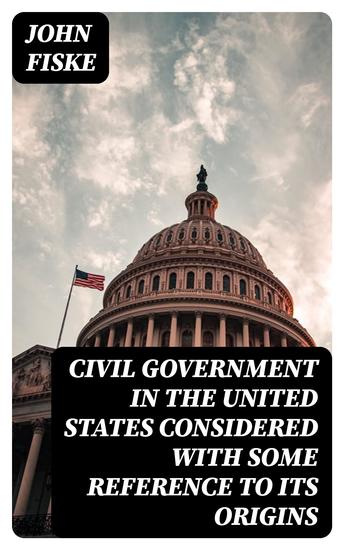
Civil Government in the United States Considered with Some Reference to Its Origins - cover

Civil Government in the United States Considered with Some Reference to Its Origins

John Fiske

Publisher: DigiCat

  • 0
  • 0
  • 0

Summary

In "Civil Government in the United States Considered with Some Reference to Its Origins," John Fiske meticulously analyzes the foundations and evolution of American governance. Employing a clear and didactic literary style, Fiske situates his work within the broader context of political philosophy and historical development, examining the principles of democracy, federalism, and individual rights. His rigorous exploration of constitutional history is woven together with reflections on the social contract theory, illuminating the ideological motivations that shaped the formation of the U.S. government. John Fiske (1842-1901), a prominent American philosopher and historian, was deeply influenced by the turbulent political landscape of his time, as well as by the transcendentalist movement. His background in both theology and history, coupled with a profound interest in social progress, informed his analysis of the American political system. Fiske's works often reveal a commitment to enlightenment principles and a belief in the inevitable progress of humanity, making his insights particularly resonant in a period marked by rapid change. This book is an essential read for anyone interested in American history, political science, or the development of democratic institutions. Fiske's lucid prose and incisive arguments invite readers to reflect on the foundational concepts that continue to shape the U.S. government today, making it not only scholarly intriguing but also relevant to contemporary discussions of governance and citizenship.
Available since: 09/16/2022.
Print length: 303 pages.

Other books that might interest you

  • Drones - What Everyone Needs to Know(r) - cover

    Drones - What Everyone Needs to...

    Sarah E. Kreps, James Patton Rogers

    • 0
    • 0
    • 0
    The second edition of Drones: What Everyone Needs to Know® provides a comprehensive and updated look at the rapidly evolving world of drones, otherwise known as unmanned or uncrewed aerial vehicles (UAVs). Covering the past, present, and future of military and civilian applications, this book explores how drones have transformed—and are transforming—industries and warfare. It delves into the ethical, legal, and safety concerns raised by their widespread use, examining issues from privacy violations to international security.While the US has historically been a dominant force in drone development, this fully updated volume addresses the global proliferation of drones. They quickly became one of the most effective weapons in the Russia-Ukraine War, and states like China, Iran, and Turkey are now supplying drones to states and violent non-state actors around the world. Drones also expands beyond the air to cover ground and maritime drones, and projects the future of drone technology across multiple domains with a focus on autonomous vehicles and lethal autonomous weapons. A must-listen for anyone seeking a well-rounded understanding of this pivotal technology, Drones: What Everyone Needs to Know® provides crucial insights into how UAVs are reshaping modern warfare, domestic security, and civilian life.
    Show book
  • No Democracy Lasts Forever - How the Constitution Threatens the United States - cover

    No Democracy Lasts Forever - How...

    Erwin Chemerinsky

    • 0
    • 0
    • 0
    No Democracy Lasts Forever argues that the Constitution has become a threat to American democracy and must be dramatically changed or replaced if secession is to be avoided. 


    Deeply troubled by the Constitution's inherent flaws, Erwin Chemerinsky, the renowned dean of Berkeley law school, came to the sobering conclusion that our nearly 250-year-old founding document is responsible for the crisis now facing American democracy. Pointing out that just fifteen of the 11,848 amendments proposed since 1789 have passed, Chemerinsky contends that the very nature of our polarization results from the Constitution's "bad bones," which have created a government that no longer works or has the confidence of the public. Yet political armageddon can still be avoided, Chemerinsky writes, if a new constitutional convention is empowered to replace the Constitution of 1787, much as the Founding Fathers replaced the outdated Articles of Confederation. If this isn't possible, Americans must give serious thought to forms of secession—including a United States structured like the European Union—based on a recognition that what divides us as a country is, in fact, greater than what unites us.
    Show book
  • Are We Free Yet? - The Black Queer Guide to Divorcing America - cover

    Are We Free Yet? - The Black...

    Tina Strawn

    • 0
    • 0
    • 0
    "Liberation is ultimately a celebration of our deepest humanity, and our fight for it must include a deeper examination of how we relate to oppressive systems while centering our joy, peace, and pleasure." — Tina Strawn 
     
    Are We Free Yet? The Black Queer Guide to Divorcing America is simultaneously a personal reflection and a collective examination of our relationship to liberation and oppression. 
     
    In it, Tina Strawn, host of the Speaking of Racism podcast and Instagram platform of the same name, shares her intimate experiences of queerness and Blackness, heartbreak and loss, foreign and home, as she navigates and finds freedom. 
     
    Alongside Tina's personal journey through a year of challenging transitions, Are We Free Yet? offers an interactive guide to four pillars of activism: joy, liberation, pleasure, and connection. 
     
    From the role of cannabis to the importance of embracing our grief, this book offers a critical take on all it means to be an activist, offering deep reflection and discussions on race, social change, sex, and healing.
    Show book
  • The Angry Alien - cover

    The Angry Alien

    Kay Brophy

    • 0
    • 0
    • 0
    Anger is one of the six core human emotions which we all experience from time to time. The Angry Alien feels 'different' and means he finds it difficult to control his emotions. His anger only makes him harder to understand until a good friend helps him come to terms with why he is the way he is and how to overcome those 'big feelings.' A book for younger readers to read alone or with the help of adults. Useful reading aids included. Beautifully illustrated and in easy-to-understand rhyme.
    Show book
  • Self-Discipline - The Controlled Self - Cultivating Habits of Integrity and Focus - cover

    Self-Discipline - The Controlled...

    Esther Jameson

    • 0
    • 0
    • 0
    Self-discipline is the cornerstone of personal development and success. It is the ability to control one’s emotions, behaviors, and actions in the face of temptations and impulses. In a world filled with distractions and instant gratification, self-discipline becomes increasingly important. It is what allows individuals to make decisions that align with their long-term goals, even when immediate desires may try to pull them off course. 
    At its core, self-discipline is about the ability to focus on what is important, not just what is easy. It involves a deep understanding of personal values and the determination to act according to those values, regardless of external influences. People who possess self-discipline are able to say "no" to short-term pleasures and distractions in favor of achieving their greater objectives. Whether it’s choosing to exercise, staying on top of work deadlines, or resisting the temptation to procrastinate, self-discipline helps maintain the balance between immediate gratification and long-term success. 
    One of the key aspects of self-discipline is understanding that it is not an inherent trait, but rather a skill that can be developed over time. While some individuals may have a natural tendency toward discipline, anyone can cultivate this ability with practice and persistence. The first step in building self-discipline is recognizing the areas in life where improvement is needed and then committing to making changes. This often involves setting clear goals, developing strategies, and following through on commitments, even when it feels difficult or inconvenient.
    Show book
  • A Rare Recording of Corrie ten Boom Vol 2 - cover

    A Rare Recording of Corrie ten...

    Corrie ten Boom

    • 0
    • 0
    • 0
    Cornelia Arnolda Johanna "Corrie" ten Boom (April 15, 1892 - April 15, 1983) was a Dutch watchmaker who worked with her father Casper and other family members to help, reportedly, 800 Jews escape the Nazi Holocaust during World War II by hiding them in their home. Eventually, the family was caught, and ten Boom was arrested and sent to Ravens-brück concentration camp, but released after ten months due to a clerical error. Later in life, ten Boom wrote, "The Hiding Place," a biography that recounts the story of her family's efforts and how she was able to find hope while imprisoned at the concentration camp. It was later made in to a movie.
    Show book