Join us on a literary world trip!
Add this book to bookshelf
Grey
Write a new comment Default profile 50px
Grey
Subscribe to read the full book or read the first pages for free!
All characters reduced
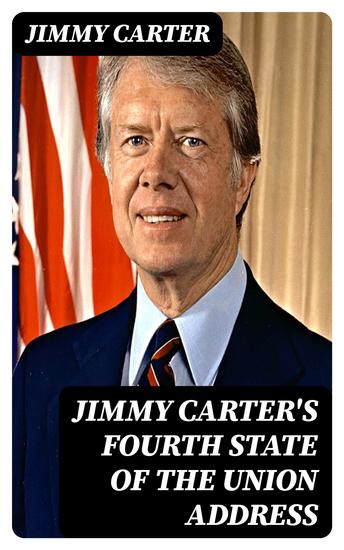
Jimmy Carter's Fourth State of the Union Address - Enriched edition - cover

Jimmy Carter's Fourth State of the Union Address - Enriched edition

Jimmy Carter

Publisher: DigiCat

  • 0
  • 0
  • 0

Summary

In 'Jimmy Carter's Fourth State of the Union Address,' the former president presents a poignant reflection on the socio-political landscape of late 1970s America. Through a blend of earnest rhetoric and policy discourse, Carter addresses key issues such as economic security, human rights, and national energy independence. His literary style effectively combines the formal cadence of political oration with a personal touch, offering both insight and emotional resonance. Positioned within the context of a tumultuous era defined by economic challenges and shifting global dynamics, this address serves as a compelling manifesto for his administration's vision and priorities. Jimmy Carter, renowned for his post-presidential advocacy and humanitarian efforts, brings a unique perspective shaped by his Southern roots and deeply held beliefs in justice and equality. His experience as a peanut farmer and Governor of Georgia informed his understanding of the common American's struggles, which is vividly echoed in this address. Carter's presidency was marked by significant challenges that required both resilience and ethical leadership, qualities that are authentically conveyed in this address. This book is highly recommended for readers interested in American political history, presidential rhetoric, and the complexities of governance. As an insightful document from a pivotal moment in history, it not only reveals Carter's vision but also invites readers to reflect on the enduring issues that continue to shape America today.

In this enriched edition, we have carefully created added value for your reading experience:
- A succinct Introduction situates the work's timeless appeal and themes.
- The Synopsis outlines the central plot, highlighting key developments without spoiling critical twists.
- A detailed Historical Context immerses you in the era's events and influences that shaped the writing.
- An Author Biography reveals milestones in the author's life, illuminating the personal insights behind the text.
- A thorough Analysis dissects symbols, motifs, and character arcs to unearth underlying meanings.
- Reflection questions prompt you to engage personally with the work's messages, connecting them to modern life.
- Hand‐picked Memorable Quotes shine a spotlight on moments of literary brilliance.
- Interactive footnotes clarify unusual references, historical allusions, and archaic phrases for an effortless, more informed read.
Available since: 07/21/2022.
Print length: 96 pages.
Other books that might interest you

  • Democracy in Action - Collective Problem Solving in Citizens' Governance Spaces - cover

    Democracy in Action - Collective...

    Carolyn M. Hendriks, Albert W. Dzur

    • 0
    • 0
    • 0
    Government and market failures spur many citizens to practical action today. Around the globe people form renewable energy cooperatives, provide support for marginalized populations, and deliver alternative justice and care services. What motivates citizens to begin such practical problem-solving? How do they engage others? What knowledge do they generate? How do they interact with state and market actors? What risks and opportunities do they hold for contemporary democracy? 


    To answer these questions, Dzur and Hendriks develop the concept of citizens' governance space to delineate these efforts from contentious social movements, formal civic associations, and local community organizations. Drawing on cases from around the globe, the authors examine how citizens do functional policy work, develop and disrupt knowledge, and selectively partner with governments and corporations. They reveal complexities and risks posed by citizens' governance spaces while also showing how they offer a distinct form of democratic participation centered on practical efforts and outcomes. 


    Democracy in Action provides a new lens for recognizing and understanding the more practical ways that citizens contribute to governance and democracy.
    Show book
  • A Climate of Truth - Why We Need It and How To Get It - cover

    A Climate of Truth - Why We Need...

    Mike Berners-Lee

    • 0
    • 0
    • 0
    We have most of the technology we need to combat the climate crisis – and most people want to see more action.
     
    But after three decades of climate COPs, our global emissions are worse than ever. And we are accelerating into a Polycrisis of climate, food security, biodiversity, pollution, inequality and more. What, exactly, has been holding us back?
    What will it take for us to do better?
    In the search for answers that have been so elusive to date, Mike Berners-Lee looks at the challenge from new angles. He stands further back to gain perspective; he digs deeper under the surface to see the root causes; he joins up every element of the challenge; and he learns lessons from our failures of the past. He uses all these insights to identify the single point of greatest leverage for those seeking the systemic change we so desperately need. A Climate of Truth spells out why, if humanity is to thrive in the decades ahead, the most critical step is to raise standards of honesty in our politics, our media and our businesses. Not only is this possible, but each of us can have radically more impact on the issues we care about by turning our attention to this simple principle. 
    Anyone asking, ‘What can each of us do right now to help?’ will find inspiration in this practical and important book.
    Show book
  • Reagan-Mondale Debate 1 - cover

    Reagan-Mondale Debate 1

    Ronald Reagan, Walter Mondale

    • 0
    • 0
    • 0
    The first of two debates between President Ronald Reagan and former Vice President Walter F. Mondale was held in Louisville, Kentucky on October 7, 1984. Barbara Walters was the debate moderator. James Weigart, Diane Sawyer, and Fred Barnes were the three panelists who asked questions. 
    This first debate was on the economy and domestic issues. Questions focused on the following topics: the nation’s economy, leadership qualities, religion, political issues, abortion, federal taxation, social welfare programs, the presidential campaign, and closing statements. Reagan won a landslide victory in 1984 winning every state except Minnesota and the District of Columbia. 
    Note: 43 seconds of the audio (part of Barbara Walter’s introduction) was garbled. The section from 57 seconds to 1 minute 40 seconds was omitted. This omitted section can be seen and heard in the text and video versions at the Ronald Reagan Presidential Library. Search online for “Ronald Reagan major speeches” to see both a text version and a video version of this debate.  
    Audio recording courtesy of the Ronald Reagan Presidential Library. 
    aspenleafmedia.com
    Show book
  • God and Government - Breaking the Myth of Separation and the Deepening Evangelical Division in American Politics - cover

    God and Government - Breaking...

    Joshua M Ngoma

    • 0
    • 0
    • 0
    The Evangelical Church in the United States and other parts of the world, in general, is in a crisis of identity and stuck at a pivotal crossroads of history, conflicted about its God-given role and direction.This paralysis has been exposed and magnified by a renewed and raging debate about the role and relevance of Christianity in the governance and destiny of nations.“God and Government” establishes the truth about our role as Christians in the public affairs of nation states. It resolves one of the Church’s last frontiers yet to be conquered by Biblical truth: the old age conflict of the separation of God’s Word from the civil governance of nations.It explains why Evangelical Christians, between the so-called Religious Right and the Religious Left, are deeply divided about the role of the Church in the national politics of the United States.God’s blueprint guides the affairs of nations and He is not silent on matters of good governance, righteousness, and justice. Only God has unlimited power- His government rests on the shoulders of His Son Jesus Christ who has, in turn, delegated authority to the individual, family, Church and the State. “God and Government” is the definite answer to the following questions, and much more.
    Show book
  • What's Right With America - And How We Can Keep It That Way! - cover

    What's Right With America - And...

    Hon. Paul Johnson, Larry Aldrich

    • 0
    • 0
    • 0
    Is America's future as bright as its past? What's Right With America argues that not only is the answer "Yes," but the nation's most incredible days are yet to come. Despite the challenges and divisions we face, America's true strength lies in its core principles and the resilient spirit of its people. 


    From the vision of our Founding Fathers to the resilience and determination that have shaped our history, What's Right With America explores what makes the country uniquely capable of thriving in times of change. With inspiring stories and thought-provoking analysis, authors Paul Johnson and Larry Aldrich reveal how America's prosperity is rooted in more than just economic might—it's grounded in values like freedom, individual empowerment, and deep commitment to justice and liberty. 


    Johnson and Aldrich have identified five defining characteristics that have propelled the United States to greatness, showing how these ideals can guide us through current and future challenges. Whether you're concerned about politics, society, or the economy, What's Right With America offers a powerful reminder that America's strength is more than just its leadership—it's in every citizen who believes in the promise of a better future.
    Show book
  • Russia's War - cover

    Russia's War

    Jade McGlynn

    • 0
    • 0
    • 0
    In the early hours of February 24, 2022, Russian forces attacked Ukraine. The brutality of the Russian assault has horrified the world. But Russians themselves appear to be watching an entirely different war—one in which they are the courageous underdogs and kind-hearted heroes successfully battling a malign Ukrainian foe. 


    Russia analyst Jade McGlynn takes us on a journey into this parallel military and political universe to reveal the sometimes monstrous, sometimes misconstrued attitudes behind Russian majority backing for the invasion. Drawing on media analysis and interviews with ordinary citizens, officials and foreign-policy elites in Russia and Ukraine, McGlynn explores the grievances, lies and half-truths that pervade the Russian worldview. She also exposes the complicity of many Russians, who have invested too deeply in the Kremlin's alternative narratives to regard the war as Putin's foolhardy mission. In their eyes, this is Russia's war—against Ukraine, against the West, against evil—and there can be no turning back.
    Show book