Join us on a literary world trip!
Add this book to bookshelf
Grey
Write a new comment Default profile 50px
Grey
Subscribe to read the full book or read the first pages for free!
All characters reduced
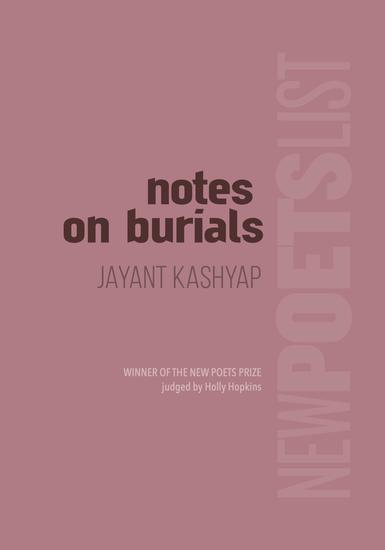
Notes on Burials - cover

Notes on Burials

Jayant Kashyap

Publisher: The Poetry Business

  • 0
  • 0
  • 0

Summary

Winner of the 2024 New Poets Prize, judged by Holly Hopkins.
An archaeological dig, a visit to an imagined London, puppies that come back from the dead. In Notes on Burials, Jayant Kashyap makes a series of journeys: real, mythological and etymological as he navigates what is lost and what is buried. Kashyap's poems of love and remembrance reach out to collective losses, human and environmental, in a series of disappearing acts and excavations that take us from broken childhood patio to a snowboarder in an avalanche.
Available since: 07/18/2025.
Print length: 36 pages.
Other books that might interest you

  • The Top 10 Poets – Artists - Five poems each from some of the best poets to have been artists - cover

    The Top 10 Poets – Artists -...

    Rabindranath Tagore, William...

    • 0
    • 0
    • 0
    The language of Poetry is an art that most of us attempt at some point in our lives.  Although its commonplace exposure has been somewhat marginalised in today’s often fast-paced lives we all recognise good verse that can empathise with our thoughts or open us up to experience new things in new ways, to better understand and to enjoy the many strands of our lives. 
    But finding a starting point can be overwhelming, even off-putting, so in this series we offer up our Top 10 classic poets, who brim with talent and verse, on a range of subjects and themes that we can all enjoy. 
    In this volume we explore Artists and whether they be painters, novelists and the like were as equally adept and famed for their poetry and verse.
    Show book
  • Very Close to Pleasure There's a Sick Cat (Unabridged) - cover

    Very Close to Pleasure There's a...

    Shakti Chattopadhyay

    • 0
    • 0
    • 0
    In the early 1960s, the Hungry Generation revitalized Bengali poetry in Calcutta, liberating it from the fetters of scholarship and the fog of punditry and freeing it to explore new forms, language, and subjects. Shakti Chattopadhyay was a cofounder of the movement, and his poems remain vibrant and surprising more than a half century later. In his 'urban pastoral' lines, we encounter street colloquialisms alongside high diction, a combination that at the time was unprecedented. Loneliness, anxiety, and dislocation trouble this verse, but they are balanced by a compelling belief in the redemptive power of beauty.
    
    This book presents more than one hundred of Chattopadhyay's poems, introducing an international audience to one of the most prominent and important Bengali poets of the twentieth century.
    Show book
  • An Orange A Syllable - cover

    An Orange A Syllable

    Gillian Sze

    • 0
    • 0
    • 0
    The latest book by Gillian Sze, author of the Pat Lowther Memorial Award–winning book Quiet Night Think
    		 
    This prosimetrical work is a meditation on motherhood, language, and art. The central speaker witnesses the earliest utterances of her child and launches into a poetic inquiry of words themselves, asking, How to measure one’s mouth by its words? The speaker seeks an answer amidst the language that surrounds her — words misspoken, mispronounced, remembered, unwritten — and, in doing so, struggles with signification and significance.
    		 
    Each prose poem in the five-part collection darts between the many meanings of “fit” — as in “a sudden burst of emotion” or “to be the right size and shape,” and the archaic “fytte” (a section of a poem). A text becomes an open mouth, a square day of a calendar, or a bare fragment of a narrative. The final section of the book is an intimate and ekphrastic engagement with the work of Danish painter Vilhelm Hammershøi. Drawn to Hammershøi’s paintings of the empty rooms of his apartment, the speaker recognizes a familiar space of art’s insistence.
    		 
    An Orange, A Syllable details a period of maternal and artistic transformation.
    Show book
  • Born in England – Exploring English Poetry - London - A celebration of English poems - cover

    Born in England – Exploring...

    Geoffrey Chaucer, William Blake,...

    • 0
    • 0
    • 0
    Poetry. A form of words that seems so elegantly simple in one verse and so cleverly complex in another.  Each poet has a particular style, an individual and unique way with words and yet each of us seems to recognise the path and destination of where the verses lead, even if sometimes the full comprehension may be a little beyond us. 
     
    Through the centuries every culture has produced verse to symbolize and to describe everything from everyday life, natural wonders, the human condition and even in its more hubristic moments, the crushing triumph of an enemy. 
     
    In the volumes of this series, we take a look at poetry through the prism of individual regions of England, or sometimes more quaintly known as ‘Albion’, or ‘Blighty’, through the centuries of its gloried history. 
     
    England, despite its perception of reserve and under-statement has, in reality, strode the global stage at various time in many things, both good and bad, from Empire to long distance running. Here our focus in on its literature.  Famed for its fiction and dramas, it is equally admired for its plethora of gifted poets and the dazzling verse which has added so much to its artistic legacy.  These classic poets are wonders of their age and of their art.  Genius is written in their names. 
     
    In this volume the instantly globally recognisable city of London has, for century after century, dominated the country.  Its rich history of art, culture and commerce interweave with generation after generation of poets to produce a supremely rich tapestry of undimmed brilliance.  Our poets include Alexander Pope, Amy Levy, Edmund Spenser, John Keats, G K Chesterton and a host of others.  Genius has many names.
    Show book
  • The Poetry of Alfred Lichtenstein - Surrealist German poet who was killed in WW1 - cover

    The Poetry of Alfred...

    Alfred Lichtenstein

    • 0
    • 0
    • 0
    Alfred Lichtenstein was born on the 23rd August 1889, in Berlin-Wilmersdorf, the son of a Jewish manufacturer.  He grew up in Berlin before studying law at Erlangen in Bavaria.   
     
    A writer in the Expressionist style his poems and stories are short but beautifully honed works.  His tragically curtailed life allowed only a small part of his talents to rest with us.  Undoubtedly a full life would have given the world a very gifted literary force. 
     
    Alfred Lichenstein volunteered for duty in the German Army for World War I.  He died on the front at the Somme in the early months of combat on the 25th September 1914.  He was 25.
    Show book
  • The Poetry of George Meredith - Victorian master of poetry and prose that was nominated for the Nobel Prize seven times - cover

    The Poetry of George Meredith -...

    George Meredith

    • 0
    • 0
    • 0
    George Meredith, OM, was born in Portsmouth, England on February 12th, 1828. His mother died when he was five. As a fourteen year old teenager he was sent to a Moravian School in Neuwied, Germany, staying there for two years. After reading law he was articled as a solicitor, but quickly abandoned that career path for journalism and poetry. He collaborated with Edward Gryffydh Peacock, son of Thomas Love Peacock in publishing a privately circulated literary magazine, the Monthly Observer. At age twenty-one he married Mary Ellen Nicolls, Edward Peacock's beautiful widowed sister, on August 8th, 1849. Mary Ellen was 28. 
    The marriage produced one child; Arthur (1853–1890). Meredith collected his early writings, all previously published in periodicals, in an 1851 volume, Poems. In 1856 he posed as the model for The Death of Chatterton, a well-known picture by the English Pre-Raphaelite painter Henry Wallis, which romantised the teenage Chatterton’s demise. Although Meredith received some publicity for this his wife received rather more attention from Wallis because of it. Mary Ellen ran off with Wallis in 1858, shortly before giving birth to a child that all assumed to be Wallis. Tragically she died three years later. From that dreadful experience emerged a collection of sonnets entitled Modern Love in 1862 together with much of his first major novel; The Ordeal of Richard Feverel. 
    Meredith married Marie Vulliamy in 1864 and they settled in Surrey. Together they had two children; William (1865) and Mariette (1874). He had a keen understanding of comedy and his Essay on Comedy (1877) remains a reference work in the history of comic theory. In The Egoist, published in 1879, he applies some of his theories of comedy in one of his most thoughtful and enduring novels. During most of his career, he had difficulty crossing over from critical acclamation to popular success. It was only in 1885 that his first genuine commercial success appeared; Diana of the Crossways.  With an unreliable income stream he sought to bolster that with a job as a publisher's reader. 
    The company that gave him this lifeline was Chapman & Hall. His advice to the company was very well received and made him influential in the world of letters. In 1868 Meredith was introduced to Thomas Hardy. Hardy had submitted his first novel, The Poor Man and the Lady. Meredith felt the book was too bitter a satire on the rich and told Hardy to put it aside as it was likely it would be savaged by reviewers and destroy his nascent career. Meredith had received the same reaction with The Ordeal of Richard Feverel. Although it had brought him success it was judged so shocking that Mudie's circulating library cancelled an order of 300 copies. But these years, creatively, were very prolific and successful for Meredith. Novels and poems flowed from his pen including everything from The Adventures of Harry Richmond to many poetry volumes including The Lark Ascending (which later inspired the Vaughan Williams music). In 1886, tragedy struck when Marie Vulliamy, died of cancer. 
    Whilst his personal life was producing horrendous scars he was receiving many accolades. Oscar Wilde was a fan. In The Decay of Lying, he says of Meredith "Ah, Meredith! Who can define him? His style is chaos illumined by flashes of lightning". In 1891 Meredith was even the subject of homage when Sir Arthur Conan Doyle in his Sherlock Holmes short story The Boscombe Valley Mystery. Holmes turns to Watson during case discussions and says "And now let us talk about George Meredith, if you please, and we shall leave all minor matters until tomorrow." George Meredith, aged 81, died at his home in Box Hill, Surrey on May 18th, 1909. He is buried in the cemetery at Dorking, Surrey. 
     
    This volume comes to you from Portable Poetry, a specialized imprint from Deadtree Publishing.  Our range is large and growing and covers single poets, themes, and many compilations.
    Show book