Join us on a literary world trip!
Add this book to bookshelf
Grey
Write a new comment Default profile 50px
Grey
Subscribe to read the full book or read the first pages for free!
All characters reduced
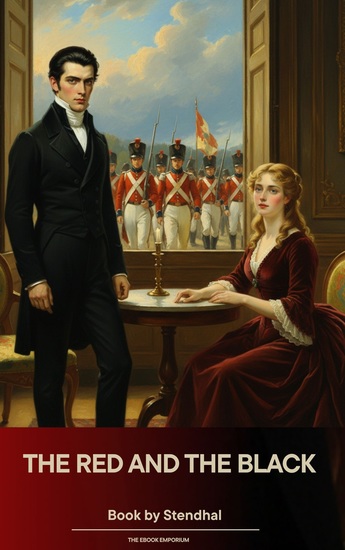
The Red and the Black - cover

The Red and the Black

Stendhal

Translator C K Scott Moncrieff

Publisher: The Ebook Emporium

  • 0
  • 0
  • 0

Summary

"In a world of cold calculation, can a heart of fire survive?"

Born the son of a provincial carpenter, Julien Sorel is possessed by a brilliant mind and a dangerous obsession with Napoleon Bonaparte. Realizing that the "Red" path of military glory is closed to him in the stagnant era of the Bourbon Restoration, he chooses the "Black" path of the clergy as a means to power. Julien's journey takes him from the bedchambers of provincial nobility to the glittering salons of Paris, as he maneuvers through a society where hypocrisy is the only language spoken fluently. Caught between his genuine passion for the gentle Madame de Rênal and his intellectual fascination with the haughty Mathilde de la Mole, Julien finds that the climb to the top is paved with secrets that could lead to his ultimate downfall.

The "Red" vs. the "Black": The title serves as a perfect metaphor for Julien's internal conflict. The "Red" represents the lost glory of the battlefield and the meritocracy of the Empire, while the "Black" represents the mourning clothes of the Church and the subtle, often corrupt, influence of the priesthood. Julien is a hero who plays a part he despises to achieve a status he craves.

A Pioneer of Psychology: Stendhal was one of the first novelists to focus intensely on "inner monologue." He provides a window into Julien's constant self-analysis and strategic thinking, revealing the anxiety and pride that drive every move. It is a remarkably modern look at how we construct our identities to fit the expectations of others.

Why It Is a Literary Essential: The Red and the Black is the ultimate "outsider" novel. It speaks to anyone who has ever felt like they were watching life from the sidelines, planning their entry. It is a thrilling, tragic, and bitingly funny critique of a society that rewards the mask more than the man.

Witness the rise and fall of Julien Sorel. Purchase "The Red and the Black" today.
Available since: 01/19/2026.
Print length: 314 pages.

Other books that might interest you

  • Innocent When You Dream - cover

    Innocent When You Dream

    Ken Narasaki

    • 0
    • 0
    • 0
    80-something Dan Yamada has been rendered speechless after a stroke, and as he lies in bed, he vividly recalls his life, from his days in the World War 2-era internment camps, to serving in the US Army, to his one true love. At his bedside in the present, his adult children fight over his care and legacy, all while Dan tries to communicate his poignant final wish.  
     
    Includes an interview with playwright Ken Narasaki. 
     
    This play is sponsored by the California Civil Liberties Public Education Program, a state-funded grant project of the California State Library. 
     
    Recorded at The Invisible Studios, West Hollywood in January 2024. 
     
    Directed by Anna Lyse Erikson 
    Producing Director: Susan Albert Loewenberg 
     
    An L.A. Theatre Works full cast recording, starring: 
     
    Kurt Kanazawa as Frank Fujiyama  
    John Miyasaki as Young Dan Yamada  
    Suzy Nakamura as Joy Yamada-Hanke  
    Ken Narasaki as Dr. Park  
    Rosie Narasaki as Young Grace Hamamoto Sharon Omi as Adult Grace Hamamoto  
    Sab Shimono as Dan Yamada  
    Greg Watanabe as Merv Yamada 
     
    Senior Producer: Anna Lyse Erikson 
    Prepared for audio by Mark Holden 
    Recorded and edited by Neil Wogenson 
    Designed and mixed by Charles Carroll for The Invisible Studios, West Hollywood. 
    Senior Radio Producer: Ronn Lipkin 
    Foley Artist: Stacey Martinez 
     
    “Blue Skies” performed by Kurt Kanazawa
    Show book
  • Poets of the Early 20th Century The - Volume 2 - Find beauty and hope in a period ravaged worldwide by war - cover

    Poets of the Early 20th Century...

    Edna St. Vincent Millay, TS...

    • 0
    • 0
    • 0
    In England the Victorian Age was about to become the past and a new age of worldwide wars of horror and slaughter would envelop and decimate generations, forever staining mankind.   
     
    The Century would see the World discover strengths. The Democracies would stand firm against Fascism and later Communism yet still keep its own elite and privileged in power and the rest of us underfoot. 
     
    The World was more connected than ever before.  Culture accelerated its kaleidoscopic and interwoven journey. Transport delivered people by car and train and then aeroplane to far flung corners of the globe.  Empires were at their zenith and ready to fragment with new nations, many troubled, rising from their decay. 
     
    The natural world continued to be plundered and pillaged for its resources by industries who pledged ‘more’ and ‘better’ and would clothe and feed a growing world yet sow the seeds now ready to devastate us in our current times. 
     
    The globe was as vibrant and violent as troubled and tarnished as it ever was.  But new ideas, new political systems, new times changed everything once again. 
     1 - The Poets of the Early Twentieth Century  - Volume 2 - An Introduction 
    2 - The Lions by Joseph Mary Plunkett 
    3 - 1841-1891 by Joseph Mary Plunkett 
    4 - If We Return by F W Harvey 
    5 - The Soldier Speaks by F W Harvey 
    6 - The Negro Soldiers by Roscoe C Jamison 
    7 - Into Battle by Julian Grenfell 
    8 - Prayer For Those on the Staff by Julian Grenfell 
    9 - Hymn by Fenton Johnson 
    10 - Tired by Fenton Johnson 
    11 - Sonnet I by Fernando Pessoa 
    12 - If, After I Die by Fernando Pessoa  
    13 - I Have A Rendezvous with Death by Alan Seeger 
    14 - All Thats Not Love by Alan Seeger 
    15 - Maktoob by Alan Seeger 
    16 - The Unseen Planets by Raymond Chandler 
    17 - The Poet's Knowledge by Raymond Chandler 
    18 - I Saw A Man This Morning by Patrick Shaw Stewart 
    19 - Whispers of Immortality by T S Eliot 
    20 - The Love Song of J Alfred Prufrock by T S Eliot 
    21 - Preludes by T S Eliot 
    22 - The Wounded Bird by Katherine Mansfield 
    23 - Stars by Katharine Mansfield 
    24 - A Fine Day by Katherine Mansfield 
    25 - I Taught Myself To Live Simply by Anna Akhmatova 
    26 - When I Write Poems by Anna Akhmatova 
    27 - Poetry by Claude McKay 
    28 - The White House by Claude McKay 
    29 - The Lynching by Claude McKay 
    30 - Strange Hells by Ivor Gurney 
    31 - Crucifix Corner by Ivor Gurney 
    32 - Serenade by Ivor Gurney 
    33 - Break of Day in the Trenches by Isaac Rosenberg 
    34 - Dead Man's Dump by Isaac Rosenberg 
    35 - August 1914 by Isaac Rosenberg 
    36 - Journey's End by Zora Neale Hurston 
    37 - The Dog Tupman by Stella Benson 
    38 - The Ballad of the Harp-Weaver by Edna St Vincent Millay 
    39 - My Heart Being Hungry by Edna St Vincent Millay 
    40 - What Lips My Lips Have Kissed, And Where, And Why by Edna St Vincent Millay 
    41 - Sonnet XVIII - I, Being Born a Woman by Edna St Vincent Millay 
    42 - Unity by Cesar Vallejo 
    43 - Love by Edith Sodergran 
    44 - On Foot I Had to Cross the Solar System by Edith Sodergran 
    45 - Insouciance by Richard Aldington 
    46 - Goodbye by Richard Aldington 
    47 - Grey Hairs by Marina Ivanova Tsvetaeva 
    48 - Lady with Camelias by Marina Ivanova Tsvetaeva 
    49 - To Mother by Marina Ivanova Tsvetaeva 
    50 - Back To Rest by Lietenant William Noel Hodgson MC 
    51 - Before Action  by Lieutenant William Noel Hodgson MC 
    52 - Past One O'Clock by Vladimir Mayakovsky 
    53 - So This Is How I Turned into a Dog by Vladamir Mayakovsky 
    54 - Verse for a Certain Dog by Dorothy Parker 
    55 - A Dream Lies Dead by Dorothy Parker<p
    Show book
  • rock flight - cover

    rock flight

    Hasib Hourani

    • 0
    • 0
    • 0
    rock flight is a book-length poem that follows a personal and historical narrative to compose an understated yet powerful allegory of Palestine's occupation. The poem uses refrains of suffocation, rubble, and migratory bird patterns to address the realities of forced displacement, economic restrictions and surveillance technology that Palestinians face both within and outside Palestine. It depicts a restlessness brought about by dispossession, and a determination to find significance in fleeting objects and fragments. It looks to the literary form as an interactive experience, and the book as an object in flux, inviting the reader to embark on an exploration of space, while limited by the box-like confines of the page. Formally claustrophobic, the poem morphs into irony, declaring everything a box while refusing to exist within one.
    'rock flight is relentlessly potent. Merging resistance and poetry, Hasib Hourani writes back—against the "suffocating state" and imperial forces. Be ready to be transformed by Hourani's diasporic anticolonial poetics.' — Don Mee Choi
    'Here is a poetry of passion; a poetry of necessity; a poetry of survival, and a poetry-triumphant.' — Maxine Beneba Clarke
    Show book
  • Transcendence - cover

    Transcendence

    Andrew Rae

    • 0
    • 0
    • 0
    What lies behind this sunlit world?…Something too deep for thought,…Open only to prayer.
     
    These poems reflect moments when one experiences something more than what one  sees and hears, feelings of the sublime, the holy, the transcendent.
     
    …When meditating by a Wiltshire stream, or walking alone through an African forest, observed by a thousand unseen eyes and ears, from giant cats to tremulous snakes.
     
    …Feelings of going beyond oneself, beyond anxiety and feelings of inadequacy, losing oneself in the great chain of being.
     
    …The healing experience of being part of nature, losing the fear of death.
     
    From  intimations of transcendence in nature, this book moves on to the magic of ancient churches where so many have offered up their sorrows and joys and then to meditations and prayers, as well as the consolations offered by ancient rituals, by the rhythm of the church’s seasons, from the magic of Christmas through the penitence of Lent to the glories of Easter.
     
    The final section explores the tragic lockdowns caused by Covid-19.
    Show book
  • Poetry Dead To Society - cover

    Poetry Dead To Society

    Cee Jay Spring

    • 0
    • 0
    • 0
    Book of Poetry - Was written to awaken and bring back to life poetry within our society! There are many poems of a variety of topics that will amaze and stun. This book contains love, romance, life journey, religion, heartbreak, and even hatred. It is guaranteed to open your mind's eye!
    Show book
  • Octaves - Poem from a Pulitzer prize winner - cover

    Octaves - Poem from a Pulitzer...

    Edward Arlington Robinson

    • 0
    • 0
    • 0
    Edwin Arlington Robinson was born on the 22nd December 1869 in Tide in Lincoln County, Maine.  
    His childhood was described by him as ‘stark and unhappy’.  His name was drawn out of a hat from a fellow vacationer from Arlington Massachusetts when fellow holiday makers decided that his parents had waited long enough at 6 months to name him.  It was a name he despised and reflects the station to which his parents had placed him; their great hope at his birth were that he was a girl to complement their two sons. 
    His pessimistic mood carried him to adulthood and a doomed encounter with Emma Loehen Shepherd who constantly encouraged his poetry.  Edwin was thought too young to be her companion and so his elder, middle brother, Herman was assigned to her.  It was a great blow to Edwin and during their marriage on February 12th, 1890, he stayed home and wrote ‘Cortege’ 
    In the fall of 1891 Edwin entered Harvard, taking classes in English, French and Shakespeare.  He felt at ease with the Ivy League and made great efforts to be published in one of the Harvard literary journals.  Indeed, the Harvard Advocate published ‘Ballade of a Ship’ but then his career appeared to stall.  His father died and although he returned to Harvard for a second year it was to be his last but also the start of some life-long friendships. 
    In 1893 he returned to Gardiner Maine as the man of the household.  Herman by this time had become an alcoholic, having suffered business failures, and was now to become estranged from Emma. 
    Edwin began farming whilst he wrote and quickly developed a close relationship with Emma who had now moved back to Gardiner after Herman’s death with her children. 
    Although he proposed twice, he was rejected and in consequence moved to New York to start afresh. 
    But it was a salutary experience. Although surrounded by artists he had little money and life was difficult. 
    In 1896 he published his own book, ‘The Torrent and the Night Before’, paying 100 dollars for 500 copies.  Edwin wanted it to be a surprise for his Mother, but days before its arrival she died of diphtheria. 
    His second volume, ‘The Children of the Night’, had a wider circulation.  At the behest of President Roosevelt, whose son was an avid admirer, he was given a job in 1905 at the New York Customs Office although it appears his real job was “to help American letters”. 
    Either way his success began to widen and his influence proper.  During the 1920s he won the Pulitzer Prize for Poetry on three separate occasions. In 1922 for ‘Collected Poems’ again in 1925 for ‘The Man Who Died Twice’ and finally in 1928 for ‘Tristram’. 
    During the last twenty years of his life he became a regular summer resident at the MacDowell Colony in New Hampshire, where he became the object of fascination by several women.  But he never married. 
    Edwin Arlington Robinson died of cancer on the 6th April 1935 in the New York Hospital in New York. He was 65.
    Show book