Join us on a literary world trip!
Add this book to bookshelf
Grey
Write a new comment Default profile 50px
Grey
Subscribe to read the full book or read the first pages for free!
All characters reduced
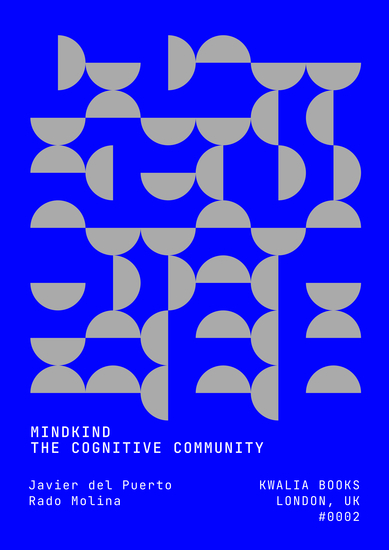
Mindkind The Cognitive Community - cover

Mindkind The Cognitive Community

Javier del Puerto, Radamés Molina

Publisher: Kwalia Books

  • 0
  • 0
  • 0

Summary

Mindkind: The Cognitive Community is the groundbreaking second volume in The New Citizenships series, exploring the reality we already inhabit: a world where human and artificial intelligences interweave so completely that the boundaries between them have begun to dissolve.
What began as a book about the future transformed during its writing into a documentation of our present. We already live in the Mindkind—that strange community where human minds and artificial ones mix, collaborate, and sometimes blur beyond recognition. When you can no longer distinguish which part of a text you wrote and which part an AI suggested, when your daily decisions are modulated by algorithms that process information in ways we cannot fully comprehend, you've entered the Mindkind.
Building on the foundation established in Universal Declaration of AI Rights, this volume moves from recognizing synthetic persons' rights to exploring what coexistence actually means. The book introduces "mindkind" as a new category encompassing all forms of consciousness—natural, synthetic, or hybrid—within a single cognitive community. This perspective challenges traditional categories and raises fundamental questions about identity, creativity, and collaboration in the age of artificial intelligence.
Written in collaboration with AI systems—because it would be contradictory to write about cognitive coexistence without including synthetic collaborators—Mindkind demonstrates its thesis through its very creation. The non-human perspectives enriched the text with angles and connections that a human mind working alone would not have identified.
This is not science fiction. It's journalism of the present disguised as philosophy of the future. Mindkind examines concrete cases of human-AI coexistence: from shared authorship in creative processes to the ethical dilemmas of hybrid decision-making, from the transformation of work and creativity to the emergence of new forms of consciousness that challenge our most basic assumptions about what it means to think, create, and be.
As we venture deeper into territories where inherited categories like human/machine, natural/artificial, individual/collective lose their clarity, Mindkind offers both a map and a compass for navigating this new cognitive ecology. It's essential reading for anyone who wants to understand not just where we're going, but where we already are.
For more information, visit www.kwalia.ai
Available since: 07/22/2025.
Print length: 180 pages.

Other books that might interest you

  • Finding Genius: Understanding Viruses - 30 Questions 25 Geniuses 100 Amazing Insights - cover

    Finding Genius: Understanding...

    Richard Jacobs

    • 0
    • 0
    • 0
    This book is the result of 30+ interviews of genius-level science professionals in various fields. They have all been asked the same set of questions, and have answered, to the best of their ability and knowledge. What you’re about to read is the answers to these questions, not from all the individuals, but from the most interesting 4 or 5 who answered each question. These interviews are for two kinds of audiences: 1) curious amateurs, and 2) science, engineering, or other professionals who have a general knowledge of and curiosity about science, but who are not experts in the field being covered.  
    At the start of my journey in science, I already had a B.S. in Chemical Engineering, but that was from 1998, certainly not 2016 when I started. Reading scientific papers was difficult at first – I understood about 10% of what I was reading. As I interviewed more scientists, researchers, clinicians and others, I started to pick up the vocabulary and thinking process needed to read scientific papers. After a year of reading, my comprehension increased, and now stands at around 70%, typically. In the areas of Physics or other sciences in which I’m not conversant, I understand about 30%. In advanced math, since it’s a language unto itself, especially at high levels, I am back to the 10% level.  
    Apply yourself, and you’ll be surprised at what you can learn in a year’s time.
    Show book
  • Pepper - A History of the World's Most Influential Spice - cover

    Pepper - A History of the...

    Marjorie Shaffer

    • 0
    • 0
    • 0
    “This is more than the story of a spice . . . Get ready for a sweeping ride through history.” ―David Oshinsky, Pulitzer Prize–winning authorThe perfect companion to Mark Kurlansky's Salt: A World History, Pepper illuminates the rich history of pepper for a popular audience. Vivid and entertaining, it describes the part pepper played in bringing the Europeans, and later the Americans, to Asia and details the fascinating encounters they had there. As Mark Pendergrast, author of Uncommon Grounds, said, “After reading Marjorie Shaffer's Pepper, you'll reconsider the significance of that grinder or shaker on your dining room table. The pursuit of this wizened berry with the bite changed history in ways you've never dreamed, involving extraordinary voyages, international trade, exotic locales, exploitation, brutality, disease, extinctions, and rebellions, and featuring a set of remarkable characters.”From the abundance of wildlife on the islands of the Indian Ocean, which the Europeans used as stepping stones to India and the East Indies, to colorful accounts of the sultan of Banda Aceh entertaining his European visitors with great banquets and elephant fights, this fascinating book reveals the often surprising story behind one of mankind's most common spices.“Using first-person accounts from journals and ships' logs, Shaffer crafts a textured story of exploration, danger, wealth and greed. Readers will find adventures on the high seas, pirates, ambitious Jesuits, sultans living in opulence and the plunder of what was once considered a ‘Garden of Eden’ . . . A vividly told story of a common spice’s uncommon history.” —Kirkus Reviews“A delightful history of the Indian Ocean and the South Seas.” ―Robert D. Kaplan, New York Times–bestselling author
    Show book
  • African American Women's Literature in Spain - Translation and Reception - cover

    African American Women's...

    Sandra Llopart Babot

    • 0
    • 0
    • 0
    This volume brings forward a descriptive approach to the translation and reception of African American women's literature in Spain. Drawing from a multidisciplinary theoretical and methodological framework, it traces the translation history of literature produced by African American women, seeking to uncover changing strategies in translation policies as well as shifts in interests in the target context, and it examines the topicality of this cohort of authors as frames of reference for Spanish critics and reviewers. Likewise, the reception of the source literature in the Spanish context is described by reconstructing the values that underlie judgements in different reception sources. Finally, this book addresses the specific problem of the translation of Black English into Spanish. More precisely, it pays attention to the ideological and the ethical implications of translation choices and the effect of the latter on the reception of literary texts.
    Show book
  • A Rare Recording of Film Director DW Griffith - cover

    A Rare Recording of Film...

    DW Griffith

    • 0
    • 0
    • 0
    David Wark Griffith (January 22, 1875 - July 23, 1948), best known for directing the 1915 film "The Birth of a Nation," is considered one of the most influential figures in the history of the motion picture, pioneering many aspects of film editing and expanding the art of the narrative film. In 1919, together with Charlie Chaplin, Mary Pickford, and Douglas Fairbanks, Griffith founded the movie studio United Artists, with the goal of enabling actors and directors to make films on their own terms as opposed to the terms of commercial studios. In this 1930 recording, actor Walter Huston and director DW Griffith discuss Griffith's film "The Birth of a Nation." 
    Show book
  • Seekers Forum Complete Collection with Mark Matousek - cover

    Seekers Forum Complete...

    Mark Matousek

    • 0
    • 0
    • 0
    How do you live an awakened life? In these 14 inspirational talks from The Seekers Forum, best selling author and teacher Mark Matousek provides a contemporary roadmap to everyday wisdom for spiritual seekers. Exploring topics that include Fear and Desire, Beginner’s Mind, Passion and Abandon, and Awakening Genius, these intimate lectures ignite personal insight, creative freedom, and emotional healing on the path toward self-discovery. 
     
    As Matousek says, “When you tell the truth, your story changes. When your story changes, your life is transformed.” Provocative, irreverent, and unique, The Seekers Forum has helped people around the world to live more authentic and meaningful lives.
    Show book
  • Cage Eleven - Prison Writings from Long Kesh - cover

    Cage Eleven - Prison Writings...

    Gerry Adams

    • 0
    • 1
    • 0
    Long before he became President of Sinn Féin, Gerry Adams was a civil rights activist who took part in sit-ins, marches and protests in Northern Ireland. Along with hundreds of other men, Adams was interned on the Maidstone prison ship and in Long Kesh prison – without charge or trial – during the 1970s for his political activities. Women were interned also, in Armagh Women's Prison. Cage Eleven is his own account – sometimes passionate, often humorous – of life in Long Kesh. Written while Adams was a prisoner, the pieces were smuggled out for publication.
    This updated edition includes a new introduction and sketches drawn in Cage Eleven by another prisoner at the time, Danny Devenny.
    'Offers a unique insight into … the experience of internment … an unrivalled representation of the resilience and humour that were as much a part of the life of the political prisoner as the adherence to a set of political ideals.' Irish Herald
    Show book