Join us on a literary world trip!
Add this book to bookshelf
Grey
Write a new comment Default profile 50px
Grey
Subscribe to read the full book or read the first pages for free!
All characters reduced
Social Letters - cover

Social Letters

Jasper Holt

Translator A AI

Publisher: Publifye

  • 0
  • 0
  • 0

Summary

Social Letters explores the fascinating intersection of personal correspondence and social history, revealing how letters both reflect and shape the evolution of social norms and values. Delving into historical and contemporary letters, the book uncovers insights into everyday lives and evolving mindsets, offering a unique perspective often missed by traditional historical records. Letters are not merely personal communications but valuable artifacts that encapsulate social expectations, contribute to negotiating norms, and sometimes challenge social hierarchies. 

 
The book progresses through specific themes like courtship, family relationships, and political discourse as reflected in letters from different eras. By analyzing language, etiquette, and content, Social Letters highlights how individuals navigated acceptable social behavior. 

 
This approach challenges conventional historical narratives focused on macro-level events, emphasizing the importance of individual experiences in shaping broader social change and offering a unique window into how social expectations evolve over time.
Available since: 05/05/2025.
Print length: 70 pages.

Other books that might interest you

  • Speaking in Tongues - cover

    Speaking in Tongues

    J.M. Coetzee, Mariana Dimópulos

    • 0
    • 0
    • 0
    Language, historically speaking, has always been slippery. Two dictionaries provide two different maps of the universe: which one is true, or are both false? Speaking in Tongues—taking the form of a dialogue between Nobel laureate novelist J. M. Coetzee and eminent translator Mariana Dimópulos—examines some of the most pressing linguistic issues that plague writers and translators well into the twenty-first century. 


    The authors inquire if one can truly love an acquired language, and they question why certain languages, like Spanish, have gender differences built into them. They examine the threat of monolingualism and ask how we can counter, if at all, the global spread of the English language, which seems to maraud like a colonial power. They question whether it should be the duty of the translator to remove morally objectionable language. And in the conclusion, Coetzee even speculates whether it's only mathematics that can tell the truth about everything. 


    Drawing from decades of experience in the craft of language, both Dimópulos and Coetzee face the reality that when it comes to self-expression, some things will always get lost in translation. Speaking in Tongues finally emerges as an engaging and accessible work of philosophy, shining a light on some of the most important linguistic and philological issues of our time.
    Show book
  • Research Methods in Psychology: 2nd Canadian Edition - cover

    Research Methods in Psychology:...

    Paul C. Price, Rajiv S....

    • 1
    • 1
    • 0
     While Research Methods in Psychology is fairly traditional— making it easy for you to use with your existing courses — it also emphasizes a fundamental idea that is often lost on undergraduates: research methods are not a peripheral concern in our discipline; they are central. The overarching goal of this textbook is to present the basics of psychological research methods — focusing on the concepts and skills that are most widely shared within the discipline — emphasizing both their centrality to our field and their contribution to our understanding of human behavior. The book will include several features that will help accomplish this overarching goal.
    Listed by Unglue.it.
    Show book
  • A Rare Recording of Titanic Survivor Frank Prentice - cover

    A Rare Recording of Titanic...

    Frank Prentice

    • 0
    • 0
    • 0
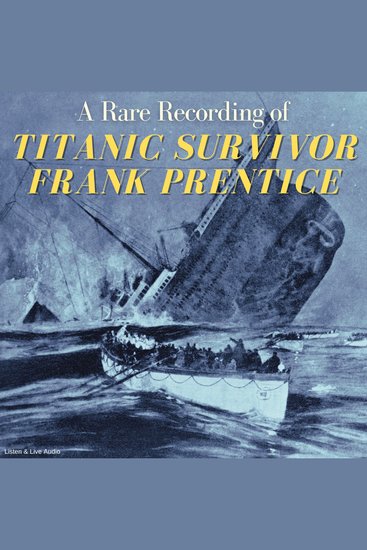
    RMS Titanic was a British passenger liner, operated by the White Star Line, that sank in the North Atlantic Ocean on April 15, 1912, after striking an iceberg during her maiden voyage from Southampton, England, to New York City. Of the estimated 2,224 passengers and crew aboard, more than 1,500 died, making it the deadliest sinking of a single ship up to that time. It remains the deadliest peacetime sinking of an ocean liner or cruise ship. Frank Prentice, an assistant purser on the Titanic, offers his account of how he survived the sinking of the ship.
    Show book
  • Deadly Triangle - "Famous Architect His Wife Their Chauffeur and Murder Most Foul The" - cover

    Deadly Triangle - "Famous...

    Susan Goldenberg

    • 0
    • 0
    • 0
    "The 1935 murder of architect Francis Mawson Rattenbury, world famous for his design of the iconic Parliament Buildings and Empress Hotel in Victoria, British Columbia, and the arrest and lurid trial of his thirty years younger second wife, Alma, and the family chauffeur, George Percy Stoner, her lover, who was half her age, riveted people. Debate continues even today as to which one of them really was responsible. Francis and Alma had moved to Bournemouth, England, when Victoria had ostracized them for their scandalous, flagrant affair while Francis was married to his first wife. Their life in Bournemouth was tangled. Francis became lush and impotent. Sex-starved, Alma seduced George, previously a virgin. They conducted their affair in her upstairs bedroom with her and Francis’s six-year-old son in a nearby bed, “sleeping” she said, and the near-deaf Francis, apparently unaware, downstairs in his armchair in a drunken stupor. The lovers were tried together at the historic high-profile Old Bailey Criminal Court in London, U.K., resulting in intense public interest and massive, frenzied media coverage. The trial sparked widespread debate over sexual mores and social strata distinctions."
    Show book
  • Human Nature - cover

    Human Nature

    Julie S. Paschold

    • 0
    • 0
    • 0
    The poems in Human Nature offer a stunning and tender ecology. It’s impossible to turn away from the awe and beauty, even as the poems also engage in playfulness and grief and resistance. In these deeply spiritual poems, the body is intricately bound to the natural world. As readers of this work, we can feel both the immense power and smallness of our human hands trembling in each shimmering line. 
    —Stacey Waite, author of Butch Geography 
    Embodying a rainbow of emotions, the poetry of Paschold grounds the reader to the world around them and those that inhabit it, big and small. 
    —Joel Sartore Photography - Office Staff 
    Julie Paschold takes a bold swing right in the title of her collection Human Nature, the delineation of which has been the prime ambition of literary folks since the first someone put pen to paper. Even, or especially, when “[w]e thin-skinned hairless beings” look outside ourselves at spiders and crocodile icefish, we also hold up a mirror in order to study our own reflection. Who can’t at times identify with “a prairie vole, / popcorn of the prairie, / . . . everything is out to eat me”? And it’s not just our fellow critters we see ourselves in: Even “[t]he sky has a sliver caught in her thumb.” It's this commonality which drives the poems and helps us understand where and how we fit in. 
    —JV Brummels, author of All the Live-Long Day
    Show book
  • Apologise… Hell No! - The Power of an Apology in an Entitled World - cover

    Apologise… Hell No! - The Power...

    SJ Sherwood

    • 0
    • 0
    • 0
    Apologise… Hell, No! The Power of an Apology in an Entitled World is a visceral read that explores the ups and down of the apology in a world that's forgetting how to say sorry and mean it. Combining personal memoir, along with some practical advice this book is rich in its openness and evocative enough to challenge, assist and uplift you as it takes both a light-hearted and serious look at the different uses of the apology spanning stoic philosophers, Stick Man, #MeToo, Black Lives Matter, narcissism, entitlement, slavery and WW1 to name but a few. 
    "A deeply personal yet systematic approach to the delicate art of apologizing." — Kirkus Reviews 
     "Unflinching honesty that has translated into something rich and evocative." — Sara Starbuck
    Show book