Join us on a literary world trip!
Add this book to bookshelf
Grey
Write a new comment Default profile 50px
Grey
Subscribe to read the full book or read the first pages for free!
All characters reduced
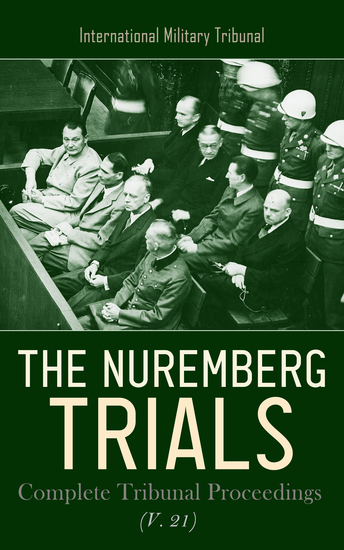
The Nuremberg Trials: Complete Tribunal Proceedings (V 21) - Trial Proceedings from 12th August 1946 to 26th August 1946 - cover

The Nuremberg Trials: Complete Tribunal Proceedings (V 21) - Trial Proceedings from 12th August 1946 to 26th August 1946

International Military Tribunal

Publisher: e-artnow

  • 0
  • 0
  • 0

Summary

The Nuremberg trials were a series of military tribunals held after World War II by the Allied forces under international law and the laws of war. The trials were most notable for the prosecution of prominent members of the political, military, judicial, and economic leadership of Nazi Germany, who planned, carried out, or otherwise participated in the Holocaust and other war crimes. The trials were held in Nuremberg, Germany. 
This volume contains trial proceedings from 12th August 1946 to 26th August 1946.
Available since: 08/20/2022.
Print length: 524 pages.

Other books that might interest you

  • Handbook Transdisciplinary Learning - cover

    Handbook Transdisciplinary Learning

    Tobias Schmohl, Thorsten Philipp

    • 0
    • 0
    • 0
    What is transdisciplinarity - and what are its methods? How does a living lab work? What is the purpose of citizen science, student-organized teaching and cooperative education? This handbook unpacks key terms and concepts to describe the range of transdisciplinary learning in the context of academic education. Transdisciplinary learning turns out to be a comprehensive innovation process in response to the major global challenges such as climate change, urbanization or migration. A reference work for students, lecturers, scientists, and anyone wanting to understand the profound changes in higher education.
    Show book
  • Solitude - The Science and Power of Being Alone - cover

    Solitude - The Science and Power...

    Thuy-vy T. Nguyen, Heather...

    • 0
    • 0
    • 0
    The average adult spends nearly one-third of their waking life alone. How do we overcome the stigma of solitude and find strength in going it alone? Whether we love it or try to avoid it, we can make better use of that time. The science of solitude shows that alone time can be a powerful space used to tap into countless benefits. Translating key research findings into actionable facts and advice, this book shows that alone time can boost well-being. From relaxation and recharging to problem solving and emotional regulation, solitude can benefit personal growth, contentment, creativity, and our relationships with ourselves and others. By learning what makes us better at spending time alone, you can use these principles to move toward your best possible self.
    Show book
  • Uncharted - A Rediscovered History of Voyages to the Americas Before Columbus - cover

    Uncharted - A Rediscovered...

    James Martin, Tim Wallace-Murphy

    • 0
    • 0
    • 0
    The Americas have had native groups living there for more than ten thousand years, but Columbus was surely not their first visitors. Uncharted covers a range of cultures who seemingly have been visiting the Americas since long before Columbus. Evidence is explored of potential Roman and Phoenician shipwrecks off the coast of South America through to Celtic and Norse exploration of Northern America. Put simply, the history of the discovery of the North America is all wrong. How did the Knights Templar influence the discovery of the new world? What do the Sinclair family, Rosslyn chapel, and two venetian brothers have to do with the discovery of a new continent? How did the Vikings navigate their way? With source materials dating back through millennia, including very recent finds, this book will induce you to thought about a side of history still so readily dismissed by some. 


    Uncharted tackles the evidence and stories of visiting distant lands that abound from many cultures, such the Egyptian, Greeks, Celts, Vikings, as well as various people from Asia; and one large Chinese group likely settled in the Americas in 100 BC, which current DNA evidence supports. Columbus should be remembered, but remembered for the conquering tyrant he was. These other groups did not come to conquer, but to trade, explore, and escape.
    Show book
  • The Classical Wisdom Collection - History’s Greatest Works on Philosophy Ethics and Political Thought - cover

    The Classical Wisdom Collection...

    Marcus Aurelius, Sun Tzu,...

    • 0
    • 0
    • 0
    What if you could access the very core of moral, philosophical, and political thought—spanning centuries and cultures—all in one place? 
    This expansive collection gathers monumental texts that have shaped global civilization. From the Stoic reflections of Marcus Aurelius to Aristotle’s ethical frameworks, from Nietzsche’s radical provocations to Kierkegaard’s existential depth, each volume has been adapted for modern readers, offering timeless wisdom for navigating life’s complexities. 
    What You’ll Discover in This Essential Anthology: 
    - Meditations – Marcus Aurelius – A Stoic guide to self-discipline and resilience. 
    - The Art of War – Sun Tzu – Strategic wisdom on leadership and success. 
    - The Book of Five Rings – Miyamoto Musashi – Samurai philosophy on discipline and mastery. 
    - Letters from a Stoic – Seneca – Profound insights on ethics and personal strength. 
    - Discourses & Enchiridion – Epictetus – Practical Stoic wisdom for everyday life. 
    - Tao Te Ching – Laozi – A guide to balance and harmonious living. 
    - Nicomachean Ethics – Aristotle – Foundational teachings on virtue and happiness. 
    - Politics – Aristotle – A blueprint for governance and justice. 
    - Poetics – Aristotle – An analysis of storytelling and artistic expression. 
    - Beyond Good and Evil – Friedrich Nietzsche – A bold challenge to conventional morality. 
    - Thus Spoke Zarathustra – Friedrich Nietzsche – A poetic exploration of human potential. 
    - Fear and Trembling – Søren Kierkegaard – A deep examination of faith and existential angst. 
    Imagine possessing a library of wisdom that sharpens your intellect and expands your worldview. The Classical Wisdom Collection is a guide for self-improvement and cultural understanding. 
    Open the door to humanity’s greatest ideas. Get your copy now and immerse yourself in a legacy of unmatched intellectual heritage.
    Show book
  • Thee-Inn Visible Warp - cover

    Thee-Inn Visible Warp

    A M Tackett

    • 0
    • 0
    • 0
    There happens to be certain parts of an individual’s life that they possess a soft spot for. Music had been the one thing in my life that I had always treasured and wanted to pursue. I have been engrossed in the different genres of music that have been introduced since the beginning, and I have wanted to be a musician since childhood. But fate had other plans when the circumstances of my life prevented me from pursuing a career in music. But he never let these trivial setbacks bring him down. Instead, he pursued his dream and started a recording studio of his own. This book entails the story of a person who wanted to pursue music as a profession and how that person thought that his life would only revolve around the farm he lived on with his family, how a certain shift of events allowed him to stay connected to his passion while balancing a life that his family was content with. while working as a tour bus driver for entertainers and celebrities. This book sheds light on the importance of following one’s passion despite challenging circumstances. This book serves as a memoir of the author’s life on the farm, where he grew up, and how he became interested in music in the first place. It also expounds on the importance of making memories throughout the different phases of life and the importance of familial relationships and friendships. This book is a demonstration of how an individual can balance their passion and responsibilities along with other things in their life. even as politics and misinformation tried to divide. Even close families and friends.
    Show book
  • The Largest Amphibious Campaigns of World War II - cover

    The Largest Amphibious Campaigns...

    Editors Charles River

    • 0
    • 0
    • 0
    Despite the gargantuan scale and the importance of Operation Husky, the invasion of Sicily has since taken a backseat to the landings on D-Day. During the first half of 1944, the Americans and British commenced a massive buildup of men and resources in the United Kingdom, while Allied Supreme Commander Dwight D. Eisenhower and military brass planned the details of an enormous and complex amphibious invasion of Europe. Though the Allies used misinformation to try deceiving the Germans, the most obvious place for an invasion was just across the narrow English Channel, and the Germans had built coastal fortifications throughout France to protect against just such an invasion. 
    	The invasion across the Channel came in the early morning hours of June 6, 1944. That day, forever known as D-Day, the Allies commenced Operation Overlord by staging the largest and most complex amphibious invasion in human history. The complex operation would require tightly coordinated naval and air bombardment, paratroopers, and even inflatable tanks that would be able to fire on fortifications from the coastline, all while landing over 150,000 men across nearly 70 miles of French beaches. Given the incredibly complex plan, it’s no surprise that General Eisenhower had already written a letter apologizing for the failure of the invasion, which he carried in his coat pocket throughout the day, but the operation’s success eventually guaranteed the liberation of Paris and victory in Europe.   
    	By the time the second Phillipines campaign started, Japan was on the defensive, but as they would prove in other places like Iwo Jima and Okinawa, Japanese soldiers would act fanatically before admitting defeat or surrendering. During this second major Philippines campaign, an estimated 330,000 Japanese died, and only a bit more than 10,000 were willing to be taken prisoner.
    Show book