Join us on a literary world trip!
Add this book to bookshelf
Grey
Write a new comment Default profile 50px
Grey
Subscribe to read the full book or read the first pages for free!
All characters reduced
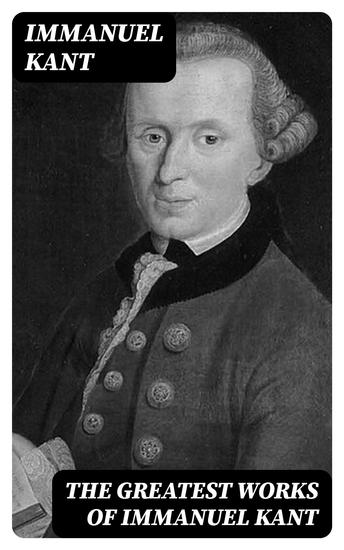
The Greatest Works of Immanuel Kant - cover

The Greatest Works of Immanuel Kant

Immanuel Kant

Translator Thomas De Quincey, Paul Carus, J. H. Bernard, T. K. Abbott, William Hastie, J. M. D. Meiklejohn, W. J. Eckoff, Emanuel F. Goerwitz, R. B. Haldane

Publisher: DigiCat

  • 0
  • 0
  • 0

Summary

In 'The Greatest Works of Immanuel Kant,' readers are presented with a compendium of ideas that have profoundly shaped modern philosophy. This collection includes critical essays such as 'Critique of Pure Reason,' 'Critique of Practical Reason,' and 'Critique of Judgment,' showcasing Kant's groundbreaking inquiry into metaphysics, ethics, and aesthetics. His rigorous analytical style is marked by a meticulous approach to delineating the limits of human understanding and the nature of moral imperatives, set against the backdrop of Enlightenment thought, where reason was lauded as the primary source of authority. Kant's work invites readers on an intellectual journey that challenges preconceived notions of knowledge and morality, insisting that enlightenment is not merely an act of the mind but a moral obligation as well. Immanuel Kant, a central figure in Western philosophy, emerged from the intellectual milieu of 18th-century Prussia, where the intersection of rationalism and empiricism was fervently debated. His personal quest for knowledge, alongside his experiences as a scholar and a professor, led him to address the pressing philosophical questions of his time. Kant's emphasis on autonomy and reason not only reflects his own beliefs but also contributes significantly to the development of critical philosophy, influencing countless theorists across disciplines. Readers seeking a deeper understanding of the foundations of Western thought will find 'The Greatest Works of Immanuel Kant' indispensable. It serves not only as an introduction to Kant's pivotal ideas but also as a comprehensive reference for those wishing to engage with the rich tapestry of philosophical discourse. By immersing oneself in Kant's writings, one can appreciate not just the complexity of his arguments but also their enduring relevance in contemporary discussions on ethics, knowledge, and the human condition.
Available since: 11/13/2022.
Print length: 820 pages.


Other books that might interest you

  • Wars of Scottish Independence - Military Campaigns between England and Scotland - cover

    Wars of Scottish Independence -...

    Kelly Mass

    • 0
    • 0
    • 0
    Knowing everything we do about siege warfare and the medieval way of conquering and being conquered, this book sheds more light on the series of wars that formed the initiative to become independent as a Scottish nation. There is much confusion about the Scottish wars of independence, and in this book, we will clarify some of that. 
    In the late 13th and early 14th centuries, the Wars of Scottish Independence were a series of army fights performed between the Kingdom of Scotland and the Kingdom of England. This is a significant event in Scottish history. 
    The English intrusion of Scotland in the year 1296 launched the First War. The Second War (1332-- 1357) started in the year 1332 and ended in the year 1357 with the finalizing of the Treaty of Berwick. Scotland was in the middle of a major dilemma at the time, and the disputes turned into one of the most essential periods in its history. Scotland's status as an independent state was maintained after the end of both wars. Other reasons for the disputes' significance include the introduction of the longbow as an important weapon in middle ages warfare. 
    Let’s take a look at what else happened and what we can learn from the background of those wars.
    Show book
  • The Re-Creation of the World as Expressed Through Myth - cover

    The Re-Creation of the World as...

    Michael Meade

    • 0
    • 0
    • 0
    Meade advises us that we must break the spell of normalcy itself and we must accept the presence of uncertainty. However, the good news is that with every ending there is a new beginning. This deep dialogue explores the collective rite of passage we are experiencing and how using the wisdom of myths gives us a roadmap to the renewal of life itself.
    Show book
  • Enemy of the People - How Jacob Zuma stole South Africa and how the people fought back - cover

    Enemy of the People - How Jacob...

    Adriaan Basson, Pieter Du Toit

    • 0
    • 0
    • 0
    He swore to serve the people, but Jacob Zuma robbed us blind. 
    This is the first definitive account of Zuma’s catastrophic misrule, offering eyewitness descriptions and cogent analysis of how South Africa was brought to its knees – and how the people fought back.  
    When Jacob Zuma took power of the ANC in December 2007, he inherited a country whose economy was growing and a party that had the support of two-thirds of the electorate. Today, South Africa is caught in the grip of state capture, the economy is moribund and a divided ANC is staring down the barrel of defeat at the 2019 elections. How did we get here? 
    Zuma ruthlessly brought his party to heel, subduing and isolating his political opponents. Then he built a patronage network of family, friends and business associates – powerful, corruptible political tenderpreneurs – who stopped at nothing to take control of state institutions and enterprises. State capture became Zuma’s brand – a maze of corruption so far-reaching that it has replaced many parts of government, causing irreparable damage to institutions, state enterprises, and the ANC itself.  
    But it hasn’t all gone Zuma’s way. In a new era of activism, former political allies, public-minded civil servants, the media and the people have stepped forward to join the anti-Zuma groundswell. In the courts, too, the pressure has mounted against a bad president, who has become an enemy of the people. 
    As a deeply divided ANC squares off for the party’s conference in December, journalists Adriaan Basson and Pieter du Toit offer an insightful, up-to-the-minute account of the Zuma era.
    Show book
  • Virginia's Civil Rights Hero Curtis W Harris Sr - cover

    Virginia's Civil Rights Hero...

    William Lazarus

    • 0
    • 0
    • 0
    In 1924, the Virginia State Legislature passed the Racial Integrity Act. The act banned interracial marriage down to "a single drop" of African blood. Just three months later, Curtis W. Harris was born in Dendron, Virginia. Harris was the sixth child of impoverished sharecroppers, living in a desolate outpost of the Commonwealth, but in time he would lead the fight against the Racial Integrity Act and many other racially restrictive laws. Despite being arrested multiple times and beaten, Rev. Harris would help reverse centuries of racial discrimination that began when slaves first arrived in Virginia in 1619. Author William Paul Lazarus tells the story of Harris' determination in the face of intense hostility, which took him to the forefront of America's Civil Rights Movement, arm-in-arm with the Rev. Martin Luther King Jr.
    Show book
  • The Chicken Little Agenda - Debunking "Experts'" Lies - cover

    The Chicken Little Agenda -...

    Anonymous

    • 0
    • 0
    • 0
    A scientist takes on the distortions and outright lies foisted on the public! 
    "A much-needed antidote to the prevailing plague of desperate (and often groundless) pessimism." —Michael Medved, Nationally Syndicated Radio Host 
    Robert G. Williscroft firmly establishes that the sky is not falling. By using scientific research and solid reasoning, he explains some of the most disturbing problems facing our nation including global warming, the safety of nuclear power, the politics of education, and the oxymoron of government efficiency. With a clear message, he discerns what is true from what is merely Chicken Little gibberish.
    Show book
  • Adam Smith - The Father of Modern Economics - cover

    Adam Smith - The Father of...

    Hector Davidson

    • 0
    • 0
    • 0
    Adam Smith, often hailed as the father of modern economics, revolutionized the field with his pioneering ideas in the 18th century. His significance lies in his formulation of the foundational principles of classical economics, particularly through his seminal works, The Theory of Moral Sentiments and An Inquiry into the Nature and Causes of the Wealth of Nations. 
    In The Wealth of Nations, Smith introduced the concept of the "invisible hand," a metaphor for the self-regulating nature of free markets. He argued that individuals pursuing their self-interest unintentionally contribute to the economic well-being of society, as if guided by an invisible hand. This idea challenged the prevailing mercantilist views of the time, advocating instead for free trade and minimal government intervention in economic affairs. 
    Smith's exploration of the division of labor highlighted how productivity and efficiency could be vastly improved when tasks are specialized. This principle not only influenced economic theory but also had a profound impact on industrial practices and economic policy.
    Show book