Join us on a literary world trip!
Add this book to bookshelf
Grey
Write a new comment Default profile 50px
Grey
Subscribe to read the full book or read the first pages for free!
All characters reduced
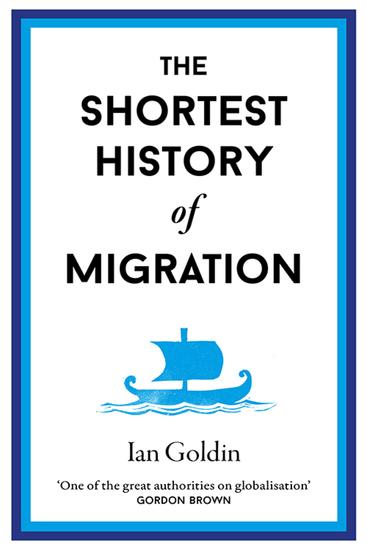
The Shortest History of Migration - cover

The Shortest History of Migration

Ian Goldin

Publisher: Old Street Publishing

  • 0
  • 0
  • 0

Summary

*Released early for the UK election.*

From our earliest wanderings to the rise of the digital nomad, here is the story of human migration.

For hundreds of thousands of years, the ability of Homo sapiens to travel across vast distances and adapt to new environments has been key to our survival as a species. Yet this deep migratory impulse is being tested as never before. By building ever stronger walls and raising barriers to progress, governments are harming the lives of migrants and threatening the future well-being of our societies.

In The Shortest History of Migration, a visionary thinker tells a story of the movement of peoples that spans every age and continent and goes to the heart of what makes us human. Drawn from ancient records and the latest genetic research, it recounts strange, terrible and uplifting tales of migrants past and present, examining the legacies of empire, slavery and war.

Finally, Goldin turns his attention to today's world, bringing together the evidence of history with the most recent data to suggest how we might create a more humane future -- one that allows us to reap the tremendous benefits that migration can offer.
Available since: 06/20/2024.
Print length: 272 pages.
Other books that might interest you

  • Account of Egypt An - cover

    Account of Egypt An

    Herodotus

    • 0
    • 0
    • 0
    Explore Ancient Egypt with Herodotus' An Account of Egypt 
    Dive into the wonders of ancient Egypt through the eyes of Herodotus, the Father of History. An Account of Egypt is not just a historical record; it's a vivid journey into a civilization that has intrigued scholars and dreamers alike. Herodotus offers more than facts; he presents a world rich with myths, culture, and astonishing stories that bring the ancient Nile valley to life. 
    This masterpiece combines meticulous research with captivating storytelling, making the splendor of Egypt accessible and engaging. From the awe-inspiring Pyramids to the life-giving Nile, Herodotus's narrative is both an educational tool and a spellbinding tale, designed to satisfy the curious mind and the hungry soul. 
    An Account of Egypt is your portal to an era where gods and pharaohs walked the earth. Whether you're a history enthusiast or a lover of enchanting stories, this book promises an unforgettable adventure into the heart of ancient wisdom and mystique. 
    Don't miss the opportunity to uncover the secrets of one of history's most fascinating civilizations. Delve into An Account of Egypt by Herodotus, and let the journey begin! 
    This audiobook was narrated and produced by RAM Studios, where humans and artificial intelligence collaborate to create an excellent listening experience. (The reading is done primarily by AI)
    Show book
  • Coming to Terms With One’s Shadow - Bodhi Leaves No 77 - cover

    Coming to Terms With One’s...

    Ruth Walshe

    • 0
    • 0
    • 0
    "Though, to some extent, the psychological and the Buddhist way of looking at the shadow is similar, the Buddhist way of seeing, rather than investigating, is far deeper and more penetrating. For if you wash your dirty linen yourself instead of sending it to the laundry, you yourself discover the stains. But unlike with the washing, there is no need to scrub them, it is just the act of seeing which cleanses them. 
     
    In order to explain the shadow, we must first turn the spotlight onto the discrimination of good and bad which starts off our suffering, followed by craving— the second Noble Truth—which in its turn is brought about by our erroneous I-am-I consciousness. I want!—I don’t want! I want the good!—I don’t want the bad! This is outward-bound but exactly the same applies to our emotions too."
    Show book
  • Humbleness - The Quiet Strength: Embracing a Modest and Unpretentious Attitude - cover

    Humbleness - The Quiet Strength:...

    Esther Jameson

    • 0
    • 0
    • 0
    Humbleness is often misunderstood as weakness or submissiveness, yet it is one of the greatest strengths a person can possess. True humbleness is not about diminishing oneself or pretending to be less than what one is. Instead, it is about recognizing one’s worth without the need for validation or superiority over others. It allows a person to remain grounded, open to learning, and free from the constant pressure to prove themselves. 
    Unlike false modesty, which seeks attention through downplaying achievements, genuine humbleness comes from self-awareness. A humble person does not feel the need to boast or seek recognition. They understand that their value does not depend on external praise. This mindset fosters quiet confidence, enabling individuals to navigate life with grace, even in challenging situations. 
    Humbleness is a trait admired across cultures and philosophies. Many religious and philosophical teachings emphasize its importance, highlighting how humility leads to wisdom and deeper connections with others. It allows people to embrace mistakes, learn from experiences, and grow without being hindered by pride. When one acknowledges their limitations, they become more receptive to new ideas and perspectives. This ability to listen and learn creates a path toward continuous self-improvement.
    Show book
  • It is Only a Very Silent Mind That Can Actually See - Amsterdam 1967 - Public Talk 5 - cover

    It is Only a Very Silent Mind...

    Jiddu Krishnamurti

    • 0
    • 0
    • 0
    It is only a very silent mind that can actually see - 30 May 1967 
    - Conflict exists only when there are two opposing things: fear and non-fear,violence and non-violence. 
    - A mind that is in a state of inquiry is entirely different from a mind that is seeking. Seeking implies effort, conformity, authority and therefore conflict.  
    - Without space in which there is no boundary, the mind is incapable of comingupon immeasurable reality. 
    - It is only a silent mind that can perceive, actually see, not a chattering mind, acontrolled mind, a mind that is tortured, suppressed, yielding or indulging. 
    - When one has totally denied the psychological world which man has created,and the psychological structure of society of which we are, then there is spaceand silence. 
    - Q: Could you de ne contemplation and meditation? 
    - Q: It is not possible ever to observe totally one's own irrational thoughts. 
    - Q: What does it mean to stand alone?
    Show book
  • The Value Gap - Female-Driven Films from Pitch to Premiere - cover

    The Value Gap - Female-Driven...

    Courtney Brannon Donoghue

    • 0
    • 0
    • 0
    Conversations about gender equity in the workplace accelerated in the 2010s, with debates inside Hollywood specifically pointing to broader systemic problems of employment disparities and exploitative labor practices. Compounded by the devastating #MeToo revelations, these problems led to a wide-scale call for change. The Value Gap traces female-driven filmmaking across development, financing, production, film festivals, marketing, and distribution, examining the realities facing women working in the industry during this transformative moment. Drawing from five years of extensive interviews with female producers, writers, and directors at different stages of their careers, Courtney Brannon Donoghue examines how Hollywood business cultures "value" female-driven projects as risky or not bankable. Industry claims that "movies targeting female audiences don't make money" or "women can't direct big-budget blockbusters" have long circulated to rationalize systemic gender inequities and have served to normalize studios prioritizing the white male–driven status quo. Through a critical media industry studies lens, The Value Gap challenges this pervasive logic with firsthand accounts of women actively navigating the male-dominated and conglomerate-owned industrial landscape.
    Show book
  • Arawak Empire - The Seafarers and Early Inhabitants of the Caribbean - cover

    Arawak Empire - The Seafarers...

    Rolf Hedger

    • 0
    • 0
    • 0
    The Arawak people trace their origins to the vast and resource-rich region of the Orinoco River basin in present-day Venezuela. As part of the larger Arawakan language family, they were one of the many groups that gradually expanded across South America and into the Caribbean. Their migration was driven by a combination of environmental factors, population growth, and the search for fertile land and abundant resources. Over generations, they navigated rivers, coastlines, and open waters, eventually settling in the islands of the Greater and Lesser Antilles, where they established thriving communities. 
    Archaeological evidence suggests that the Arawak migration into the Caribbean began around 2000 BCE, with the earliest settlements appearing in the Guianas and Trinidad before spreading to islands such as Hispaniola, Cuba, and Puerto Rico. The seafaring skills of the Arawak were instrumental in their expansion, allowing them to cross large distances using well-crafted dugout canoes. These vessels, some of which could carry dozens of people, enabled them to transport goods, establish trade networks, and maintain cultural connections between islands. 
    The Arawak developed a rich cultural identity deeply connected to their environment. They were skilled agriculturalists, cultivating staple crops such as cassava, maize, sweet potatoes, and fruits like guava and pineapple. Their farming methods, including slash-and-burn techniques and mound cultivation, allowed them to sustain large populations and support the growth of permanent villages. In addition to agriculture, they engaged in fishing and hunting, making use of the diverse ecosystems found throughout the Caribbean.
    Show book