Join us on a literary world trip!
Add this book to bookshelf
Grey
Write a new comment Default profile 50px
Grey
Subscribe to read the full book or read the first pages for free!
All characters reduced
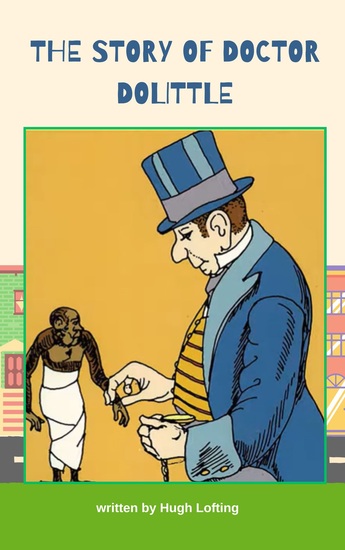
The Story of Doctor Dolittle - The Classic Tale of Talking Animals and Timeless Adventure - cover

The Story of Doctor Dolittle - The Classic Tale of Talking Animals and Timeless Adventure

Hugh Lofting, Zenith Crescent Moon Press

Publisher: Zenith Crescent Moon Press

  • 0
  • 0
  • 0

Summary

🌟 Embark on a Journey into a World of Wonder. Dive into the enchanting story of Doctor Dolittle, the beloved physician with an extraordinary ability to talk to animals. This timeless classic by Hugh Lofting will capture the hearts of readers of all ages.

🐘 Meet the Unforgettable Characters. From the wise Polynesia the parrot to the loyal Jip the dog, join Doctor Dolittle and his animal friends on a series of whimsical adventures. Each character brings their unique charm to this delightful narrative.

🌍 Explore Exotic Lands. Travel alongside Doctor Dolittle as he embarks on daring expeditions to far-off lands. Discover new cultures, breathtaking landscapes, and the magic of understanding the animal kingdom.

📚 A Legacy of Imagination. "The Story of Doctor Dolittle" has inspired generations of readers with its imaginative storytelling and heartwarming themes. Celebrate the enduring legacy of this cherished tale.

📖 What Readers Are Saying.

"A delightful and enchanting read for all ages! Doctor Dolittle's adventures are pure magic." – Family Reading Corner

"A timeless classic that ignites the imagination and warms the heart. A must-have for every child's bookshelf." – Children's Literature Review

👉 Join the Adventure. Ready for a journey filled with talking animals and boundless imagination? Download "Adventures with Doctor Dolittle" now and embark on an unforgettable adventure!
Available since: 03/10/2025.
Print length: 98 pages.
Other books that might interest you

  • A Realistic Blacktopia - Why We Must Unite To Fight - cover

    A Realistic Blacktopia - Why We...

    Derrick Darby

    • 0
    • 0
    • 0
    The United States is dogged by racism and racial disparities in income, wealth, health, education, and criminal justice. Philosophers disagree on what kind of politics is needed to address this problem. Do we pursue race-specific remedies to undo racism or do we assume the permanence of racism and opt for non-race-specific remedies in pursuit of a more egalitarian society? Paradoxically, the way to make racial progress in racist America is to downplay race. 


    In A Realistic Blacktopia, political philosopher Derrick Darby challenges the "small tent" approach by examining U.S. Supreme Court cases on education and voting rights arguing that they hold general lessons about the limits of racial politics. Securing racial justice in racist America calls for "big tent" remedies, and Darby argues that pursuing non-race-specific remedies with maximal democratic inclusion is a necessary strategy for mitigating racial inequality and achieving racial justice. 


    A Realistic Blacktopia offers clarity on how racism persists, contrary to claims that America is a post-racial society. Explaining why the myth of post-racialism cannot be ignored in crafting remedies for racial inequality, Darby supplies a principled pragmatic proposal for achieving racial justice. Darby also explains why achieving racial justice requires inclusive democracy.
    Show book
  • Sundaland and Doggerland: The History and Mysteries of the Sunken Landmasses in Asia and Europe - cover

    Sundaland and Doggerland: The...

    Editors Charles River

    • 0
    • 0
    • 0
    By the time the Pleistocene Epoch ended around 12,000 years ago, Homo sapiens had become one of the most significant species on the planet. 	It was also near the end of that period of time that modern humans began to gradually populate what would become Europe, Asia, and the Americas, eventually becoming the inheritors of the Paleolithic era and the only human species to make it into the Neolithic era. 	The cold Pleistocene temperatures lowered water levels across the planet, exposing land that was not there before or after the period. At the same time, significant regions of the planet were very different during the Pleistocene, including Southeast Asia, particularly the modern islands of Bali, Borneo, Sumatra, and the Malay Peninsula, roughly equivalent to parts of Indonesia, Malaysia, and Thailand. This region, which modern scholars refer to as Sunda or Sundaland, was unique because all of it was connected by land, meaning today’s islands were once part of a contiguous subcontinent, and in terms of the people, flora, and fauna, it was very different than it is today.  
    Among the most significant water displacement phenomena in the Western world was Doggerland on the northern European continent. The notable inundation occurred in both a steady and eruptive fashion covering a vast stretch of former tundra, a land bridge between today’s British Isles and the European continent. The event brought about the modern English Channel and an expanded North Sea, and unlike the early supercontinents, the inundation of Doggerland took place after the appearance of people. Incrementally submerged since roughly 18,000 years ago as the climate warmed, the patch of sea between Britain and Europe is the subject of much recent scientific scrutiny. 
    Show book
  • The Lady - cover

    The Lady

    Gary M. Douglas

    • 0
    • 0
    • 0
    Are You a Lady or a Woman?The Lady is about a kind, elegant, playful—and very powerful—way of being in the world that extends to all aspects of life, from business, money and parenting to flirtation, seduction and sex.A lady is a source of power that creates possibility.  She chooses to be everything that she is without being defined by what others think she should be.  She knows what she desires and how to get it.  She leads without controlling—she never has to compete with anyone.This book is about fully receiving and enjoying the beauty, power, fun and excitement of who you are.  It describes a way of being that welcomes men and women to be kind, understanding, and knowledgeable about the world and how to navigate it."A lady is always an inspiration to others, just by knowing who he or she is.”
    Show book
  • Wicked Bozeman - cover

    Wicked Bozeman

    Kelly Suzanne Hartman

    • 0
    • 0
    • 0
    Wicked Bozeman delves into a dangerous and dark pastThe Gallatin History Museum, housed in the old Gallatin County Jail, holds many secrets. From the house of ill repute on Mendenhall Street to the earliest jail break in 1873, the historic crimes are replete with con artists, forgers, robbers and the insane each leaving a trail of deceit and mystery. There is laughter, shock and the hard reality of a life lost to time behind bars. Using the original jail ledgers as a jumping off point, Museum Curator Kelly Suzanne Hartman takes the reader along on an investigative journey through Bozeman's seedier past.
    Show book
  • Hekate - Goddess of Witches - cover

    Hekate - Goddess of Witches

    Courtney Weber

    • 0
    • 6
    • 0
    Learn the myths and legends behind this beloved goddess plus practices and suggestions for making Hekate part of your spiritual path. Courtney Weber (author of Brigid and The Morrigan) offers an informed, accessible journey through the lore and history of Hekate, the ancient goddess of crossroads, ghosts, and witchcraft, and reflects on Hekate’s relevance today. Tools and techniques for incorporating this goddess into your personal journey round out the book.  Similar to her other works, Weber strikes a balance between the scholarly and the spiritual. Her exploration of Hekate combines solid research with practical, modern applications. The spiritual content is accessible to anyone with an interest in witchcraft, regardless of their faith or background.   Each chapter focuses on a different aspect of Hekate, exploring original mythology, historical context, and contemporary connotations, concluding with spells and personal rituals. The final chapter is a grimoire full of rituals, offerings, and other practices designed to help readers align themselves with this extraordinary goddess. The book also explores magickal ethics, what it means to be a witch in the twenty-first century, and best practices for successful witchcraft.
    Show book
  • The Temples of Egypt - Sacred Spaces and Religious Practices - cover

    The Temples of Egypt - Sacred...

    Omar Khalil

    • 0
    • 0
    • 0
    Temples in ancient Egypt were far more than mere places of worship. They stood at the very heart of Egyptian civilization, functioning as both spiritual centers and instruments of political and social order. Each temple was seen as a dwelling place for a god or goddess, and the rituals performed within their walls were believed to maintain the cosmic balance known as ma’at. The presence of a temple in a city or region signaled divine favor and legitimacy, reinforcing the bond between the gods and the ruling pharaoh. 
    Pharaohs were considered divine intermediaries between the gods and the people, and their authority was deeply rooted in religious belief. Temples were a direct reflection of this divine connection. Often constructed by pharaohs to honor specific deities, temples helped assert royal power and ensure harmony across the land. Through grand architecture and lavish offerings, rulers demonstrated their piety and reaffirmed their right to govern. This link between kingship and temple worship made temples central to the ideological framework of the state. 
    Beyond their religious significance, temples also played a pivotal role in the social life of ancient Egyptians. They were the sites of numerous festivals and ceremonial events that brought entire communities together. These occasions were marked by processions, music, dancing, and the display of sacred statues, all of which reinforced communal identity and devotion. The most prominent of these was the Opet Festival in Thebes, during which statues of Amun, Mut, and Khonsu were transported from Karnak to Luxor Temple in a public procession along the Nile. Such festivals reminded people of the gods’ presence and the pharaoh’s divine role in upholding order.
    Show book