Join us on a literary world trip!
Add this book to bookshelf
Grey
Write a new comment Default profile 50px
Grey
Subscribe to read the full book or read the first pages for free!
All characters reduced
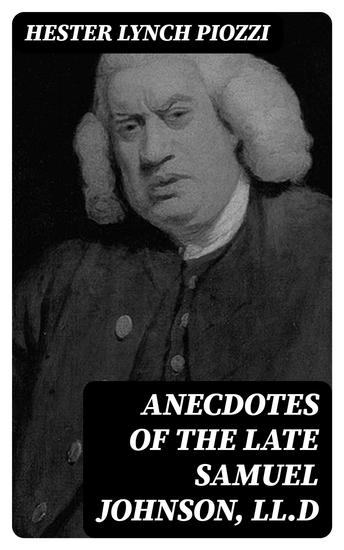
Anecdotes of the late Samuel Johnson LLD - During the Last Twenty Years of His Life - cover

Anecdotes of the late Samuel Johnson LLD - During the Last Twenty Years of His Life

Hester Lynch Piozzi

Publisher: DigiCat

  • 0
  • 0
  • 0

Summary

In "Anecdotes of the late Samuel Johnson, LL.D," Hester Lynch Piozzi offers a unique and intimate portrait of one of the most significant literary figures of the 18th century. This collection of anecdotes, written in a conversational and personal style, transcends mere biography, immersing readers in the complexities of Johnson's character, wit, and intellect. Piozzi's work is situated within the broader context of Johnson's literary achievements and the sociocultural milieu of the Enlightenment, providing valuable insights into his relationships with contemporaries and the profound impact he had on English literature. Hester Lynch Piozzi, an accomplished writer and devoted friend of Samuel Johnson, draws upon her extensive personal experiences and observations to craft this memoir. Her unique position as both a participant in and witness to Johnson's literary circle enriches her narratives, allowing for an authentic exploration of his idiosyncrasies and profound insights. Piozzi's own literary contributions and her role as a woman in a predominantly male literary world further inform her candid and nuanced portrayal of Johnson, reflecting both admiration and critical engagement. I highly recommend "Anecdotes of the late Samuel Johnson, LL.D" to anyone interested in literary history, biography, or the complexities of friendship. Piozzi's engaging prose serves not only as a tribute to Johnson but also as a testament to the importance of personal narrative in understanding historical figures. This work is essential for readers seeking a deeper appreciation of Johnson's life and his enduring legacy.
Available since: 09/04/2022.
Print length: 124 pages.


Other books that might interest you

  • The Cinematic Connery - The Films of Sir Sean Connery - cover

    The Cinematic Connery - The...

    A. J. Black

    • 0
    • 0
    • 0
    Scotland’s greatest export. The world’s first super spy. Voted the sexiest man on the planet. Sir Sean Connery was a titanic figure on screen and off for over half a century.  Behind the son of a factory worker, growing up in near-poverty on the harsh streets of pre-war Edinburgh, lay a timeless array of motion pictures that spanned multiple decades and saw Connery work across the globe with directors as diverse as Alfred Hitchcock, Steven Spielberg and Michael Bay. And amongst them his greatest role, whether he liked it or not – Bond, James Bond.  Author A. J. Black delves into Connery’s life for more than mere biography, exploring not just the enormously varied pictures he made including crowd pleasing blockbusters such as The Untouchables or Indiana Jones and the Last Crusade, serious-minded fare in The Hill or The Offence, and his strange sojourns into eclectic fantasy with Zardoz or Time Bandits, but also the sweep of a career that crossed movie eras as well as decades.  From skirmishes with the angry young men of the British New Wave, via becoming the cinematic icon of the 1960s as 007, through to a challenging reinvention as a unique older actor of stature in the 1980s, this exploration of the Cinematic Connery shows just how much his work reflected the changing movie-going tastes, political realities and cultural trends of the 20th century, and beyond . . .
    Show book
  • Dance or Die - From Stateless Refugee to International Ballet Star A MEMOIR - cover

    Dance or Die - From Stateless...

    Ahmad Joudeh

    • 0
    • 0
    • 0
    A Syria-born dancer offers his deeply personal story of war, statelessness, and the pursuit of the art of dance in this inspirational memoir. 


    Dance or Die is an autobiographical coming-of-age account of Ahmad Joudeh, a young refugee who grows up in Damascus with dreams of becoming a dancer. When he is recruited by one of Syria's top dance companies, neither bombs nor family opposition can keep him from taking classes, practicing hard, and becoming a Middle Eastern celebrity on a Lebanese reality show. Despite death threats if Ahmad continues to dance, his father kicking him out of the house, and the war around him intensifying, he persists and even gets a tattoo on his neck right where the executioner's blade would fall that says, "Dance or Die." 


    A powerful look at refugee life in Syria, Dance or Die tells of the pursuit of personal expression in the most dangerous of circumstances and of the power of art to transcend war and suffering. It follows Ahmad from Damascus to Beirut to Amsterdam, where he finds a home with one of Europe's top ballet troupes, and from where he continues to fight for the human rights of refugees everywhere through his art, his activism, and his commitment to justice.
    Show book
  • The Guv'nor In His Own Words - Conversations with the Bare Knuckle Fighting Legend - cover

    The Guv'nor In His Own Words -...

    Peter Gerrard

    • 0
    • 0
    • 0
    Born in East London in 1949, Lenny McLean grew up in an area that had been ravaged by the Second World War. Although money was scarce and fighting was commonplace, a camaraderie and deep sense of honour and respect remained. A victim of violent abuse at the hands of his stepfather, Lenny spent much of his teenage life in borstal as he began to follow a life of crime. However, it was his ability as a fighter that was to turn his life around.Lenny McLean inspired fear in many, but respect from all, as he became a bare-knuckle fighting legend. His fame became even greater in later life, appearing in Guy Ritchie's Lock, Stock and Two Smoking Barrels just as his autobiography was reaching the top of the bestsellers chart. Lenny's untimely death from cancer in 1998 marked the beginning of the end of the old Cockney way of life and interest in his story has only increased since his passing, inspiring documentaries as well as a feature film, My Name is Lenny.In these unedited conversations between Lenny and his 'book man' Peter Gerrard, featuring many anecdotes that did not appear in The Guv'nor, we get to see the man behind the public image. As he looks back on his life, these transcripts reveal Lenny's humour and charm as well as the volatility that made him one of the most notorious figures ever to emerge from the East End.Although the original interview tapes have been lost, this immersive audiobook has replicated Lenny and Peter's conversations as they really happened.
    Show book
  • A Grotesque Animal - cover

    A Grotesque Animal

    Amy Lee Lillard

    • 0
    • 0
    • 0
    At the age of forty-three, Amy Lee Lillard learned she was autistic. She learned she was part of a community of unseen women who fell through the gaps due to medical bias and social stereotypes. 


    A Grotesque Animal explores the making, unmaking, and making again of a woman with an undiagnosed disorder. How did a working-­class background and a deep-rooted Midwest culture of silence lead to hiding in plain sight for decades? How did sexuality and anger hide the roots of trauma among the women in her family? And what does it mean to be a queer, disabled, aging woman, a descendant of wild but tamed mothers and a survivor of the things patriarchy inflicts? 


    Through wide-ranging styles and a combination of personal storytelling and cultural analysis, Lillard dissects anger, sexuality, autistic masking, bodies, punk, and female annihilation to create a new picture of modern women.
    Show book
  • The Case of the Married Woman - Caroline Norton and Her Fight for Justice for Women - cover

    The Case of the Married Woman -...

    Antonia Fraser

    • 0
    • 0
    • 0
    Caroline Norton dazzled nineteenth-century society with her vivacity, her intelligence, her poetry, and in her role as an artist's muse. After her marriage in 1828 to the MP George Norton, she continued to attract friends and admirers to her salon in Westminster. Most prominent among her admirers was the widowed Prime Minister, Lord Melbourne. 


    Racked with jealousy, George Norton took the Prime Minister to court, suing him for damages on account of his adultery with Caroline. A dramatic trial followed. Despite the unexpected and sensational result—acquittal—Norton was still able to legally deny Caroline access to her children. He also claimed her income as an author for himself, since the copyrights of a married woman belonged to her husband. 


    Yet Caroline refused to despair. Beset by the personal cruelties perpetrated by her husband and a society whose rules were set against her, she chose to fight. She channeled her energies in an area of much-needed reform: the rights of a married woman and specifically those of a mother. She campaigned tirelessly, achieving her first landmark victory with the Infant Custody Act of 1839. Provisions which are now taken for granted owe much to Caroline, who was determined to secure justice for women at all levels of society from the privileged to the dispossessed.
    Show book
  • Tamerlane: The Life and Legacy of the Legendary Mongol Conqueror - cover

    Tamerlane: The Life and Legacy...

    Editors Charles River

    • 0
    • 0
    • 0
    Though history is usually written by the victors, the lack of a particularly strong writing tradition from the Mongols ensured that history was largely written by those who they vanquished. Because of this, their portrayal in the West and the Middle East has been extraordinarily (and in many ways unfairly) negative for centuries, at least until recent revisions to the historical record. The Mongols have long been depicted as wild horse-archers galloping out of the dawn to rape, pillage, murder and enslave, but the Mongol army was a highly sophisticated, minutely organized and incredibly adaptive and innovative institution, as witnessed by the fact that it was successful in conquering enemies who employed completely different weaponry and different styles of fighting, from Chinese armored infantry to Middle Eastern camel cavalry and Western knights and men-at-arms. Likewise, the infrastructure and administrative corps which governed the empire, though largely borrowed from the Chinese, was inventive, practical, and extraordinarily modern and efficient. This was no fly-by-night enterprise but a sophisticated, complex, and extremely well-oiled machine.  
    	Aside from Genghis and his grandson Kublai Khan, the most famous Mongol conqueror was Tamerlane, who dominated Eurasia in the 14th century. He was known by the name Timur in Asia, while the Europeans used the name Tamerlane, which came from the Persian Timur-i-Leng, meaning “Timur the Lame.” This was intended to be an insult referring to crippling injuries he received to his right leg and arm as a young man, probably from arrows, but clearly his injuries did not prevent him from spending much of his lifetime in the saddle. Tamerlane came from a Turkicized Mongol tribe, the Barlas, which had several constituent sub-clans. A number of original Mongol tribes had migrated west, where the majority of the population was Turkish, and over time, the Mongols blended with the Turks.
    Show book