Join us on a literary world trip!
Add this book to bookshelf
Grey
Write a new comment Default profile 50px
Grey
Subscribe to read the full book or read the first pages for free!
All characters reduced
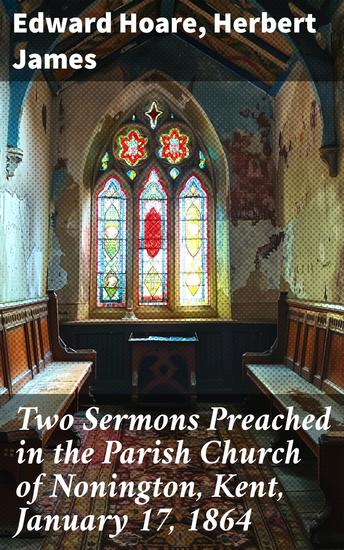
Two Sermons Preached in the Parish Church of Nonington Kent January 17 1864 - Being the Sunday following the Funeral of John Pemberton Plumptre Esq - cover

Two Sermons Preached in the Parish Church of Nonington Kent January 17 1864 - Being the Sunday following the Funeral of John Pemberton Plumptre Esq

Herbert James, Edward Hoare

Publisher: Good Press

  • 0
  • 0
  • 0

Summary

Two Sermons Preached in the Parish Church of Nonington, Kent, January 17, 1864, is a remarkable anthology that captures the spirit and fervor of mid-19th century religious discourse. The collection features a pair of sermons reflecting a tapestry of theological reflection and moral philosophy. These sermons combined examine pressing spiritual questions and societal issues of their time, offering a profound exploration into the minds navigating faith during a period marked by swift change and a burgeoning awareness of modernity. The duality of different sermonic approaches paints a vivid picture of Victorian religious contemplation, leaving an indelible impression on the reader as it oscillates between solemnity, encouragement, and guidance. The noteworthy sermons included in this anthology are penned by two influential figures of the era, Edward Hoare and Herbert James, whose combined insights paint a dynamic portrait of ecclesiastical thought. Both authors bring to the fore their distinctive literary styles, yet converge in their shared commitment to the moral and spiritual upliftment of their community. This convergence echoes the greater movement of Anglican reform occurring during this period, highlighting broader socio-religious changes within Victorian England, and conveying diverse interpretations of evangelical and clerical duties. Readers are invited to explore this anthology as a profound educational engagement, uncovering the myriad ways religious ideas were articulated and contested during a transformative era. This collection offers a rare opportunity to traverse the intellectual landscapes of two compelling voices, whose sermons encourage reflection and dialogue. The volume'Äôs substantial offerings illuminate faith'Äôs nuanced role within broader societal currents, making it not only an invaluable historical document but a timeless exploration of the human condition.
Available since: 10/28/2023.
Print length: 22 pages.


Other books that might interest you

  • Ghostwriter - cover

    Ghostwriter

    Meredith Carson

    • 0
    • 0
    • 0
    The circumstances surrounding the bizarre photograph initially inspiring Meredith Carson to ghostwrite Jack Wagoner’s horrifying account are now included in this audiobook and remain unexplained. When Meredith Carson accepted the task of ghostwriting the frightening narrative you are about to hear, she had no idea how that decision would affect her. Miss Carson shared with other members of the World Codex Staff that, at times, while transcribing Jack Wagoner’s spellbinding story, she felt like Agent Starling from THE SILENCE OF THE LAMBS. Meredith Carson’s unnerving experience documenting Wagoner’s struggle for survival in the Klamath Mountains and the subsequent events is astonishing.
    Show book
  • A Thousand Deaths - From their pens to your ears genius in every story - cover

    A Thousand Deaths - From their...

    Jack London

    • 0
    • 0
    • 0
    John Griffith Chaney was born on January 12th, 1876 in San Francisco.   
    His father, William Chaney, was living with Flora Wellman when she became pregnant.  Chaney insisted she have an abortion.  Flora's response was to turn a gun on herself.  Although her wounds were not severe the trauma made her temporarily deranged. 
    In late 1876 his mother married John London and the young child was brought to live with them as they moved around the Bay area, eventually settling in Oakland where now, calling himself Jack, he completed grade school. 
    Jack worked hard at several jobs, sometimes 12-18 hours a day, but his dream was university.  He studied hard and borrowed the money to enrol in the summer of 1896 at the University of California in Berkeley. 
    In 1897, at 21, Jack searched out newspaper accounts of his mother's suicide attempt and for the name of his biological father. He wrote to Chaney, then living in Chicago, who claimed he could not be Jack’s father because he was impotent and casually asserted that London's mother had relations with other men.  Jack, devastated by the response, quit Berkeley and went to the Klondike. Other accounts suggest that his dire finances presented Jack with the excuse he needed to leave. 
    In the Klondike Jack began to gather material for his writing but also accumulated many health problems, including scurvy, which together with hip and leg problems he would carry for the rest of his life. 
    During the late 1890's Jack was regularly publishing short stories and by the turn of the century full blown novels. 
    By 1904 Jack had married, fathered two children and was now in the process of divorcing.  A stint as a reporter on the Russo-Japanese war of 1904 was equal amounts trouble and experience. But that experience was always put to good use in a continuing and remarkable output of work. 
    In 1905 he married Charmian Kittredge who at last was a soul and companion who brought him some semblance of peace despite his advancing alcoholism and his incurable wanderlust. 
    Twelve years later Jack had amassed both wealth and a literary reputation through such classics as ‘The Call of the Wild’, ‘White Fang’ and many others. He had a reputation as a social activist and was a tireless friend of the workers.   
    Jack London died suffering from dysentery, late-stage alcoholism and uremia, aged only 40, on November 22nd 1916 at his property in Glen Elen in California.
    Show book
  • King John Henry III and England’s Lost Civil War - cover

    King John Henry III and...

    John Paul Davis

    • 0
    • 0
    • 0
    This sweeping history of thirteenth century England examines how the successive reigns of two very different kings established the English way of life. 


    In 1204, the great Angevin Empire was fragmenting under King John's rule. Unable to withstand France's invasion of Normandy, John also faced difficult relations with the papacy, and rising dissent among his barons. By the time John died in 1216, the failed Magna Carta gave way to civil conflict, and more than half of the country had fallen to the dauphin of France. These troubles were then passed, along with the crown, to John's nine-year-old son, Henry III. 


    Even with a regency government commanding the ship of state, Henry faced a dire threat to his royal authority. But the First Baron's War came to an end as Henry aligned himself with the pope and offered a revised Magna Carta. While this may have ensured short-term survival, living up to the promises of this foundational contract would create a more significant challenge—and lay the groundwork for the Second Baron's War.
    Show book
  • Ninth Building - cover

    Ninth Building

    Jingzhi Zou

    • 0
    • 0
    • 0
    Ninth Building is a fascinating collection of vignettes drawn from Zou Jingzhi's experience growing up during the Cultural Revolution, first as a boy in Beijing and then as a teenager exiled to the countryside. Zou poetically captures a side of the Cultural Revolution that is less talked about—the sheer tedium and waste of young life, as well as the gallows humor that accompanies such desperate situations. Jeremy Tiang's enthralling translation of this important work of fiction was awarded a PEN/Heim Grant.
    Show book
  • The Power of Possibility - A journey of inspiration and courage - cover

    The Power of Possibility - A...

    Alexandra André

    • 0
    • 0
    • 0
    An ordinary hero doing something extraordinary for her mates.  
    Far from an elite athlete, Alexandra André bounced from one running injury to the next for the best part of five years before deciding to take part in the toughest one- day sporting event in the world. Without an ounce of confidence she could achieve it, Alexandra signed up to do the 2015 IRONMAN Melbourne – 3.8 km swim, 180 km ride, 42.195 km run. 
    Training for the event became more of a journey than she could have imagined. One of great purpose, filled with synchronicities and opportunities. 
    THE POWER OF POSSIBILITY is a compelling sports story and much more. Alexandra’s very real and honest account of the highs and lows of reaching her goal make it remarkable. Her story is engaging and relatable, leaving us not only inspired, but with hope in our hearts, full of wonder for the world of possibility that awaits when we find the courage to test our limits.
    Show book
  • Every Weapon I Had - A Vietnam Vet's Long Road to the Medal of Honor - cover

    Every Weapon I Had - A Vietnam...

    Paris Davis

    • 0
    • 0
    • 0
    The story of a Green Beret commander's heroism during the Vietnam War, and the long fight to recognize his bravery.When Col. Paris Davis was selected to lead one of the Green Beret A-teams organizing resistance to Communist incursions into South Vietnam, his commanding officer warned him that some of his soldiers would resent his authority. This was no surprise; there were only a handful of Black officers in the Special Forces. Davis quickly won the respect of his soldiers, and would soon fight beside him as bullets snapped past and mortars exploded overhead.On June 18th, Davis led a group of inexperienced locals and Special Forces soldiers in an attack on a Viet Cong base in Bong Son. They were met by a superior enemy force, and Davis led the charge in a grueling firefight. He was seriously wounded, but he disobeyed a direct order to retreat until he dragged three injured Green Berets off the battlefield to safety.Every Weapon I Had is an inspiring tale of valor and sacrifice, set against the backdrop of major escalations in both the Vietnam War and the Civil Rights movement. It is also a story of deferred honor and delayed recognition; Davis earned the Silver Star and Purple Heart for his actions, but his nomination for the Congressional Medal of Honor was repeatedly “lost.” No official reason has ever been given for this oversight, but those who fought to correct it believe that it was motivated by racial prejudice. Davis was finally awarded the Medal in 2023, 58 years after the battle.A Macmillan Audio production from St. Martin’s Press.
    Show book