Join us on a literary world trip!
Add this book to bookshelf
Grey
Write a new comment Default profile 50px
Grey
Subscribe to read the full book or read the first pages for free!
All characters reduced
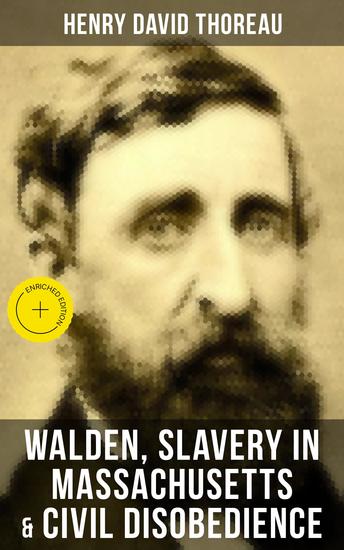
Walden Slavery in Massachusetts & Civil Disobedience - Enriched edition - cover

Walden Slavery in Massachusetts & Civil Disobedience - Enriched edition

Henry David Thoreau

Publisher: Musaicum Books

  • 0
  • 0
  • 0

Summary

In Henry David Thoreau's 'Walden, Slavery in Massachusetts & Civil Disobedience', Thoreau explores themes of simple living, self-sufficiency, and environmental consciousness. Through detailed descriptions of his experiences living in a cabin by Walden Pond, Thoreau reflects on the importance of mindfulness and contemplation in a fast-paced society. Written in a reflective and contemplative style, the book delves into the complexities of human nature and society, offering timeless insights on the pursuit of a meaningful life. The inclusion of essays on slavery in Massachusetts and civil disobedience further showcases Thoreau's deep moral convictions and commitment to social justice. Thoreau's use of vivid imagery and introspective prose adds depth to his philosophical musings, making this book a classic example of transcendentalist literature. Henry David Thoreau, a renowned American philosopher and naturalist, drew inspiration from his close observation of nature and his studies of Eastern philosophy. His experiences living in solitude at Walden Pond greatly influenced his beliefs on the importance of simplicity and individuality. Thoreau's activism and writings on civil disobedience also solidified his reputation as a social reformer and a champion of personal liberty. I highly recommend 'Walden, Slavery in Massachusetts & Civil Disobedience' to readers interested in transcendentalist philosophy, environmental ethics, and social justice. Thoreau's profound reflections on the human experience offer valuable lessons that are still relevant today, making this book a must-read for anyone seeking a deeper understanding of themselves and the world around them.

In this enriched edition, we have carefully created added value for your reading experience:
- A comprehensive Introduction outlines these selected works' unifying features, themes, or stylistic evolutions.
- The Author Biography highlights personal milestones and literary influences that shape the entire body of writing.
- A Historical Context section situates the works in their broader era—social currents, cultural trends, and key events that underpin their creation.
- A concise Synopsis (Selection) offers an accessible overview of the included texts, helping readers navigate plotlines and main ideas without revealing critical twists.
- A unified Analysis examines recurring motifs and stylistic hallmarks across the collection, tying the stories together while spotlighting the different work's strengths.
- Reflection questions inspire deeper contemplation of the author's overarching message, inviting readers to draw connections among different texts and relate them to modern contexts.
- Lastly, our hand‐picked Memorable Quotes distill pivotal lines and turning points, serving as touchstones for the collection's central themes.
Available since: 11/15/2017.
Print length: 688 pages.

Other books that might interest you

  • Persuasion Purr-sistence: How to Win Arguments with Cats - "Revamp your argument game! Enjoy powerful audio lessons to help you win every debate with your cats!" - cover

    Persuasion Purr-sistence: How to...

    Orson Grimsby

    • 0
    • 0
    • 0
    "Persuasion Purr-sistence: How to Win Arguments with Cats" 
    Are you eager to improve your communication skills and master the art of persuading your feline friends? 
    Searching for a thorough guide that encompasses everything you need to effectively communicate and win arguments with cats? 
    Your search ends here! 
    This audiobook is your ultimate partner in enhancing your understanding, honing your skills, and engaging with practical exercises focused on feline persuasion techniques. With this guide, you're all set for success. 
    Updated for the latest strategies in effective communication. 
    Key features of this enriched guide: 
    - In-depth insights into the secrets of effective communication with cats 
    - Comprehensive explanations of feline behavior and psychology 
    - Proven strategies to prepare for and handle persuasive interactions with your pets 
    Our guide stands out with its thorough coverage, essential for your success in engaging your cats. Concepts are not just touched upon; they are explored with great detail. 
    Please keep in mind that this guide is an independent resource and is not affiliated with any official pet training organization. 
    Crafted with a straightforward structure and easy-to-understand language, "Persuasion Purr-sistence" ensures smooth transitions between topics. Say farewell to complicated terminology and embrace clear, accurate content. 
    So, why wait? Click the BUY NOW button, grab your copy, and embark on your journey to mastering persuasive communication with your cats!
    Show book
  • Victimhood Memory and Consumerism - Profiting from Pablo - cover

    Victimhood Memory and...

    David Goyes, Katja Franko

    • 0
    • 0
    • 0
    Inhabitants of Medellín, Colombia, suffered from the war-like violence perpetrated by drug cartels and other actors in the 1980s and 1990s. Thousands died, including innocent civilians, judges, and journalists, many more were injured and suffered psychological trauma. Three decades later, however, transnational media companies such as Netflix have transformed the traumatic memories into entertainment while the main perpetrator, Pablo Escobar, became a 
    recognizable brand name. 


    Victimhood, Memory, and Consumerism: Profiting from Pablo documents the story of violence inflicted on Medellín, and critically examines the status of its victims. Drawing on unique empirical material, the book addresses the impact of commercial exploitation of the city's violent past on the victims of mass drug violence and on the present nature of the city. 


    Victimhood, Memory, and Consumerism offers a poignant critique of the role of the global market economy in the unequal distribution of narrative power among those engaged in processes of collective memory construction. A thoroughly compelling listen, this volume will appeal internationally to academics in criminology and victimology, as well as those interested in critical perspectives on Netflix, commercialism, and Colombian history.
    Show book
  • Great Escapes during the World Wars: The History of the Most Legendary Prisoner Breakouts in World War I and World War II - cover

    Great Escapes during the World...

    Editors Charles River

    • 0
    • 0
    • 0
    War has always led to prisoners. In ancient times, many were turned into slaves by the victorious armies, while in medieval Europe, they were often returned to their families in return for a ransom, leading to fortune or poverty depending upon which side one was on. By the Napoleonic era, as armies grew in size and professionalism, many were kept in camps for the duration of the fighting, their captors not wanting to restore their enemies' manpower while the fate of nations hung in the balance. 
    Prisoners were taken across the world, and prisoners of war were typically comprised of two classes: officers and other ranks. Officers were often treated well, as there was still a sort of aristocratic courtesy among officers, particularly among the Germans, British, French, and somewhat less so for the Russians, Italians, and Turks. Concepts such as honor still held considerable currency, and bravery was greatly admired. Enemy officers as a class often had more in common with each other than with the millions of draftees in their armies, so enlisted men as POWs generally were not as well treated. 
    	Regardless of rank though, throughout the war, many of these men did not sit idle. Many spent their time preparing elaborate escape plans in the hopes of returning to their home nations and back to the fight.  
    The Second World War was full of escape stories, some bold, some tragic, and most filled with courage and ingenuity. The greatest number of successful escapes was made by Allied troops in Europe, including soldiers left behind after the fall of France and airmen shot down in bombing raids, but escapes happened across the world, from Canadian trains to German castles, and from the mountains of Italy to the wilds of Australia. Axis as well as Allied troops made their bids for freedom, keeping both sides on their toes. Everybody was looking to make the next great escape.
    Show book
  • History for Kids: The Lives of the Founding Fathers - cover

    History for Kids: The Lives of...

    Editors Charles River

    • 0
    • 0
    • 0
    The Founding Fathers have held a special place in American society since the nation gained its freedom, and many of them had become national heroes even before then. Over 200 years later, Americans still look with reverence to these men, often debating with each other what the Founding Fathers would think about a certain issue, or how they would judge a certain law or legislation. In many respects, these men have become icons, whose words, thoughts and deeds are rarely questioned. 
    Every American is taught a pristine narrative of the life and legacy of George Washington and can easily recite the highlights and myths of Washington's life. Thomas Jefferson was instrumental in authoring the Declaration of Independence, laying out the ideological groundwork of the notion of states’ rights, leading one of the first political parties, and overseeing the expansion of the United States during his presidency. Before the United States of America even existed, the first American celebrity was Benjamin Franklin, who dabbled throughout his life in many fields as an author, printer, political theorist, politician, postmaster, scientist, musician, inventor, satirist, civic activist, statesman, and diplomat. Despite being one of the youngest delegates at the Constitutional Convention, James Madison was the Convention’s most influential thinker, and the man most responsible for the final draft of the U.S. Constitution, forever earning the name "Father of the Constitution). And if the American Dream has come to represent the ability to climb the social ladder with skill and hard work, no Founding Father represented the new America more than Alexander Hamilton, an orphan who rose to become one of the influential Founding Fathers at the Constitutional Convention, the driving force behind the Federalist Papers, and the leader of a political party before engaging in the country's most famous duel.
    Show book
  • All About Shapeshifting - cover

    All About Shapeshifting

    Martin K. Ettington

    • 0
    • 0
    • 0
    Shapeshifting has a history of occurring all over the world. From American Indians to Slavs in Europe, shapeshifters are part of our world history.In this book we explore what shapeshifting is, it’s history, types of shapeshifters, and regions around the world where it has been reported.We also review practices and exercises to allow the individual to shapeshift themselves to some type of animal.What was Carlos Castenada’s involvement with shapeshifting? And how is the Greek God Proteus related to this topic?And what is the difference between a skin walker and a vampire? Lots of these issues are addressed here and I hope you enjoy the journey.
    Show book
  • Portugal's Bush War in Mozambique - cover

    Portugal's Bush War in Mozambique

    Al J. Venter

    • 0
    • 0
    • 0
    A new account of how Portugal fought a bush war in Mozambique for over a decade.Portugal fought a bush war in Mozambique — one of the most beautiful countries in the world — for over a decade. The small European nation was ranged against formidable odds and in the end was unable to muster the resources required to effectively take on the might of the Soviet Union and its collaborators—every single communist country on the planet and almost all of Black Africa. Yet, Al Venter argues, Portugal did not actually lose the war, and indeed fought in difficult terrain with a good degree of success over an extended period. It was radical domestic politics that heralded the end.  Mozambique is once again embroiled in a guerrilla war, this time against a large force of Islamic militants, many from Somalia and some Arab countries, and unequivocally backed by Islamic State and the lessons of Mozambique’s bush war are still relevant today.
    Show book