Join us on a literary world trip!
Add this book to bookshelf
Grey
Write a new comment Default profile 50px
Grey
Subscribe to read the full book or read the first pages for free!
All characters reduced
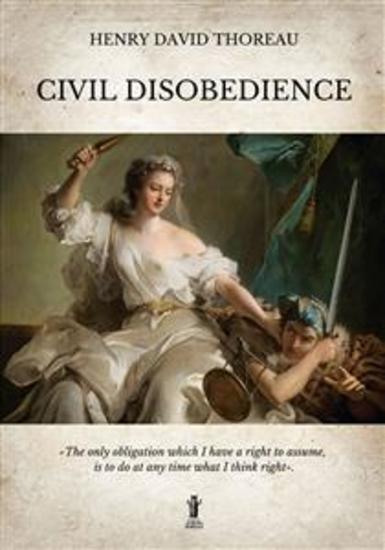
Civil disobedience - cover

Civil disobedience

Henry David Thoreau

Publisher: Edizioni Aurora Boreale

  • 0
  • 0
  • 0

Summary

Henry David Thoreau, American naturalist, essayist, poet, and philosopher, was born on July 12, 1817 in Concord, Massachusetts. One of the great protagonists of the “American Renaissance”, is considered one of the greatest American philosophers of all time. His essay Resistance to Civil Government, also known as Civil Disobedience, first published in 1849, was destined to become one of the most important manifestos against injustice and in favor of humanity’s freedom of thought and action. An essay today more than ever decidedly relevant, in an era in which the most fundamental freedoms and the rights of humanity have been questioned and limited by those power elites who hide behind governments and pursue the plans of a New World Order founded on slavery, control and submission. For Thoreau, conscience comes above law: we should be men first, and subjects afterward: «The only obligation which I have a right to assume, is to do at any time what I think right».
Available since: 08/23/2022.
Other books that might interest you

  • Ancient Greece - cover

    Ancient Greece

    Nicolas Sofos

    • 0
    • 0
    • 0
    Ancient Greece, widely recognized as the birthplace of western civilization thrived from 800 BCE to 146 BCE. It is renowned for its contributions, to domains, including literature, philosophy, politics, arts and sciences. These contributions have had an impact on societies. 
    The civilization was characterized by a multitude of city states with Athens and Sparta being particularly notable. Athens, considered the cradle of democracy prioritized philosophy, education and cultural pursuits. It gave rise to thinkers like Socrates, Plato and Aristotle. In contrast Sparta embraced a society that emphasized training and excellence. 
    The Ancient Greeks practiced a religion with a connection to their daily lives. One of their religious and sporting events was the Olympic Games held every four years in honor of Zeus. 
    Greek literature holds status due to works like Homers poems The Iliad and The Odyssey. Playwrights such, as Sophocles, Euripides and Aristophanes created enduring tragedies and comedies that delved into the complexities of existence. 
    In the realm of science and mathematics the Greeks achieved significant breakthroughs. 
    Prominent individuals such, as Pythagoras, Euclid and Archimedes played roles in advancing the fields of geometry and calculus. Meanwhile philosophers, like Thales and Democritus laid the foundations for reasoning. 
    Turning to politics Ancient Greece primarily relied on city states, each governed by its system. Athens implemented a form of democracy where citizens actively participated in decision making processes while Sparta had an disciplined structure. 
    Ancient Greece's influence can still be seen in various aspects of modern society, including government, philosophy, language, art, and sports. Its legacy continues to resonate in the Western world, making it one of the most impactful civilizations in history.
    Show book
  • State looters Again and again - cover

    State looters Again and again

    Philippe Pascot

    • 0
    • 0
    • 0
    On September 15, 2017, in front of millions of television viewers, Emmanuel Macron, with François Bayrou, his Keeper of the Seals at the time, delivered his first lie: “It is now impossible to be elected when you have a B2 criminal record”. Nothing could be further from the truth: in 2025, it is still possible to stand for election and be elected after having been convicted by the courts, whereas there are 396 jobs requiring a clean criminal record. Ten years after the best-seller Pilleurs d'État (State Looters), which sold 120,000 copies, Philippe Pascot takes stock of the progress and setbacks in French politics, listing all the legal abuses still available to the political class: exorbitant salaries and associated expenses, tax exemptions, multiple pensions, fictitious employment, exceptional justice, show trials, bogus declarations of interest and activities, and so many other little arrangements between friends... For Philippe Pascot, the findings are indisputable: “Behind a declared desire for transparency and moralization in the political sphere, our elected representatives continue to nurture their own interests through laws that are less and less comprehensible, in order to escape criminal prosecution and drape themselves in a circumstantial innocence. ”
    Show book
  • The Picnic - A Dream of Freedom and the Collapse of the Iron Curtain - cover

    The Picnic - A Dream of Freedom...

    Matthew Longo

    • 0
    • 0
    • 0
    In August 1989, a group of Hungarian activists organized a picnic on the border of Hungary and Austria. But this was not an ordinary picnic—it was located on the dangerous militarized frontier known as the Iron Curtain. Tacit permission from the highest state authorities could be revoked at any moment. On wisps of rumor, thousands of East German "vacationers" packed Hungarian campgrounds, awaiting an opportunity, fearing prison, surveilled by lurking Stasi agents. The Pan-European Picnic set the stage for the greatest border breach in Cold War history: hundreds crossed from the Communist East to the longed-for freedom of the West. 


    Drawing on dozens of original interviews, Matthew Longo tells a gripping and revelatory tale of the unraveling of the Iron Curtain and the birth of a new world order. Just a few months after the Picnic, the Berlin Wall fell, and the freedom for which the activists and refugees had risked imprisonment was suddenly available to everyone. But were they really free? And why, three decades since the Iron Curtain was torn down, have so many sought once again to build walls? 


    Cinematically told, The Picnic recovers a time when it seemed possible for the world to change. With insight and panache, Longo explores the opportunities taken—and the opportunities we failed to take—in that pivotal moment.
    Show book
  • Naïve Readings - Reveilles Political and Philosophic - cover

    Naïve Readings - Reveilles...

    Ralph Lerner

    • 0
    • 0
    • 0
    One sure fact of humanity is that we all cherish our opinions and will often strongly resist efforts by others to change them. Philosophers and politicians have long understood this, and whenever they have sought to get us to think differently they have often resorted to forms of camouflage that slip their unsettling thoughts into our psyche without raising alarm. In this fascinating examination of a range of writers and thinkers, Ralph Lerner offers a new method of reading that detects this camouflage and offers a way toward deeper understandings of some of history’s most important—and most concealed—messages.             Lerner analyzes an astonishing diversity of writers, including Francis Bacon, Benjamin Franklin, Edward Gibbon, Judah Halevi, Thomas Jefferson, Abraham Lincoln, Moses Maimonides, and Alexis de Tocqueville. He shows that by reading their words slowly and naïvely, with wide-open eyes and special attention for moments of writing that become self-conscious, impassioned, or idiosyncratic, we can begin to see a pattern that illuminates a thinker’s intent, new messages purposively executed through indirect means. Through these experimental readings, Lerner shows, we can see a deep commonality across writers from disparate times and situations, one that finds them artfully challenging others to reject passivity and fatalism and start thinking afresh.    
    Show book
  • The Cold War and After - History Theory and the Logic of International Politics - cover

    The Cold War and After - History...

    Marc Trachtenberg

    • 0
    • 0
    • 0
    A new way of looking at international relations from a leading expert in the fieldWhat makes for war or for a stable international system? Are there general principles that should govern foreign policy? In The Cold War and After, Marc Trachtenberg, a leading historian of international relations, explores how historical work can throw light on these questions. The essays in this book deal with specific problems—with such matters as nuclear strategy and U.S.-European relations. But Trachtenberg's main goal is to show how in practice a certain type of scholarly work can be done. He demonstrates how, in studying international politics, the conceptual and empirical sides of the analysis can be made to connect with each other, and how historical, theoretical, and even policy issues can be tied together in an intellectually respectable way.These essays address a wide variety of topics, from theoretical and policy issues, such as the question of preventive war and the problem of international order, to more historical subjects—for example, American policy on Eastern Europe in 1945 and Franco-American relations during the Nixon-Pompidou period. But in each case the aim is to show how a theoretical perspective can be brought to bear on the analysis of historical issues, and how historical analysis can shed light on basic conceptual problems.
    Show book
  • The Invented State - Policy Misperceptions in the American Public - cover

    The Invented State - Policy...

    Emily Thorson

    • 0
    • 0
    • 0
    In The Invented State, Emily Thorson argues that a problematic and understudied aspect of political misinformation reflects widespread public misperception about what the government does. Because much of public policy is invisible to the public, there is fertile ground for false beliefs to flourish, leading to what Thorson terms the "invented state": systematic misperceptions about public policy. However, people get the facts wrong not because they are stupid or blinded by partisan loyalty. Misperceptions are created when three conditions are met: when citizens have incomplete information about an issue, when their own biases color their understanding of it, and when they feel that the issue is important. The invented state is created by exposure to misinformation and by individuals' cognitive errors. 


    Correcting these policy misperceptions is highly effective at reducing false beliefs. Providing people with corrective information has downstream effects on attitudes. When they learn how policies really work, their approval increases and they also shift their policy priorities. Contrary to pundits' assumptions of a public who is largely indifferent to policy, there is a deep public desire to learn basic facts about how the government works. Thorson meets that desire with analysis on how the media can identify and correct substantive policy misperceptions.
    Show book