Join us on a literary world trip!
Add this book to bookshelf
Grey
Write a new comment Default profile 50px
Grey
Subscribe to read the full book or read the first pages for free!
All characters reduced
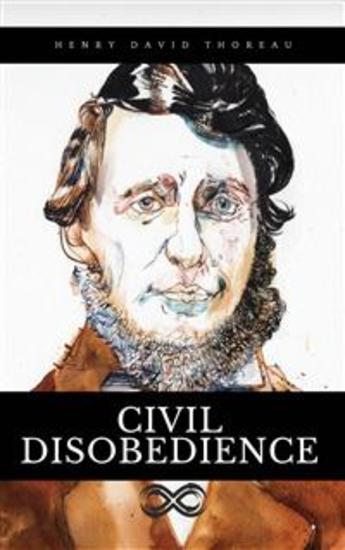
Civil Disobedience - Resistance to Civil Government - cover

Civil Disobedience - Resistance to Civil Government

Henry David Thoreau

Publisher: Sanzani

  • 0
  • 0
  • 0

Summary

Resistance to Civil Government, called Civil Disobedience for short, is an essay by American transcendentalist Henry David Thoreau that was first published in 1849. In it, Thoreau argues that individuals should not permit governments to overrule or atrophy their consciences, and that they have a duty to avoid allowing such acquiescence to enable the government to make them the agents of injustice. Thoreau was motivated in part by his disgust with slavery and the Mexican–American War (1846–1848).
Available since: 10/24/2022.


Other books that might interest you

  • Eating While Black - Food Shaming and Race in America - cover

    Eating While Black - Food...

    Psyche A. Williams-Forson

    • 0
    • 0
    • 0
    Psyche A. Williams-Forson is one of our leading thinkers about food in America. In Eating While Black, she offers her knowledge and experience to illuminate how anti-Black racism operates in the practice and culture of eating. She shows how mass media, nutrition science, economics, and public policy drive entrenched opinions among both Black and non-Black Americans about what is healthful and right to eat. Distorted views of how and what Black people eat are pervasive, bolstering the belief that they must be corrected and regulated. What is at stake is nothing less than whether Americans can learn to embrace nonracist understandings and practices in relation to food. 


    Sustainable culture—what keeps a community alive and thriving—is essential to Black peoples' fight for access and equity, and food is central to this fight. Starkly exposing the rampant shaming and policing around how Black people eat, Williams-Forson contemplates food's role in cultural transmission, belonging, homemaking, and survival. Black people's relationships to food have historically been connected to extreme forms of control and scarcity—as well as to stunning creativity and ingenuity. In advancing dialogue about eating and race, this book urges us to think and talk about food in new ways in order to improve American society on personal and structural levels.
    Show book
  • Rise of Fascism in Europe The: The History of the Fascist Takeovers in Nazi Germany Italy and Spain during the 20th Century - cover

    Rise of Fascism in Europe The:...

    Editors Charles River

    • 0
    • 0
    • 0
    It’s easy to forget how young Italy was when Benito Mussolini was born on July 29, 1883. It is hard to conceive a territory with such a long and ancient history was once young and troubled with constant conflict and instability. Similar to Germany, Italy was unified in 1861, but contrary to its northern cousin, its previous history was one of separation. Italy had no great romantic idea of a “Great Germany,” keeping it unified even during the wars between city-states. Benito Mussolini was born and raised in a highly volatile environment where ideas already considered extreme by most contemporary observers, such as Socialism, would undergo a deep and violent transformation.	Mussolini would ride that wave to power, and he would hold it for decades as he opportunistically tried to strengthen Italy's position and empire. That would lead him to foreign interventions in Africa, and eventually an alliance with Nazi Germany's Adolf Hitler, ultimately costing him everything and devastating his country throughout World War II. 
    	It is often claimed that Adolf Hitler rose to power in Germany through democratic means, and while that is a stretch, it is true that he managed to become an absolute dictator as Chancellor of Germany in the 1930s through a mixture of politics and intimidation. Ironically, he had set such a course only because of the failure of an outright coup attempt known as the Beer Hall Putsch about a decade earlier. 
    	The Spanish Civil War has exerted a powerful impact on the historical imagination. Without question, the conflict was a key moment in the 20th century, a precursor to World War II, and an encapsulation of the rise of extremist movements in the 1930s, but it was also a complex narrative in and of itself, even as it offered a truly international theatre of war. 	Ultimately, the forces of reaction, led by General Francisco Franco, triumphed, and after his victory in 1939, Franco ruled Spain with an iron fist for 36 years.
    Show book
  • Body Safety for Young Children - Empowering Caring Adults - cover

    Body Safety for Young Children -...

    Kimberly King

    • 0
    • 0
    • 0
    Talking about sexual abuse is the key to preventing it. Avoiding talking about body safety and sexual-abuse prevention is what abusers want. Body Safety for Young Children: Empowering Caring Adults gives parents, guardians, caregivers, and teachers the information, resources, tools, and helpful real-life tips to help keep children safe. This book takes the fear out of sexual-abuse prevention and makes it approachable by making a partnership between parents and teachers.  
    Show book
  • Otto von Bismarck: A short biography - 5 Minutes: Short on time – long on info! - cover

    Otto von Bismarck: A short...

    5 Minutes, 5 Minute Biographies,...

    • 0
    • 0
    • 0
    Otto von Bismarck, Prussian chancellor and famous leader of the German Empire: Life and work in a short biography! Everything you need to know, brief and concise. Infotainment, education and entertainment at its best!
    Show book
  • Difficult - Mothering Challenging Adult Children through Conflict and Change - cover

    Difficult - Mothering...

    Judith R. Smith

    • 0
    • 0
    • 0
    Told from the perspective of mothers who've lived it, Difficult focuses on mothering challenging adult children. 


    Difficult brings to life the conflicts that arise for mothers who are confronted with the unexpected and burdensome dependencies of their adult children associated with mental illness, substance use, or chronic unemployment. Through real stories of mothers and their challenging adult children, this book offers accessible, provocative, and, at times, shocking illustrations of the excruciating maternal dilemma: Which takes precedence—the needs of the mother or of the distressed adult child? Difficult addresses a family situation which too many keep secret. The book allows listeners to see that they are not alone. 


    Judith Smith speaks empathically to parents, acknowledging and illuminating the embarrassment, shame, and helplessness that women can feel when their adult children's problems puncture their own feelings of self-worth. In the absence of sufficient supports and affordable housing for persons with mental illness or substance misuse disorder, mothers feel that they have no choice—"if not me, then who?" Unpaid and unrecognized maternal caregiving work continues to limit women's quality of life, even into their later years. Smith addresses this as a societal issue which requires structural solutions.
    Show book
  • American Revolution - History of the American and Mexican Revolution - cover

    American Revolution - History of...

    Kelly Mass

    • 0
    • 0
    • 0
    These books are contained in this bundle: 
    1 - American Revolution: Between 1765 to 1791, the American Revolution was an ideological and political revolution in British America. In the American Revolutionary War (between 1775 to 1783), the Americans in the Thirteen Groups established sovereign countries that beat the British, getting independence from the British Crown and establishing the USA of America, the first modern-day constitutional liberal democracy. The tax of American settlers by the British Parliament, a body in which they had no direct representation, provided contention. Before the 1760s, Britain's American groups kept a great degree of internal autonomy, which was managed by colonist legislatures on a regional level. The Stamp Act of 1765 enforced internal taxes on the groups, leading to colonist outrage and the development of the Stamp Act Congress, which united members from different provinces. Stress reduced after the British rescinded the Stamp Act but flared again when the Townshend Acts were passed in the year 1767. In the year 1768, the British federal government dispatched soldiers to Boston to stop discontent, which led to the Boston Massacre in the year 1770. 
    2 - Mexican Revolution: The Mexican Revolution was a great revolution that included a series of army local battles instead of a single united struggle. It destroyed the Federal Force and changed it with an innovative army, changing Mexican civilization and governance at the same time It also culminated in the adoption of a new constitution that included the revolutionaries' ideal visions. In spite of the fact that President Porfirio Daz's (from about 1880 to 1911) rule had grown progressively out of favor over the prior 31 years, there was no indicator that a transformation would break out in the year 1910.
    Show book