Join us on a literary world trip!
Add this book to bookshelf
Grey
Write a new comment Default profile 50px
Grey
Subscribe to read the full book or read the first pages for free!
All characters reduced
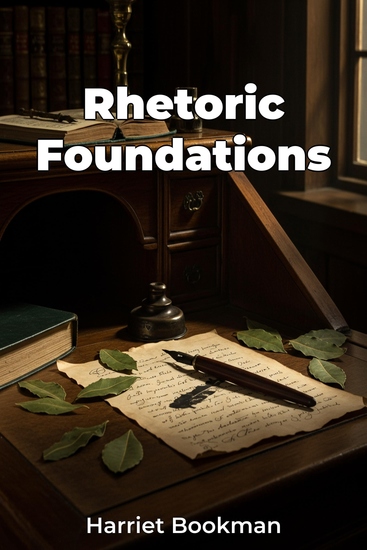
Rhetoric Foundations - cover

Rhetoric Foundations

Harriet Bookman

Translator A AI

Publisher: Publifye

  • 0
  • 0
  • 0

Summary

Rhetoric Foundations explores the art of persuasion and effective communication, delving into both classical traditions and contemporary applications in essay writing. The book highlights the enduring relevance of rhetoric in today's complex world.

 
It examines core rhetorical principles like the classical canons and rhetorical appeals (ethos, pathos, and logos), demonstrating how mastering these elements is essential for crafting persuasive arguments. The study also shows how these principles have evolved over time, shaped by social, political, and technological changes, impacting the way we communicate today.

 
The book provides a comprehensive exploration of rhetoric, guiding readers from fundamental concepts and historical context to detailed analyses of classical canons and rhetorical appeals. It then explores the application of these principles to various forms of essay writing, including argumentative, analytical, and persuasive essays.

 
What makes this book unique is its balanced approach to integrating classical theories with contemporary practices, offering fresh perspectives on established concepts. It emphasizes the ethical considerations of rhetoric, providing a framework for understanding how language shapes thought and action, which is essential for meaningful dialogue and debate.

 
The book progresses systematically, starting with an introduction to rhetoric's foundations and history, followed by in-depth analyses of its key components, and culminating in discussions of its practical applications and ethical implications. This approach makes complex ideas understandable, ensuring readers gain valuable insights and practical strategies for crafting effective arguments and engaging in meaningful communication.
Available since: 05/05/2025.
Print length: 89 pages.

Other books that might interest you

  • Grimké on the Christian Life - Christian Vitality for the Church and World - cover

    Grimké on the Christian Life -...

    Drew Martin

    • 0
    • 0
    • 0
    Francis J. Grimké's Vision of the Christian Life 
    Francis Grimké's life left a significant mark on American Christianity at the turn of the 20th century. Born enslaved in South Carolina, Grimké dedicated his life to teaching and preaching the gospel and confronting the racism and injustice of his time. For 50 years, he served as a Presbyterian pastor in Washington, DC, emerging as a prominent leader in the early civil rights movement.
    This book explores Grimké's vision of the Christian life, emphasizing his beliefs on personal piety, family, the mission of the church, and the relationship between faith and politics. His blend of doctrinal integrity and social concern helps readers wisely engage in topics like race, ethnicity, culture, and politics in the church today. As the church continues to navigate these polarized issues, Grimké reminds us that, through Christ, unity is possible.
    
    - Part of the Theologians on the Christian Life Series: Provides accessible introductions to some of church history's greatest teachers
    - Contemporary Application: Helps individuals address issues such as race, ethnicity, culture, and politics within the church today
    - Academic yet Accessible: For those interested in practical theology and the intersection between Christian faith, race, and politics
    Show book
  • Caligula - The Cruel Unpredictable Roman Leader - cover

    Caligula - The Cruel...

    Kelly Mass

    • 0
    • 0
    • 0
    Gaius Caesar Augustus Germanicus, better known as Caligula, served as the third Roman Emperor from 37 to 41 AD. Born into the illustrious Julio-Claudian dynasty, he was the son of Germanicus, a beloved Roman general, and Agrippina the Elder, Augustus' granddaughter. His lineage placed him firmly within the first reigning family of the Roman Empire, setting the stage for his eventual rise to power. 
    The Roman Empire had already undergone significant transitions by the time Caligula entered the world. Tiberius, his great-uncle, succeeded Augustus as emperor in 14 AD, adopting Germanicus as his son. Caligula’s early years were shaped by the Roman military campaigns under Germanicus in Germania, where he earned the nickname “Caligula,” meaning “little boot,” due to the small military boots he wore as a child during these campaigns with his father’s troops. 
    When Germanicus died under mysterious circumstances in Antioch in 19 AD, Caligula’s family was plunged into turmoil. Agrippina, now a widow, returned to Rome with her six children, only to become embroiled in a bitter conflict with Tiberius. Her family’s tragic fall resulted in the deaths or exile of most of her children, leaving Caligula as the only surviving male. In 26 AD, Tiberius withdrew to the island of Capri, where he lived in seclusion. Caligula followed him in 31 AD, and after Tiberius' death in 37 AD, Caligula ascended to the throne as emperor.
    Show book
  • My Secret Life Vol 1 Chapter Three - cover

    My Secret Life Vol 1 Chapter Three

    Dominic Crawford Collins

    • 0
    • 0
    • 0
    My Secret Life, the gargantuan erotic autobiography of a wealthy Victorian English gentleman has been described as 'the strangest book ever written'. Comprising one-hundred-and-eighty-four chapters and over one million words, the epic confessional describes in eloquent and explicit detail the exploits of a man (who refers to himself simply as 'Walter'), whose life was devoted to the pursuit of erotic adventure and carnal pleasure.
    
    Now for the first time in the history of this infamous erotic masterpiece, film composer Dominic Crawford Collins is producing a fully scored narration of the complete unabridged text. More 'audiofilm' than audiobook, each chapter and scene has its own unique musical accompaniment, reflecting the author's changing emotional landscape and offering the listener a truly immersive erotic audio experience.
    
    Chapter Three: A big servant - Armpits - A quiet feel - Baudy reveries - Felt by a woman - Erections - My prepuce - Seeing and feeling - Aunt and cousin - A servant's thighs - Not man enough.
    Show book
  • Not Ours To See - A Memoir - cover

    Not Ours To See - A Memoir

    Anne Sauter Lieb, Beth Huffman

    • 0
    • 0
    • 0
    What if… 
    •What would you do if your quick-tempered father controlled you unfairly? 
    •What would you do if you realized that the man you married didn’t love you? 
    •What would you do to change your life? 
    NOT OURS TO SEE is the inspirational story of a woman who faced adversities as a child, teenager and adult. Anne Sauter Lieb struggled to learn in school, struggled to feel understood in her family and struggled to find peace in a marriage where her feelings didn’t matter. In spite of everything, this devoted mother refused to give up and vowed to provide her daughters with better lives.
    Show book
  • My Secret Life Vol 8 Chapter 2 - cover

    My Secret Life Vol 8 Chapter 2

    Dominic Crawford Collins

    • 0
    • 0
    • 0
    My Secret Life is an anonymously penned memoir written during a period from the 1840s to the 1880s by a wealthy and sex obsessed English gentleman who refers to himself simply as ‘Walter’. Part confessional, part investigative erotic journalism, it meticulously documents every detail of the author’s prolific sexual encounters, offering us in the process an eye and thigh opening account of life behind closed doors in the Victorian age.
    
    Women, in both mind and body, were the all consuming object of Walter’s interest. From early youth through to old age his quest for erotic discovery and adventure with them was never diminished.
    
    Unlike contemporary 19th century erotic texts, such as The Pearl, whose sole object was to titillate, Walter’s interest in his subjects did not end with the extinguishing of the carnal flame. His hunger to understand the circumstances and minds of the women he encountered is never upstaged by the sex. Their potted life histories, their most intimate desires and acts were shared with him and in turn meticulously recorded by him, written down verbatim while still fresh in his mind.
    
    The resulting poignant record of a lost era and the intimate moments of the women who inhabited it offer us a remarkable insight into the 19th century that cannot be gleaned from any other source.
    
    The complete unabridged text is being released as a fully scored audiofilm (an audio book with accompanying music soundtrack) by film composer Dominic Crawford Collins.
    
    VOLUME 8 CHAPTER 2
    Recherché eroticisms. • An outcome of the brothel spy-hole. • An abnormal letch. • A man for a month. • Alone with him. • Mutual nervousness. • The ice broken. • Pricks produced. • An exiguous tool. - - Unavailing masturbation. • Sarah's participation. • Cuntal incitation. • Prompt rigidity. • Onanistic operation. • Spermatic ejaculation. • Instantaneous copulation. • One on and one off. • A gorged cunt. • Masculine minetting. • A gristly mouthful. • Sucking cum fucking. • After supper. • Sarah's oration. • The end of the orgy.
    Show book
  • Elizabeth Bishop - A Very Short Introduction - cover

    Elizabeth Bishop - A Very Short...

    Jonathan F.S. Post

    • 0
    • 0
    • 0
    Elizabeth Bishop has been described as the "best-loved" poet in English of the second half of the twentieth century. This Very Short Introduction explores the ninety or so published poems that are at the core of her remarkable canon of verse. Drawing on biographical and critical material, Jonathan Post also makes frequent use of Bishop's letters and commentary by fellow poets, including Marianne Moore, Robert Lowell, and James Merrill to illuminate her writing and contemporary landscape. 


    Throughout, Post places Bishop's lyric poetry alongside her other poetic genres, short stories, and translations within the context of her life and aesthetic values, showing how these shaped her work. Ranging across her poems, the book covers a wide range of core themes, including Bishop's powerful use of description, the environment, balance, and ideas of love and loss, as well as looking at Bishop's interest in the visual arts.
    Show book