Join us on a literary world trip!
Add this book to bookshelf
Grey
Write a new comment Default profile 50px
Grey
Subscribe to read the full book or read the first pages for free!
All characters reduced
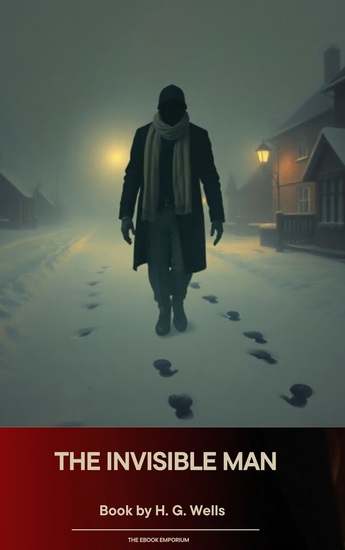
The Invisible Man - cover

The Invisible Man

H. G. Wells

Publisher: The Ebook Emporium

  • 0
  • 0
  • 0

Summary

"I am all men—and I am no man. I am the Invisible Man."

In the dead of winter, a mysterious stranger arrives at a quiet inn in the village of Iping, his face swathed in bandages and his eyes hidden behind dark goggles. This is Griffin, a brilliant scientist who has discovered the secret to making human tissue transparent. But his breakthrough is his undoing. Trapped in a state of invisibility and hunted by a world that fears what it cannot see, Griffin's initial dream of power curdles into a violent obsession. As he attempts to establish a "Reign of Terror," the story becomes a pulse-pounding race against a man who can strike from nowhere.

The Anatomy of an Anti-Hero: Griffin is not your typical Victorian protagonist. He is irritable, brilliant, and increasingly sociopathic. Wells uses invisibility as a metaphor for the ultimate freedom from social accountability. Without a face to recognize or a body to imprison, Griffin believes he is above morality, leading to a chilling study of how absolute power (or the illusion of it) corrupts the soul.

A Village Under Siege: The novel masterfully shifts from the "weird tale" atmosphere of the Iping countryside to a high-stakes manhunt across England. Through the characters of the bumbling tramp Thomas Marvel and the rational Dr. Kemp, Wells explores the societal reaction to the "invisible threat." The tension builds to a climactic confrontation that remains one of the most memorable endings in the history of science fiction.

Witness the terror of the unseen. Purchase "The Invisible Man" today and confront the darkness of the human heart.
Available since: 01/08/2026.
Print length: 142 pages.

Other books that might interest you

  • Les Misérables: Volume 4: The Idyll in the Rue Plumet and the Epic in the Rue St Denis - Book 7: Slang (Unabridged) - cover

    Les Misérables: Volume 4: The...

    Victor Hugo

    • 0
    • 0
    • 0
    Victor-Marie Hugo (26 February 1802 - 22 May 1885) was a French poet, novelist, essayist, playwright, and dramatist of the Romantic movement. During a literary career that spanned more than sixty years, he wrote abundantly in an exceptional variety of genres: lyrics, satires, epics, philosophical poems, epigrams, novels, history, critical essays, political speeches, funeral orations, diaries, and letters public and private, as well as dramas in verse and prose.
    BOOK 7: SLANG: Pigritia is a terrible word. It engenders a whole world, la pègre, for which read theft, and a hell, la pègrenne, for which read hunger.
    Show book
  • Stories To Make You Cry - Sometimes you need a good cry - cover

    Stories To Make You Cry -...

    Anton Chekhov, Stephen Crane,...

    • 0
    • 0
    • 0
    When we read or listen, words can have a transforming effect.  Our mood can alter in the space of a few sentences from joy to sadness.  And not just our mood.  These words can affect us physically, they can engage our emotions and even in their sadness bring a lump to our throat and tears to our eyes.  Sometimes the relief can be palpable. 
     
    Our authors, from Anton Chekhov, Stephen Crane, Willa Cather, Katherine Mansfield and a wealth of others are well aware of what their talents will evoke.   Genius has many names.   
     
    1 - Short Stories To Make You Cry  - An Introduction 
    2 - Vanka by Anton Chekhov 
    3 - A Dark Brown Dog by Stephen Crane 
    4 - Suicides by Guy de Maupassant 
    5 - The Life of Ma Parker by Katherine Mansfield 
    6 - The District Doctor by Ivan Turgenev 
    7 - Paul's Case by Willa Cather 
    8 - Hands by Sherwood Anderson 
    9 - Silence by Leonid Andreyev 
    10 - The Stones of the Village by Alice Dunbar Nelson 
    11 - Hide And Seek or Pliatki by Fyodor Sologub
    Show book
  • The Mark on the Wall - cover

    The Mark on the Wall

    Virginia Woolf

    • 0
    • 0
    • 0
    How much can a single, ordinary detail reveal about the human mind?
    
    First published in 1917, The Mark on the Wall by Virginia Woolf is a pioneering modernist short story that transformed the way fiction could represent thought. What begins as a simple observation—a small mark on a wall—unfolds into a rich stream of reflection, questioning reality, history, authority, and the nature of consciousness itself.
    
    Through her innovative stream-of-consciousness style, Woolf draws readers deep into the mind, showing how everyday moments spark complex inner worlds. The story quietly challenges rigid structures of knowledge and certainty, favoring imagination, curiosity, and personal perception.
    
    This eBook presents the original text in a clear, accessible format, allowing readers to experience one of Woolf's earliest and most influential experiments in modernist fiction.
    
    Inside this eBook, you'll explore:
    
    A landmark example of stream-of-consciousness writing
    
    Woolf's early break from traditional narrative form
    
    Themes of perception, uncertainty, and inner life
    
    A foundational work in literary modernism
    
    Frequently studied in literature courses and admired for its originality, The Mark on the Wall remains essential reading for anyone interested in modernist writing and the evolution of narrative art.
    
    Enter the mind where a single mark opens infinite thought. Buy now and experience one of Virginia Woolf's most influential short stories.
    Show book
  • Bartleby - cover

    Bartleby

    Herman Melville

    • 0
    • 0
    • 0
    "Bartleby, the Scrivener: A Story of Wall Street" is a short story by the American writer Herman Melville, first serialized anonymously in two parts in the November and December 1853 issues of Putnam's Magazine.
    Show book
  • Oliver Twist - Full Cast Drama - cover

    Oliver Twist - Full Cast Drama

    Charles Dickens

    • 0
    • 0
    • 0
    "Oliver Twist," one of Charles Dickens' most enduring works, unfolds a compelling narrative of an orphaned boy's struggle against the stark injustices of 19th-century London. The story begins with the birth of Oliver in a workhouse, where his mother, who has died during childbirth, is just one of many tragic figures in the heartless world of poverty and exploitation. As a young boy, Oliver faces a harsh existence in the workhouse and eventually escapes to the bustling and treacherous streets of London. 
     
    In the city, Oliver becomes entangled with a gang of juvenile delinquents led by the malevolent Fagin and his menacing associate, Bill Sikes. Despite his innocence, Oliver is drawn into a world of crime, a stark contrast to his inherently good nature. As the narrative unfolds, readers follow Oliver's journey from the dangerous underworld to the compassionate embrace of Mr. Brownlow, who offers the boy a glimpse of a better life. 
     
    The narrative of "Oliver Twist" is a tale of contrasts, highlighting the stark divisions between the privileged and the impoverished, the forces of good and evil, and the corrupting influences of society. Dickens paints a vivid picture of the injustices and suffering experienced by the poor and orphaned, while also showcasing the potential for redemption and transformation. Through Oliver's journey, the narrative ultimately conveys a message of hope, resilience, and the belief that individuals, even those born into the most dire circumstances, can find their way to a better, more just life. Dickens' storytelling in "Oliver Twist" remains a powerful reminder of the enduring struggle for social justice and the resilience of the human spirit in the face of adversity.
    Show book
  • Prince and the Pauper The - Audiobook - cover

    Prince and the Pauper The -...

    Mark Twain, Classic Audiobooks,...

    • 0
    • 0
    • 0
    Set in 16th-century England, The Prince and the Pauper tells the story of two boys who are identical in appearance but born into very different worlds. Tom Canty, a poor boy from a destitute London family, and Prince Edward, heir to the English throne, meet by chance and decide to switch clothes as a joke. But when fate traps them in each other's roles, they must navigate the harsh realities of their new lives.As the prince experiences life among the poor and Tom is thrown into the rigid world of royalty, both boys gain empathy, wisdom, and a deeper understanding of justice. Twain blends adventure, satire, and social commentary to craft a timeless tale about identity, inequality, and the human spirit.
    Show book