Join us on a literary world trip!
Add this book to bookshelf
Grey
Write a new comment Default profile 50px
Grey
Subscribe to read the full book or read the first pages for free!
All characters reduced
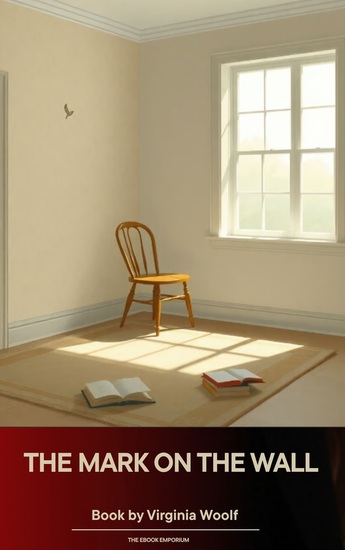
The Mark on the Wall - cover

The Mark on the Wall

Virginia Woolf

Publisher: The Ebook Emporium

  • 0
  • 0
  • 0

Summary

How much can a single, ordinary detail reveal about the human mind?

First published in 1917, The Mark on the Wall by Virginia Woolf is a pioneering modernist short story that transformed the way fiction could represent thought. What begins as a simple observation—a small mark on a wall—unfolds into a rich stream of reflection, questioning reality, history, authority, and the nature of consciousness itself.

Through her innovative stream-of-consciousness style, Woolf draws readers deep into the mind, showing how everyday moments spark complex inner worlds. The story quietly challenges rigid structures of knowledge and certainty, favoring imagination, curiosity, and personal perception.

This eBook presents the original text in a clear, accessible format, allowing readers to experience one of Woolf's earliest and most influential experiments in modernist fiction.

Inside this eBook, you'll explore:

A landmark example of stream-of-consciousness writing

Woolf's early break from traditional narrative form

Themes of perception, uncertainty, and inner life

A foundational work in literary modernism

Frequently studied in literature courses and admired for its originality, The Mark on the Wall remains essential reading for anyone interested in modernist writing and the evolution of narrative art.

Enter the mind where a single mark opens infinite thought. Buy now and experience one of Virginia Woolf's most influential short stories.
Available since: 01/21/2026.
Print length: 22 pages.

Other books that might interest you

  • The Master of Ballantrae - A Winter’s Tale - cover

    The Master of Ballantrae - A...

    Robert Louis Stevenson

    • 0
    • 0
    • 0
    Stevenson’s tragic masterpiece unfolds against a hauntingly beautiful Scottish landscape, where the 1745 Jacobite rising is dividing the country against itself. Amidst this outer conflict, one family finds itself devastatingly divided from within, as two brothers discover their opposing loyalties. Their rivalry soon spreads from war to love, as both try to win the hand of a wealthy and beautiful kinswoman. 
    Through a series of adventures, including seas voyages, piracy, and buried treasure, Stevenson weaves an acutely moving, psychologically complex story of the elemental struggle between good and evil.
    Show book
  • The Dunwich Horror — Part 10 of 10 - cover

    The Dunwich Horror — Part 10 of 10

    H. P. Lovecraft

    • 0
    • 0
    • 0
    Welcome to Timeless Terrors No. 62, concluding H. P. Lovecraft’s descent into cosmic nightmare: The Dunwich Horror. 
    The end has come to Dunwich. 
    Across the shattered hills, the aftermath of the unseen terror lies everywhere—homes flattened, fields torn raw, and the very air trembling with the residue of something vast, alien, and grieving in its destruction. The invisible behemoth, once confined to the Whateley farmhouse, now towers over the valley as its final rampage reaches a haunting crescendo. 
    Yet for the first time, a fragile beacon of resistance stands against it. 
    On the heights of Sentinel Hill, a small band of scholars prepares for a confrontation humanity was never meant to face. Armed with forbidden knowledge, perilous incantations, and a desperate understanding of the creature’s tragic origin, they move to end the catastrophe—knowing full well that their minds, their bodies, and their very souls may not survive what comes next. 
    In these final moments, cosmic horror collides with heartbreaking revelation, as the boundary between the human world and the outer void trembles on the brink of collapse. 
    Narrated by Amazon-bestselling horror author Jonathan Dunne, this concluding chapter delivers the powerful finale to Lovecraft’s masterpiece—a final stand where courage, madness, and the unknowable intertwine beneath a dark and indifferent universe. 
    This is Part 10 of a 10-part complete audiobook. 
    The nightmare ends here… but the echoes will remain.
    Show book
  • The Coup de Grace - From their pens to your ears genius in every story - cover

    The Coup de Grace - From their...

    Ambrose Bierce

    • 0
    • 0
    • 0
    Ambrose Gwinnett Bierce was born on 24th June 1842 at Horse Cave Creek in Meigs County, Ohio. His parents were poor but they introduced him to literature at an early age, instilling in him a deep appreciation of books, the written word and the elegance of language.  
    Growing up in Koscuisko County, Indiana poverty and religion were defining features of his childhood, and he would later describe his parents as “unwashed savages” and fanatically religious, showing him little affection but always quick to punish. He came to resent religion, and his introduction to literature appears to be their only positive effect. 
    At age 15 Bierce left home to become a printer’s devil, mixing ink and fetching type at The Northern Indian, a small Ohio paper. Falsely accused of theft he returned to his farm and spent time sending out work in the hopes of being published. 
    His Uncle Lucius advised he be sent to the Kentucky Military Institute. A year later he was commissioned as an Officer.  As the Civil War started Bierce enlisted in the 9th Indiana Infantry Regiment.  
    In April 1862 Bierce fought at the Battle of Shiloh, an experience which, though terrifying, became the source of several short stories. Two years later he sustained a serious head wound and was off duty for several months. He was discharged in early 1865.  
    A later expedition to inspect military outposts across the Great Plains took him all the way to San Francisco. He remained there to become involved with publishing and editing and to marry, Mary Ellen on Christmas Day 1871.  They had a child, Day, the following year.  
    In 1872 the family moved to England for 3 years where he wrote for Fun magazine. His son, Leigh, was born, and first book, ‘The Fiend’s Delight’, was published.  
    They returned to San Francisco and to work for a number of papers where he gained admiration for his crime reporting. In 1887 he began a column at the William Randolph Hearst’s San Francisco Examiner.  
    Bierce’s marriage fell apart when he discovered compromising letters to his wife from a secret admirer. The following year, 1889 his son Day committed suicide, depressed by romantic rejection. 
    In 1891 Bierce wrote and published the collection of 26 short stories which included ‘An Occurrence at Owl Creek Bridge’.  Success and further works including poetry followed.  
    Bierce with Hearst’s resources helped uncover a financial plot by a railroad to turn 130 million dollars of loans into a handout. Confronted by the railroad and asked to name his price Bierce answered “my price is $130 million dollars. If, when you are ready to pay, I happen to be out of town, you may hand it over to my friend, the Treasurer of the United States”.  
    He now began his first foray as a fabulist, publishing ‘Fantastic Fables’ in 1899.  But tragedy again struck two years later when his second son Leigh died of pneumonia relating to his alcoholism.  
    He continued to write short stories and poetry and also published ‘The Devil’s Dictionary’.  
    At the age of 71, in 1913 Bierce departed from Washington, D.C., for a tour of the battlefields where he had fought during the civil war. At the city of Chihuahua he wrote his last known communication, a letter to a friend. It’s closing words were “as to me, I leave here tomorrow for an unknown destination,” Ambrose Bierce then vanished without trace.
    Show book
  • Through the Looking‑Glass - Audiobook - cover

    Through the Looking‑Glass -...

    Lewis Carroll, Classic...

    • 0
    • 0
    • 0
    In Through the Looking-Glass, Lewis Carroll once again invites readers to join Alice as she steps into another fantastical world—this time by passing through a mirror. On the other side, she finds a land where everything is reversed, and life itself resembles a giant game of chess. Each encounter—from the bumbling Tweedledum and Tweedledee to the tragic White Knight—brings Alice closer to her goal of becoming a queen on the chessboard of this topsy-turvy universe.Carroll enriches his whimsical storytelling with memorable poems like "Jabberwocky" and playful riddles that continue to challenge the imagination. Unlike the dreamlike wandering of Wonderland, this sequel carries a clearer structure, echoing the rules and strategy of a chess game. Yet beneath the surface lies the same blend of wonder, humor, and quiet reflection that makes Alice's journey as enchanting as ever.
    Show book
  • The 39 Steps - cover

    The 39 Steps

    John Buchan

    • 0
    • 0
    • 0
    Europe is close to war and spies are everywhere. Richard Hannay the protagonist and narrator, an expatriate Scot, returns to his new home, a flat in London, after a long stay in Rhodesia, in order to begin a new life. One night he is buttonholed by a stranger, a well-travelled American, who claims to be in fear for his life. The man appears to know of an anarchist plot to destabilise Europe, beginning with a plan to assassinate the Greek Premier, Karolides, during his forthcoming visit to London.
    Show book
  • Coriolanus - cover

    Coriolanus

    William Shakespeare

    • 0
    • 0
    • 0
    The Marlowe Society perform Shakespeare's tradegy based on the life of the Roman Leader Gaius Martius Coriolanus.
    Show book