


Abonnez-vous pour lire le livre complet ou lisez les premières pages gratuitement!


D'autres livres qui pourraient vous intéresser
-

Minimalism and Decluttering Made...
Joshua Genius
So, what exactly is a minimalist lifestyle? Are there real benefits to living this way?Minimalism seems to be gaining real popularity these days. What is minimalism? It is essentially the intentional pursuit of the things we most value in life combined with the removal of anything that distracts us from achieving those things. The question then becomes, just exactly how are we supposed to do that?Answering that question is the focus of Joshua Genius’s book, Minimalism and Decluttering Made Easy: Blueprint for Minimalist Home, Living, Mindset, Lifestyle, Budgeting, and Family. This fascinating book clearly outlines what it means to live a minimalist lifestyle. It is a step-by-step guide for those with interest in learning how to live as a minimalist. This guide covers all the topics of crucial importance for the minimalist neophyte. Among them are:• What is minimalism?• What are the benefits of a minimalist lifestyle?• How to cultivate a minimalist mindset• How to become a minimalist family• How to set home guidelines• Minimalism in day-to-day life• How to maintain a minimalist home• How to budget in a minimalist way• And much, much more!For those interested in really learning about the benefits of living a minimalist lifestyle and how to focus their energies into what is truly valuable in their lives, this highly informative book by Joshua Genius is precisely what you are looking for. Satisfy your curiosity and learn about this lifestyle that is growing in popularity. Buy your copy today.
Voir livre -
Summary Bundle: Business & Home...
Readtrepreneur Publishing
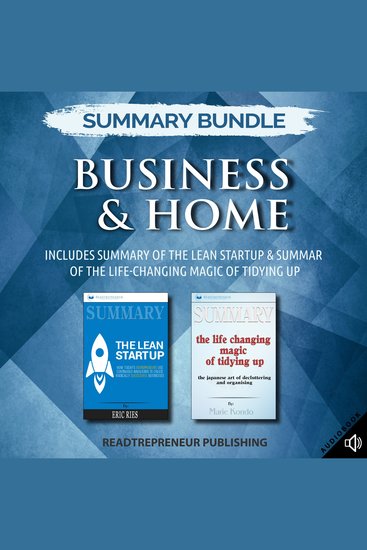
Summary Bundle: Business & Home - Readtrepreneur Publishing: Includes Summary of The Lean Startup & Summary of The Life-Changing Magic of Tidying UpFrom the Description of "Summary of The Lean Startup"..."The only way to win is to learn faster than anyone else." - Eric RiesThe Lean Startup's philosophy is simple "learn from the best". After an in-depth study of the most successful startups out there, this brilliant guide was made so you could learn from the cream of the crop. Trial and error is expensive and wastes a lot of time so start learning from the best before you jump into the startup world. Uncertainty when building a startup is unavoidable, being prepared for everything that could happen is up to you.From the Description of "Summary of The Life-Changing Magic of Tidying Up"..."Tidying is the act of confronting yourself; cleaning is the act of confronting nature" - Marie KondoTidying orders the mind while cleaning purifies it. It is really pure illusion if we think that our mind can be clear and be at peace when our house is messy. If you've tried all the other cleaning methods taught by other "gurus", give the KonMari method one last chance... one last chance to purify your house once and for all. Organizing and tidying the house could be fun and fulfilling with the KonMari method. You don't give up on your child when they're learning to walk, so why give up on your house when it's not organized?What if you could learn 3X more in 2X less time? How much faster could you accelerate to reach your goals? Start accelerating your growth today by adding this book to your shopping cart now or clicking on the buy now button.
Voir livre -
Take the Horse and Run - The...
Haylee Graham
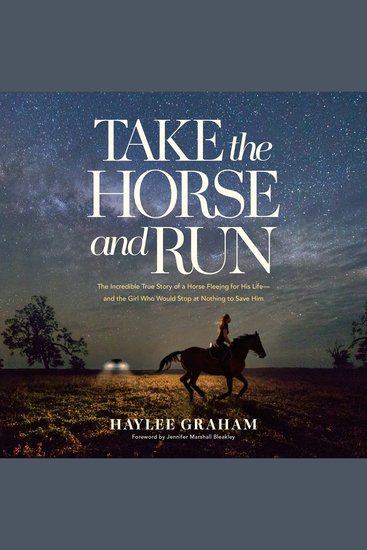
How far would you go for your best friend?When her parents’ devastating divorce uprooted her life, Haylee Graham plunged into a downward spiral. Heartbroken and afraid, the young girl turned to her beloved horse, Cartier, as a lifeline. The only place she felt safe was hiding with him in his stall; the only time she felt like herself was when the two jumped fences together.So when a corrupt lawyer threatened to seize ownership of Cartier and sell him to a slaughterhouse to repay their debts, Haylee knew she would do anything to save him. Her mom said 'Take the horse and run!”―and she did. Their late-night escape set off a relentless pursuit with a shady private investigator terrorizing Haylee and Cartier every step of the way as they tried to outrun the forces that threatened to tear them apart.But God had other plans.Perfect for horse lovers and fans of inspirational memoirs, Take the Horse and Run is:a dramatic true story brimming with danger, adventure, and hopefilled with an unforgettable cast of human and equine charactersan uplifting tale about the power of friendship and loveaccompanied by a photo gallery included in the bookHaylee’s heart-wrenching journey to save her beloved horse is a harrowing narrative filled with unforgettable characters and treacherous escapades all culminating in a shocking ending that testifies to the power of faith and proves that the bond between a girl and her horse is even more valuable than gold.
Voir livre -

A Drop in the Ocean
Jasna Tuta
Tales of great heroism and daring at sea are all well and good. But this isn’t one of them. Totally free of hyperbole and exaggeration, A Drop in the Ocean is an honest and genuine account of what it is really like to cross a very big ocean, on a very small sailboat, for the very first time...When you raise the sails and head into the unknown, you take on the most fascinating challenge of your life. But you also embark upon a voyage of an entirely different nature. As the initial fear of the unknown slowly gives way to the daily rhythm of life at sea, something entirely unexpected happens. This book is one woman’s attempt to describe the nature and effect of this subtle transformation.
Voir livre -

The Everest Politics Show -...
Mark Horrell
In April 2014 Mark Horrell went on a mountaineering expedition to Nepal, hoping to climb Lhotse, the fourth-highest mountain in the world, which shares a base camp and climbing route with Mount Everest.
He dreamed of following in the footsteps of Tenzing Norgay and Edmund Hillary, by climbing through the infamous ice maze of the Khumbu Icefall, and he yearned to sleep in the grand amphitheatre of Everest Base Camp, surrounded by towering peaks.
He was also intrigued by the media publicity surrounding commercial expeditions to Everest. He wanted to discover for himself whether it had become the circus that everybody described.
But when a devastating avalanche swept across the Khumbu Icefall, he got more than he bargained for. Suddenly he found himself witnessing the greatest natural disaster Everest had ever seen.
And that was just the start. Everest Sherpas came out in protest, issuing a list of demands to the Government of Nepal. What happened next left his team confused, bewildered and fearing for their safety.
Voir livre -
Wilderness; A Journal Of Quiet...
Rockwell Kent
The illustrator and author Rockwell Kent (1882-1971)wrote and illustrated this description of a trip to Alaska with his eldest son. Though an audiobook listener cannot, of course, see Kent's illustrations, the artist's eye is evident throughout the text. Wilderness: A Journal of Quiet Adventure in Alaska — Memoir of the fall and winter of 1918/19 painting and exploring with his eldest son – also Rockwell – on Fox Island in Resurrection Bay, Alaska (1920). (Summary by Wikipedia and David Wales)
Voir livre




