Join us on a literary world trip!
Add this book to bookshelf
Grey
Write a new comment Default profile 50px
Grey
Subscribe to read the full book or read the first pages for free!
All characters reduced
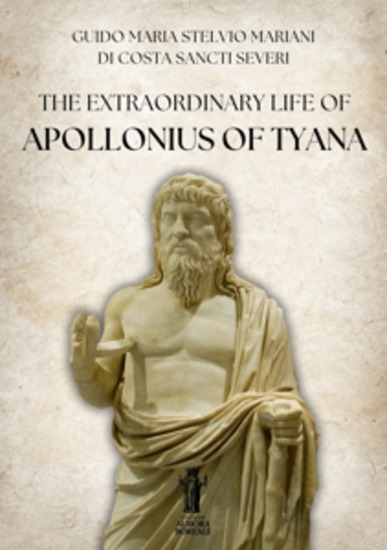
The Extraordinary Life of Apollonius of Tyana - cover

The Extraordinary Life of Apollonius of Tyana

Guido Maria Stelvio Mariani di Costa Sancti Severi

Publisher: Edizioni Aurora Boreale

  • 0
  • 0
  • 0

Summary

Apollonius of Tyana, an extraordinary figure of an initiate, magician, and prophet who lived in the first century AD, remains a great enigma in history, especially when we consider that his existence was parallel and analogous to that of another man who undoubtedly influenced the human affairs of the last two millennia: Jesus, called the Christ.The birth of Apollonius, whose life is narrated to us by Flavius Philostratus, can most likely be placed in 4 BC in Tyana, Asia Minor. The event, as the sources tell us, was preceded by portents and miracles, and it is said that before Apollonius came into the world, a splendid apparition appeared before his mother, revealing that the son she was expecting would be an incarnation of the Titan God Prometheus, the savior of humanity.Apollonius lacked the martyrdom of the cross, but everywhere, in the places he had passed through and preached, temples and statues were erected in his honor. His fame had reached every province of the Roman Empire, and his preachings, teachings, and miracles were spoken of everywhere. In fact, there were not a few who could testify to having seen him exorcise the possessed, heal the lame and the sick, and even bring the dead back to life.In light of all this, it should not be surprising that Christianity attempted by all means to erase from history the memory and events of such an extraordinary figure, who was too similar to its Messiah.
Available since: 08/26/2025.

Other books that might interest you

  • The Graeco-Roman Era - cover

    The Graeco-Roman Era

    Pericles, Julius Caesar, ...

    • 0
    • 0
    • 0
    Five speeches from the legendary orators Alexander the Great, Julius Caesar, Cicero, and Pericles.431 BCE: Pericles’ Funeral Oration is a valedictory and eulogy for the great age of Athenian democracy. Reported by Thucydides, it was given at the first annual public funeral for casualties of the Peloponnesian War. That war ended twenty-seven years later with the democratic government of Athens overthrown by an oligarchy known as The Four Hundred. 324BCE: Two speeches by Alexander the Great, reported by the historian Arrian in his Anabasis. Both speeches are a direct address to his army on embarking on a new campaign. The first was given in Opis, Mesopotamia, when rallying his armies to start a new campaign into Persia. The army took heart, and successfully conquered the Persian Empire, adding it to Alexander’s many existing conquests. The second speech is given after the first campaign is over. This time Alexander is ready to move into the Indian subcontinent. After travelling across the known world, the entire army took the offer to quit fighting and go home. This leaves Alexander understandably upset, and produces history’s most finely worded example of saying “After all I’ve done for you! Well, you can all get stuffed then, you bunch of ingrates. I hope you choke.”In 63BCE, the Cataline Conspiracy shook Rome. It was a deep shock to the Roman system, and risked civil war. Included here are speeches by the Consul Cicero and the only extant speech of Julius Caesar.Cicero’s First Speech is a rabble-rousing, impassioned, and slightly unhinged attack upon Cataline and his associates. It speaks to the outrage of the body politic and the masses.Caesar’s speech is a jurisprudential appeal to create no new laws to punish these crimes. Caesar argues that the republic would be ultimately harmed if they were not punished only under existing laws, as people remember the punishment but not the crime.
    Show book
  • Preparing for War - The Extremist History of White Christian Nationalism—and What Comes Next - cover

    Preparing for War - The...

    Bradley Onishi

    • 0
    • 0
    • 0
    The insurrection at the US Capitol on January 6, 2021, was not a blip or an aberration. It was the logical outcome of years of a White evangelical subculture's preparation for war. Religion scholar and former insider Bradley Onishi maps the origins of White Christian nationalism and traces its offshoots in Preparing for War. 


    Combining his own experiences in the youth groups and prayer meetings of the 1990s with an immersive look at the steady blending of White grievance politics with evangelicalism, Onishi crafts an engrossing account of the years-long campaign of White Christian nationalism that led to January 6. How did the rise of what Onishi calls the New Religious Right, between 1960 and 2015, give birth to violent White Christian nationalism during the Trump presidency and beyond? What propelled some of the most conservative religious communities in the country—communities of which Onishi was once a part—to ignite a cold civil war? 


    Through chapters on White supremacy and segregationist theologies, conspiracy theories, the Christian-school movement, purity culture, and the right-wing media ecosystem, Onishi pulls back the curtain on a subculture that birthed a movement and has taken a dangerous turn.
    Show book
  • Powering Inclusive Cultures - Why Measurement Matters - cover

    Powering Inclusive Cultures -...

    Christine Jones

    • 0
    • 0
    • 0
    CEOs , C-SUITE EXECUTIVES AND LEADERS have a valuable role in the continuum of diversity, equity and inclusion (DEI) for their organizations. Powering Inclusive Cultures shows why bias training alone doesn’t work and gives the reader tools that will work. Through case studies, learning activities and DEI data, readers learn why measurement is important to the task of creating real organizational change.In-depth analysis across race/ethnicity, age, gender identity, sexual orientation, ability and veteran status demographics provides insight into how different groups think, feel and act regarding their organization’s culture, management, policies, practices and procedures.Learning activities included in the book can be downloaded (with an answer key) from the author’s website.
    Show book
  • Nari da soshan - cover

    Nari da soshan

    Mahinder Singh Sodhi

    • 0
    • 0
    • 0
    S. Mahinder Singh Sodhi is the compiler of this book. It includes articles from 36 distinguished writers, both male and female, depicting the tragedies associated with a woman's life. These writers have highlighted issues such as gender inequality, suffering, rigid traditions, and superstitions that cause lifelong distress for women. Additionally, they have attempted to explore possible solutions to these problems.
    Show book
  • This is How You Vagina - All About Your Vajayjay and Why You Probably Shouldn't Call it That - cover

    This is How You Vagina - All...

    MD Nicole E. Williams

    • 0
    • 0
    • 0
    In This is How You Vagina, Dr. Nicole Williams presents readers with a much-needed education on the history, science, and attitudes of the most fascinating and misunderstood part of the female anatomy: the vagina. She covers valuable information about sexual function, childbirth, and physiology and provides answers to her patients' (and probably your) most asked questions. She matter-of-factly dispels the most common myths and misinformation concerning female genitalia, including— 


    ● No, your vagina doesn't need steaming 


    ● Those panty liners are unnecessary—your vagina needs to breathe 


    ● It's actually perfectly normal for your vagina to have an odor—consider it your personal brand 


    This book is an easy-to-understand guide, complete with illustrations, for women to explore and understand their vaginas in a way they never have before. You will learn what's normal and what's not, including that, yes, yours is most certainly normal too. 


    This is How You Vagina is essential for anyone who is looking to better understand the form and function of this most majestic and fascinating organ.
    Show book
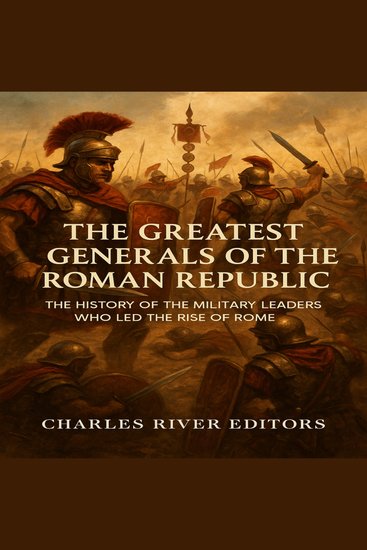
  • Greatest Generals of the Roman Republic The: The History of the Military Leaders Who Led the Rise of Rome - cover

    Greatest Generals of the Roman...

    Charles River Editors

    • 0
    • 0
    • 0
    The Roman army is one of the most famous fighting forces in history. Through its power and prowess, a once obscure Italian city forged an empire that encircled the Mediterranean and covered half of Europe. The physical remains of its presence can be traced from the mountainous borders of Scotland to the arid deserts of Egypt, but its legacy is far greater and more enduring, as Rome's influence continues to shape the political, legal, and cultural landscape of Europe to this very day. 
    While the Roman army is rightly famed as an institution, the image of the individual legionary is also an iconic one. The uniformed, disciplined soldier of the late Republic and early Empire is one of the first things many people imagine when they think of Rome. They are the ultimate image of the ancient soldier, their arms and armor instantly recognizable. Their abilities, not only as warriors but also as engineers and administrators, have made them role models for other soldiers through the centuries. In the same vein, their commanders are still celebrated and studied, and generals the world over have tried to emulate the likes of Julius Caesar. 
    While he remains far less known than his rival Hannibal, Publius Cornelius Scipio, the man who has become known to history as Scipio Africanus, is widely regarded as one of the greatest military leaders of all time. In the space of less than 10 years, the genius of Scipio took Rome from being on the brink of utter destruction to becoming the dominant power in the Mediterranean.  
    Ironically, Gaius Marius’s reforms had made the legions fiercely loyal to their individual generals rather than the state, which allowed his eventual rival Sulla to march his army against Rome and force Marius into exile. With that, Rome’s first civil war was officially underway, but Sulla’s triumph proved short-lived.
    Show book