Join us on a literary world trip!
Add this book to bookshelf
Grey
Write a new comment Default profile 50px
Grey
Subscribe to read the full book or read the first pages for free!
All characters reduced
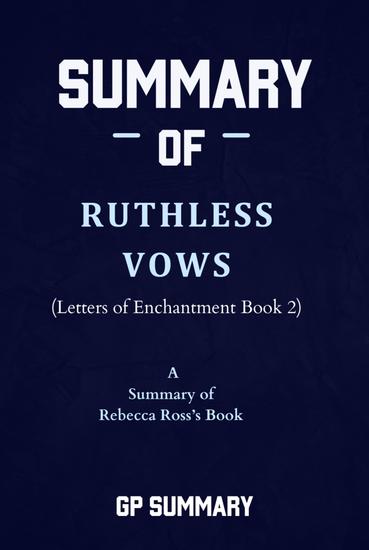
Summary of Ruthless Vows by Rebecca Ross: (Letters of Enchantment Book 2) - cover

Summary of Ruthless Vows by Rebecca Ross: (Letters of Enchantment Book 2)

GP SUMMARY

Publisher: BookRix

  • 0
  • 0
  • 0

Summary

DISCLAIMER
This book does not in any capacity mean to replace the original book but to serve as a vast summary of the original book.

Summary of Ruthless Vows by Rebecca Ross: (Letters of Enchantment Book 2)
 
IN THIS SUMMARIZED BOOK, YOU WILL GET:


- - Chapter astute outline of the main contents.
- - Fast & simple understanding of the content analysis.
- - Exceptionally summarized content that you may skip in the original book 
The epic conclusion to Divine Rivals follows Iris Winnow's return home, where Roman is missing and Oath remains in disbelief. Iris and Attie report on Dacre's movements, knowing the conflict is imminent. Roman, unable to remember his past, writes articles for Dacre, uncertain of his place in the war. A strange letter arrives, and Roman must decide whether to stand with Dacre or betray the god who healed him. As days grow darker, Roman and Iris risk their hearts and futures to change the war.
Available since: 01/05/2024.
Print length: 130 pages.

Other books that might interest you

  • On the Future of Our Educational Institutions - cover

    On the Future of Our Educational...

    Friedrich Nietzsche

    • 0
    • 0
    • 0
    In 1869, at the age of twenty-five, the precociously brilliant Friedrich Nietzsche was appointed to a professorship of classical philology at the University of Basel. He seemed marked for a successful and conventional academic career. Then the philosophy of Schopenhauer and the music of Wagner transformed his sense of purpose. The genius of such thinkers and makers—like the genius of the ancient Greeks—was the only touchstone for true understanding. How then was education to answer to such genius? Something more than sturdy scholarship was called for. A new way of teaching and questioning, a new philosophy...What that new way might be was the question Nietzsche broached in five vivid, popular public lectures in Basel in 1872. Composed in emulation (and to some degree as a satire) of a Platonic dialogue, Anti-Education presents a provocative and timely reckoning with what remains one of the great problems of modern societies.
    Show book
  • African Americans and the Gettysburg Campaign - cover

    African Americans and the...

    James M Paradis

    • 0
    • 0
    • 0
    The Sesquicentennial edition of African Americans and the Gettysburg Campaign updates the original 2006 edition, as James M. Paradis introduces readers to the African-American role in this famous Civil War battle. In addition to documenting their contribution to the war effort, it explores the members of the black community in and around the town of Gettysburg and the Underground Railroad activity in the area.
    Show book
  • The Creation of Nuclear Weapons – The Manhattan Project - The Secret Race to Build the Atomic Bomb and Change the Course of History - cover

    The Creation of Nuclear Weapons...

    Cristian Tyler

    • 0
    • 0
    • 0
    The atomic bomb ended World War II, but its creation was one of the most secretive and controversial projects in human history. Behind closed doors, the world’s greatest scientists—including Albert Einstein, J. Robert Oppenheimer, and Enrico Fermi—raced to develop nuclear weapons before Nazi Germany or Imperial Japan. But what really happened in the laboratories and desert testing sites of the Manhattan Project? 
    This audiobook takes you deep into the story of nuclear weapons, uncovering the secrets, breakthroughs, and moral dilemmas behind their creation. Discover: 
    ✅ How Einstein’s warning letter to FDR ignited a nuclear arms race 
    ✅ The top-secret laboratories and brilliant minds that built the first atomic bomb 
    ✅ The intense ethical debates among scientists about using nuclear weapons 
    ✅ How the bombings of Hiroshima and Nagasaki changed warfare forever 
    The Creation of Nuclear Weapons – The Manhattan Project is a must-listen for history lovers, science enthusiasts, and anyone fascinated by the power and consequences of human innovation.
    Show book
  • Reflections on Happiness - cover

    Reflections on Happiness

    Emilie du Châtelet

    • 0
    • 0
    • 0
    Reflections on Happiness by Gabrielle Émilie Le Tonnelier de Breteuil, Marquise du Châtelet, is a philosophical essay exploring the nature of happiness and its relationship to human life. Written in the 18th century, the work reflects the marquise's deep engagement with the intellectual currents of her time, particularly the Enlightenment. In this piece, she examines the concept of happiness, questioning what it truly means to live a fulfilled and meaningful life. 
    Du Châtelet argues that happiness is not simply a passive state of contentment but is closely linked to the pursuit of reason, virtue, and intellectual growth. She critiques the idea that material wealth or external circumstances alone can bring lasting happiness, suggesting instead that a person’s inner life—shaped by rational thought, self-control, and personal development—plays a crucial role in achieving fulfillment. Moreover, she posits that happiness is a complex and individual experience, shaped by both reason and emotions, and that it is more sustainable when it is aligned with one’s own nature and values. 
    Throughout the work, du Châtelet blends insights from philosophy, science, and personal reflection, offering a nuanced understanding of happiness as both a goal and a process. The essay reflects her belief in the power of human agency and the importance of intellectual and emotional balance in the pursuit of a meaningful life.
    Show book
  • ballast - cover

    ballast

    Quenton Baker

    • 0
    • 0
    • 0
    A poetic sequence using the 1841 slave revolt aboard the brig Creole as a lens through which to view the vitality of Black lives and the afterlife of slavery.In 1841, the only successful, large-scale revolt of American-born enslaved people erupted on the ship Creole. 135 people escaped chattel slavery that day. The event was recounted in US Senate documents, including letters exchanged between US and British consulates in The Bahamas and depositions from the white crew on the ship. There is no known record or testimony from the 135 people who escaped. Their story has been lost to time and indifference. Quenton Baker’s ballast is an attempt at incomplete redress.With imagination, deep empathy, and skilled and compelling lyricism, Baker took a black marker to those Senate documents and culled a poetic recount of the Creole revolt. Layers of ink connect readers to Baker’s poetic process: (re)phrasing the narrative of the state through a dexterous process of hands-on redactions.ballast is a relentless, wrenching, and gorgeously written book, a defiant reclamation of one of the most important but overlooked events in US history, and an essential contribution to contemporary poetry.
    Show book
  • Ancient Australia - The World of Aboriginal Culture - cover

    Ancient Australia - The World of...

    Lillian Brooks

    • 0
    • 0
    • 0
    Aboriginal culture is one of the oldest and most complex systems of human existence, stretching back over 60,000 years in Australia. The richness of this culture is woven through the landscape, the traditions, the language, and the deep spiritual connections the people have with the land. Far from a singular or homogeneous entity, Aboriginal culture is an intricate tapestry made up of diverse languages, customs, and belief systems that reflect the uniqueness of the many nations that have inhabited Australia for millennia. 
    At the heart of Aboriginal culture lies an unbreakable connection to Country. The concept of Country extends beyond mere geography; it encompasses the land, the waterways, the plants, the animals, and even the ancestors that reside within it. This intimate relationship shapes all aspects of life, from spiritual beliefs to daily practices. For Aboriginal people, their land is not simply a place to live, but a living entity that provides, sustains, and is cared for in return. This relationship is integral to the way Aboriginal communities structure their lives, making respect for and care of the environment a fundamental principle. 
    The Dreamtime, or the time of creation, forms the bedrock of Aboriginal spirituality and cultural practices. It is in this time that ancestral beings shaped the land, the people, and the laws that govern life. These stories, which are passed down through generations, guide and influence the way Aboriginal people live, ensuring their survival and cultural continuity. The Dreamtime is not a distant past but a present reality, interwoven with the lives of modern Aboriginal peoples.
    Show book