Join us on a literary world trip!
Add this book to bookshelf
Grey
Write a new comment Default profile 50px
Grey
Subscribe to read the full book or read the first pages for free!
All characters reduced
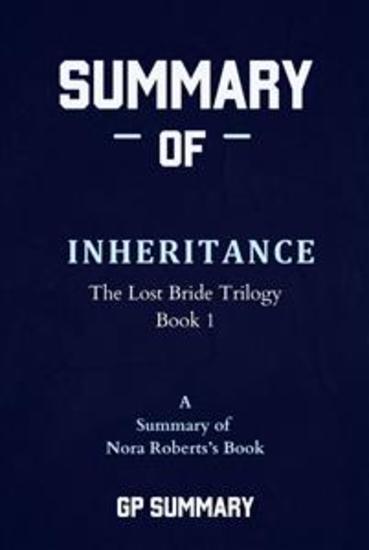
Summary of Inheritance by Nora Roberts: The Lost Bride Trilogy Book 1 - cover

Summary of Inheritance by Nora Roberts: The Lost Bride Trilogy Book 1

GP SUMMARY

Publisher: BookRix

  • 0
  • 0
  • 0

Summary

DISCLAIMERThis book does not in any capacity mean to replace the original book but to serve as a vast summary of the original book. 
Summary of Inheritance by Nora Roberts: The Lost Bride Trilogy, Book 1 
  
IN THIS SUMMARIZED BOOK, YOU WILL GET:- Chapter astute outline of the main contents.- Fast & simple understanding of the content analysis.- Exceptionally summarized content that you may skip in the original book 
  
Inheritance is the first in Nora Roberts' The Lost Bride Trilogy, a story of tragedies, love found and lost, and a family haunted for generations. In 1806, Astrid Poole is murdered and her circle of gold torn from her finger. Graphic designer Sonya MacTavish discovers her late father had a twin and her uncle, Collin Poole, has left her everything, including a Victorian house. She sets out to find out why the boys were separated at birth and solve a centuries-old curse.
Available since: 12/21/2023.
Print length: 123 pages.
Other books that might interest you

  • Our New World - A Journey to People and Places Building the Future Today - cover

    Our New World - A Journey to...

    Florian Hoffmann

    • 0
    • 0
    • 0
    The pandemic, the climate crisis, work – today's world isn't short of challenges. Social injustice. And technology that is slowly but steadily creeping into every aspect of our lives. But what if the answers to the big questions aren't found in simplistic technocracy or a mood of the-end-is-nigh?
    
    Florian Hoffmann is a founder and social entrepreneur. For years, he has been talking to, and working with, people around the world who, like himself, want to make a contribution to a more sustainable, fairer and positive future.
    
    In Our New World (Die Neue Welt), he takes the reader on an expedition to the places and people that have already arrived in this future: young entrepreneurs, innovators, founders and leaders who are courageously shaping a better world.
    
    Florian Hoffmann demonstrates the huge potential for creating a better future today. He visits places and people around the world, where courage and imagination have already paved the way for the world of tomorrow. Beacons for the way ahead, these role models encourage readers to take their own steps into the New World. Many are breaking down the border between earning money and making a positive contribution, and are asking, more generally: What impact can I have, now and in the future? How can my success offer others new chances?
    
    The journalist Saba is fighting for girls' and women's right in Pakistan. Niall dumps his high-flying job to find a solution for microplastics pollutions. Lily wants to inspire people to take up life-long learning – and develops scenarios for what future jobs might look like. These are some of the many diverse voices who believe in a better future.
    Show book
  • Ephesians - The World English Bible Book 49 (Unabridged) - cover

    Ephesians - The World English...

    Various Authors

    • 0
    • 0
    • 0
    Ephesians is the tenth book of the New Testament. Its authorship has traditionally been attributed to Paul the Apostle but starting in 1792, this has been challenged as Deutero-Pauline, that is, pseudepigrapha written in Paul's name by a later author strongly influenced by Paul's thought, probably "by a loyal disciple to sum up Paul's teaching and to apply it to a new situation fifteen to twenty-five years after the Apostle's death".
    Show book
  • The Knotsman - cover

    The Knotsman

    Math Jones

    • 0
    • 0
    • 0
    The Knotsman does not exist, you will not find him in history books or collections of 'bygone' skills. But Math Jones has created him, and his fellows, in a time very like the English Civil War. There he is, going from house to house, village to village, battlefield to gallows, unravelling knots and problems, physical, emotional and psychological; a new kind of cunning man, not always welcome, not always quite as clever as his fingers and picks would have him believe.
    Show book
  • Painted People: Humanity in 21 Tattoos - cover

    Painted People: Humanity in 21...

    Matt Lodder

    • 0
    • 0
    • 0
    In 1881, a writer in the Saturday Review called tattooing ‘an art without a history’. ‘No-one’, it went on, ‘has made it the business of his life to study the development of tattooing.’ Until now. 
    Painted People is a beguiling and intimate look at an untold history of humanity. 
    The earliest tattoos yet identified belonged to Ötzi, the ‘iceman’, whose mummy allows us a brief glimpse into the prehistory of the practice. We know that over the more than five thousand years since he was tattooed, countless cultures have performed this ancient practice, and people in every corner of the world have been tattooed. For the most part, these fascinating histories remain stubbornly untold, and the secrets of Siberian princesses, Chinese generals and Victorian socialites have been hidden on the skin, under layers of clothing and under layers of history. Now with access to a wealth of new and unreported material, this book will roll up its sleeves and reveal the artwork hidden beneath them. 
    In Painted People, Dr Matt Lodder, one of the world’s foremost experts on tattooing, tells the stories of people like Arnaq, who was tattooed in keeping with her cultural and religious traditions in sixteenth-century Canada, and Horace Ridler, who was tattooed as a means to make money in 1930s London. And in between these two extremes, he describes tattoos inked for love, for loyalty, for sedition and espionage and for self-expression, as well as tattoos inflicted on the unwilling, to ostracise. Taken together, these twenty-one tattoos paint a portrait of humanity as both artist and canvas. 
    Lodder's Painted People is a top-tier exploration of body art, blending science and design in a unique anthropological study. His criticism of popular views on tattooing offers a fresh perspective on this ancient practise. 
    For fans of Nick Schonberger (The Language of Tattoos), John Miller (The Philosophy of Tattoos), Trent Aitken-Smith (The Tattoo Dictionary), Caroline Vout (Exposed), and Yori Moriarty (Japanese Tattoos). 
    HarperCollins 2022
    Show book
  • Medieval Knights - Historical Details of the Military in the Middle Ages - cover

    Medieval Knights - Historical...

    Kelly Mass

    • 0
    • 0
    • 0
    A knight is a person who has been granted the honorary title of knighthood by a head of state, including a monarch or the Pope, in recognition of their service to the ruler, the church, or the nation, often in a military capacity. The origins of knighthood can be traced back to classical antiquity, where similar figures existed in ancient Greece and Rome, such as the Greek hippeis and hoplite, as well as the Roman eques and centurion. 
    Knighthood first emerged among mounted soldiers in Europe during the Early Middle Ages. At this time, it was typically associated with those who fought in battles on horseback, a hallmark of the knightly class. During the High Middle Ages, the concept of knighthood evolved, and it became increasingly seen as a position held by lesser aristocrats. It was no longer just about military service but also connected with ideals of chivalry, a code of conduct that governed the behavior of Christian warriors, particularly those involved in courtly matters. By the Late Middle Ages, a knight had come to represent the archetypal courtly Christian warrior, combining military prowess with a sense of honor and duty. 
    Knights were often vassals to powerful lords, serving as elite combatants, bodyguards, or even commanders of military forces in exchange for land or other forms of patronage. They had a special relationship with their lords, who relied on their skills, particularly in mounted combat, to protect their interests and defend their territories. This connection between knights and horseback riding is reflected in many words associated with knighthood, such as "chivalry," "cavalier," and other related terms. In this context, the knightly status in Christendom parallels the military class known as the furusiyya in the Islamic world.
    Show book
  • Residual Governance - How South Africa Foretells Planetary Futures - cover

    Residual Governance - How South...

    Gabrielle Hecht

    • 0
    • 0
    • 0
    In Residual Governance, Gabrielle Hecht dives into the wastes of gold and uranium mining in South Africa to explore how communities, experts, and artists fight for infrastructural and environmental justice. Hecht outlines how mining in South Africa is a prime example of what she theorizes as residual governance—the governance of waste and discard, governance that is purposefully inefficient, and governance that treats people and places as waste and wastelands. She centers the voices of people who resist residual governance and the harms of toxic mining waste to highlight how mining's centrality to South African history reveals the links between race, capitalism, the state, and the environment. In this way, Hecht shows how the history of mining in South Africa and the resistance to residual governance and environmental degradation is a planetary story: the underlying logic of residual governance lies at the heart of contemporary global racial capitalism and is a major accelerant of the Anthropocene.
    Show book