Join us on a literary world trip!
Add this book to bookshelf
Grey
Write a new comment Default profile 50px
Grey
Subscribe to read the full book or read the first pages for free!
All characters reduced
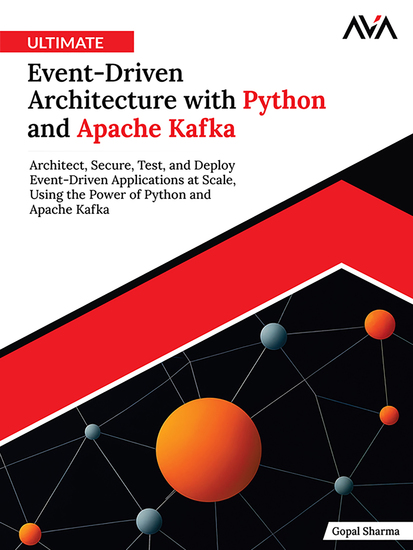
Ultimate Event-Driven Architecture with Python and Apache Kafka - Architect Secure Test and Deploy Event-Driven Applications at Scale Using the Power of Python and Apache Kafka - cover

Ultimate Event-Driven Architecture with Python and Apache Kafka - Architect Secure Test and Deploy Event-Driven Applications at Scale Using the Power of Python and Apache Kafka

Gopal Sharma

Publisher: Orange Education Pvt. Ltd

  • 0
  • 0
  • 0

Summary

Build high-performance, scalable, and resilient systems using Python and Kafka.
Book Description
Python’s simplicity and flexibility, combined with Apache Kafka’s high-throughput, fault-tolerant messaging system, make them a powerful duo for building scalable, event-driven applications. Ultimate Event-Driven Architecture with Python and Apache Kafka brings together these two technologies to help developers and architects design modern, asynchronous systems capable of handling real-time data at scale.
The book begins by introducing the fundamentals of Event-Driven Architecture (EDA), including its core principles, benefits, and real-world relevance. It then explores the essential components of an EDA system, guiding readers through design patterns, message flow, and architectural considerations. Security, testing, and observability are covered in depth to ensure robust and reliable systems.
Later chapters dive into Apache Kafka concepts and demonstrate how to build and deploy practical, real-world solutions using Python. Hands-on examples and a complete use case walk-through ensure that readers can confidently apply what they’ve learned in production scenarios.
Whether you're modernizing legacy systems or architecting from scratch, this book equips you to build event-driven systems that are scalable, resilient, and future-ready. Start your EDA journey with Python and Kafka today!
Table of Contents
1. Event-Driven Architecture: Introduction
2. Components of Event-Driven Architecture
3. Event-Driven Architecture: Real-World Examples
4. Designing Event-Driven Architecture
5. Security Best Practices
6. Testing and Debugging
7. Monitoring
8. Apache Kafka: Concept
9. Real-World Use Case with Python and Kafka      

Index
Available since: 08/31/2025.
Other books that might interest you

  • A Fenland Garden - Creating a haven for people plants and wildlife in the Lincolnshire Fens - cover

    A Fenland Garden - Creating a...

    Francis Pryor

    • 0
    • 0
    • 0
    The story of how Francis Pryor created a haven for people, plants and wildlife in a remote corner of the fens. 
     
    A Fenland Garden is the story of the creation of a garden in a complex and fragile English landscape - the Fens of southern Lincolnshire - by a writer who has a very particular relationship with landscape and the soil, thanks to his distinguished career as an archaeologist and discoverer of some of England's earliest field systems. It describes the imagining, planning and building of a garden in an unfamiliar and sometimes hostile place, and the challenges, setbacks and joys these processes entail. This is a narrative of the making of a garden, but it is also about reclaiming a patch of ground for nature and wildlife - of repairing the damage done to a small slice of Fenland landscape by decades of intensive farming. 
     
    A Fenland Garden is informed by the empirical wisdom of a practising gardener (and archaeologist) and by his deep understanding of the soil, landscape and weather of the region; Francis's account of the development of the garden is counterpointed by fascinating nuggets of Fenland lore and history, as well as by vignettes of the plantsman's trials and tribulations as he works an exceptionally demanding plot of land.
    Show book
  • The Martians - The True Story of an Alien Craze that Captured Turn-of-the-Century America - cover

    The Martians - The True Story of...

    David Baron

    • 0
    • 0
    • 0
    In the early 1900s, many Americans actually believed we had discovered intelligent life on Mars, as bestselling science writer David Baron chronicles in The Martians, his truly bizarre tale of a nation swept up in Mars mania. 


    At the center of Baron's historical drama is Percival Lowell, the Boston Brahmin and Harvard scion, who observed "canals" etched into the surface of Mars. Lowell devised a grand theory that the red planet was home to a utopian society that had built gargantuan ditches to funnel precious meltwater from the polar icecaps to desert farms and oasis cities. The public fell in love with the ambitious amateur astronomer who shared his findings in speeches and wildly popular books. 


    While at first people treated the Martians whimsically―Martians headlining Broadway shows, biologists speculating whether they were winged or gilled―the discussion quickly became serious. Inventor Nikola Tesla announced he had received radio signals from Mars; Alexander Graham Bell agreed there was "no escape from the conviction" that intelligent beings inhabited the planet. Martian excitement reached its zenith when Lowell financed an expedition to photograph Mars from Chile's Atacama Desert, resulting in what newspapers hailed as proof of the Martian canals' existence.
    Show book
  • Multiple Sclerosis Antidote - cover

    Multiple Sclerosis Antidote

    Craig Beck

    • 0
    • 0
    • 0
    Millions of people around the world have been diagnosed with incurable autoimmune diseases like Multiple Sclerosis. Debilitating conditions that make us tired, ill, and miserable. The only solution the medical industry offers are side-effect riddled maintenance drugs such as steroids and painkillers.Getting a formal diagnosis of MS is often a lengthy and challenging process. Many never get a medical confirmation of what is happening to their mind and body at all! Countless individuals live in constant pain and discomfort because they incorrectly assume all their health problems are the natural result of aging.Unfortunately, Craig Beck joined this ill-health demographic at the age of 48. After suffering months of severe symptoms, eventually, he too got handed the autoimmunity life sentence. However, rather than accept the hand as it was dealt. He remembered that the best medicine for a long and healthy life is found at the end of your fork, not the doctor's prescription pad. Craig decided to fall back on his research into natural medicine. He designed a diet and lifestyle that made inflammation the enemy and target. A process that would show amazing success at pushing Multiple Sclerosis firmly into near-permanent remission. In this special MS addition of the Autoimmune Antidote, you will gain valuable insight into the new, natural approach that can help you prevent and maybe even reverse the life-limiting symptoms of Multiple Sclerosis and other inflammatory health problems.
    Show book
  • Practical Data Analytics for BFSI - cover

    Practical Data Analytics for BFSI

    Bharat Sikka

    • 0
    • 0
    • 0
    Are you looking to unlock the transformative potential of data analytics in the dynamic world of Banking, Financial Services, and Insurance (BFSI)? This book is your essential guide to mastering the intricate interplay of data science and analytics that underpins the BFSI landscape.
    
    Designed for intermediate-level practitioners, as well as those aspiring to join the ranks of BFSI analytics professionals, this book is your compass in the data-driven realm of banking. Address the unique challenges and opportunities of the BFSI sector using Artificial Intelligence and Machine Learning models for a data driven analysis.
    This book is a step by step guide to utilize tools like IBM SPSS and Microsoft Power BI. Hands-on examples that utilize Python and SQL programming languages make this an essential guide.
    
    The book features numerous case studies that illuminate various use cases of Analytics in BFSI. Each chapter is enriched with practical insights and concludes with a valuable multiple-choice questionnaire, reinforcing understanding and engagement. This book will uncover how these solutions not only pave the way for increased profitability but also navigate risks with precision and elevate customer support to unparalleled heights.
    Show book
  • Egyptian Science - Innovations and Discoveries of the Ancient World (3 in 1) - cover

    Egyptian Science - Innovations...

    Omar Khalil

    • 0
    • 0
    • 0
    Egyptian Science – Innovations and Discoveries of the Ancient World (3 in 1) offers a captivating dive into the scientific brilliance of ancient Egypt, revealing how a civilization often known for its mysticism was also a beacon of practical knowledge and invention. This collection highlights the remarkable advancements made by Egyptian scholars, physicians, engineers, and astronomers—centuries before many of these concepts reached the rest of the world. 
    The first section explores medicine and anatomy, showcasing how ancient Egyptian doctors performed surgeries, treated wounds, and understood diseases with a surprisingly systematic approach. Medical texts, herbal remedies, and anatomical observations formed the foundation of a health system deeply intertwined with both empirical knowledge and spiritual beliefs. 
    In the second section, readers uncover the mathematical and engineering feats that made the construction of monumental structures like pyramids and temples possible. Discover how Egyptians used geometry, surveying tools, and complex planning techniques to design precise buildings and manage the Nile’s life-giving floods. Their grasp of weights, measurements, and balance was essential to everything from agriculture to architecture. 
    The final section reveals the Egyptians' advanced understanding of astronomy and timekeeping. They charted celestial movements, created solar calendars, and aligned structures with astronomical events. Whether for agricultural cycles, religious ceremonies, or royal rituals, their scientific innovations were closely tied to their spiritual worldview. This volume shows how ancient Egypt’s legacy is not only in stone but also in knowledge that shaped civilizations to come.
    Show book
  • Splinters of Infinity - Cosmic Rays and the Clash of Two Nobel Prize-Winning Scientists over the Secrets of Creation - cover

    Splinters of Infinity - Cosmic...

    Mark Wolverton

    • 0
    • 0
    • 0
    Set in a revolutionary era of physics and science when a series of rapid-fire discoveries was upending our understanding of the universe, Splinters of Infinity by Mark Wolverton tells a little-known story: the tale of two of America's foremost physicists, Robert Millikan (1868–1953) and Arthur Compton (1892–1962), who found themselves locked in an intense, often deeply personal, conflict about cosmic rays. Confirmed in 1912, cosmic rays—enigmatic forms of penetrating radiation—seemed to raise all new questions about the origins of the universe, but they also offered the potential to explain everything—or reveal the existence of God. 


    In engaging, accessible prose, Wolverton takes the listener through the twists and turns of the Millikan-Compton debate, one of the first major public examples of how heated the controversies among scientists could become—and the lengths that scientists would go to settle their disputes. Along the way, Wolverton probes the forever elusive question, still unanswered today, about where cosmic rays come from and what they reveal about black holes, distant galaxies, the existence of dark matter and dark energy, and the birth of the universe, concluding that these splinters of infinity may not hold the keys to the secret of creation but do bring us ever closer to it.
    Show book