Join us on a literary world trip!
Add this book to bookshelf
Grey
Write a new comment Default profile 50px
Grey
Subscribe to read the full book or read the first pages for free!
All characters reduced
A Collection of Emblemes Ancient and Moderne - Quickened With Metrical Illustrations Both Morall and Divine Etc - cover

A Collection of Emblemes Ancient and Moderne - Quickened With Metrical Illustrations Both Morall and Divine Etc

George Wither

Publisher: DigiCat

  • 0
  • 0
  • 0

Summary

In "A Collection of Emblemes, Ancient and Moderne," George Wither presents a captivating amalgamation of poetry and visual art that reflects the emblematic tradition of the early 17th century. This work features a series of emblems—symbolic illustrations accompanied by poetic commentary—that explore themes of morality, virtue, and the human experience. Wither's literary style is characterized by its clarity and moral undertone, deftly intertwining classical allusions and contemporary relevance, thus situating the text within the broader context of Renaissance humanism and its fascination with allegory. The emblems serve not only as aesthetic objects but also as moral treatises, encouraging readers to introspect on the ethical implications of their actions amidst the complexities of life. George Wither, an English poet and a significant figure in the realm of Renaissance literature, was influenced by the tumultuous socio-political climate of the time, including the English Civil War. His experiences as a soldier and a satirist enriched his understanding of human nature and morality, infusing his work with a fervent desire to provoke contemplation among his readers. Wither's own struggles for political and religious reform often found resonance within his emblemes, establishing him as a voice of advocacy for virtue and justice. Readers seeking a thought-provoking exploration of emblematic literature will find great value in Wither's collection. Each emblem invites contemplation and reflection, proving relevant even in today's ethical landscape. Rich with artistic beauty and profound insights, "A Collection of Emblemes, Ancient and Moderne" stands as a testament to Wither's literary prowess and enduring relevance, making it essential reading for scholars and enthusiasts of Renaissance literature alike.
Available since: 09/04/2022.
Print length: 427 pages.

Other books that might interest you

  • Power Pleasure and Pain - A Study of Abuse Through Time - cover

    Power Pleasure and Pain - A...

    Sean Dupree

    • 0
    • 0
    • 0
    "Power, Pleasure, and Pain: A Study of Abuse Through Time" delves into the dark history of how sexual violence and abuse have been intertwined with power structures throughout history. From the libertine excesses of figures like the Marquis de Sade to the scandals of modern-day predators like Harvey Weinstein and R. Kelly, this book provides a compelling examination of how those in power have used their positions to exploit and control others. 
    Spanning centuries, this critical exploration looks at the societal, cultural, and institutional failures that have enabled abusers to operate with impunity. Sean Dupree uses both historical and contemporary examples to highlight the systemic nature of sexual violence, tracing its roots back to philosophical and psychological underpinnings of dominance and submission. 
    Whether dissecting the abuse of power in religious institutions, entertainment, or the workplace, this study leaves no stone unturned. "Power, Pleasure, and Pain" is a powerful reminder that, despite the progress made by movements like #MeToo, much work remains to be done in holding abusers accountable and supporting survivors of sexual violence.
    Show book
  • Plato's Ion - cover

    Plato's Ion

    Plato

    • 0
    • 0
    • 0
    Socrates questions Ion, an actor who just won a major prize, about his ability to interpret the epic poetry of Homer. How does an actor, a poet, or any other artist create? Is it by knowing? Is it by inspiration? As the dialogue proceeds, the nature of human creativity emerges as a mysterious process and an unsolved puzzle.
    Show book
  • Untangling Critical Race Theory - What Christians Need to Know and Why It Matters - cover

    Untangling Critical Race Theory...

    Ed Uszynski

    • 0
    • 1
    • 0
    What is Critical Race Theory?
    It may be one of the most widely referenced issues of the day, but it's also one of the least understood. In its translation from the academic world to the general public, Critical Race Theory (CRT) has inaccurately become a catch-all term for anything related to race. But what does it actually mean, and how should Christians engage it?
    Ed Uszynski—whose PhD in American culture studies navigated readings in Marxism, Critical Theory, and Critical Race Theory—carefully unpacks what critical race theorists seek to accomplish and what Christians can learn from them. Uszynski generously explores CRT's roots, context, and central tenets, revealing how its insights are used and distorted but also how they might benefit the church. With responsible answers to legitimate concerns, Uszynski goes beyond the surface to provide a reliable path of just discernment and cultural engagement.
    Show book
  • The Treaty of Versailles - The Treaty that Marked the End of World War I - cover

    The Treaty of Versailles - The...

    50 50minutes

    • 0
    • 0
    • 0
    Keen to learn but short on time? Get to grips with the history of the Treaty of Versailles in next to no time with this concise guide.
    50Minutes provides a clear and engaging analysis of the Treaty of Versailles. The First World War had left Europe in a state of almost total devastation. Eager to seek revenge, the Allied powers came together to draft the Treaty of Versailles, which would see Germany pay reparations to the victors and the borders of former Empires redrawn. It was, however, a flawed agreement, and its economic and political consequences would be disastrous.
    In just 50 minutes you will:
    • Contextualise the Treaty of Versailles and the events leading up to the end of the First World War
    • Understand how the Allied powers often acted purely in their own economic and political interests
    • Recognise the consequences of the treaty's enforcement, including its economic ramifications and the rise of nationalism across Europe
    ABOUT 50MINUTES|History & Culture
    50MINUTES will enable you to quickly understand the main events, people, conflicts and discoveries from world history that have shaped the world we live in today. Our publications present the key information on a wide variety of topics in a quick and accessible way that is guaranteed to save you time on your journey of discovery.
    Show book
  • Past Imperfect - French Intellectuals 1944-1956 - cover

    Past Imperfect - French...

    Tony Judt

    • 0
    • 1
    • 0
    A “marvelously readable” critique of Sartre, Camus, de Beauvoir, and other French postwar intellectuals that “consistently entertains and provokes” (The Washington Post).   The uniquely prominent role of French intellectuals in European cultural and political life following World War II is the focus of this book by the acclaimed author of Postwar: A History of Europe Since 1945. Tony Judt analyzes this intellectual community’s most divisive conflicts: how to respond to the promise and the betrayal of Communism and how to sustain a commitment to radical ideals when confronting the hypocrisy in Stalin’s Soviet Union, in the new Eastern European Communist states, and in France itself. Judt shows why this was an all-consuming moral dilemma to a generation of French men and women, how their responses were conditioned by war and occupation, and how postwar political choices have come to sit uneasily on the conscience of later generations of French intellectuals. Judt’s analysis extends beyond the writings of fashionable “existentialist” personalities such as Jean-Paul Sartre, Albert Camus, and Simone de Beauvoir to include a wide intellectual community of Catholic philosophers, non-aligned journalists, literary critics and poets, Communist and non-Communist alike—and asserts that what he calls the “moral irresponsibility” of those years damaged France’s cultural standing, and reflected the nation’s larger difficulty in confronting its own ambivalent past.   “A forthright and uncommonly damning study of those intellectually volatile years . . . indicts these intellectuals for their inhumanity in failing to test their political thought against political reality.” —The New York Times Book Review   “Brilliant . . . splendidly written.” —Foreign Affairs
    Show book
  • Exiles of the Jews in Antiquity The: The History and Legacy of the Ancient Conflicts that Created the Jewish Diaspora - cover

    Exiles of the Jews in Antiquity...

    Editors Charles River

    • 0
    • 0
    • 0
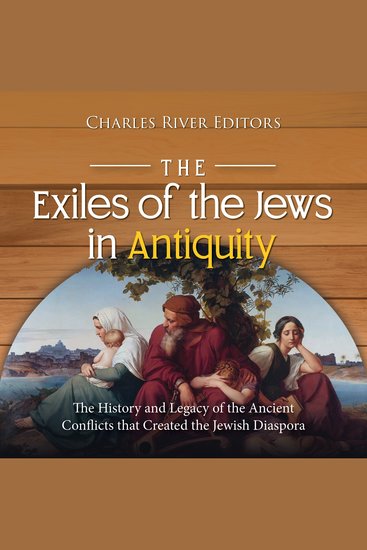
    The story of the Ancient Israelites in Egypt is one of the most famous stories in the world, and one of the most contentious from a historical standpoint. Today, most people know about the relationship between the ancient Israelites and the Egyptians from the Old Testament book of Exodus, and the numerous feature films that often depict the dealings between the two peoples in contentious ways. The deadly plagues, the crossing of the Red Sea, the arduous 40 years the Israelites spent in the desert, and the Ten Commandments all make the Exodus unforgettable, but they’ve also left generations of scholars wondering just how accurate the Scripture is. 
    	The return of the Israelites to Israel is, of course, inextricably linked to the history of the Jewish people, their dispersal throughout the Mediterranean world, and their reestablishment of the modern state of Israel in the wake of the horrors of the Holocaust. The small area around Jerusalem was originally known to the ancient Greeks as Ioudaioi, hence the name Judea. An Iron Age kingdom is said, in the Bible, to have existed as a successor to the United Kingdom of Israel, which, it is claimed, existed from approximately 1010-930 BCE. The split in the kingdom, according to the Bible, was the result of the refusal of the northern tribes to accept the son of Solomon, Rehoboam, as their king. The Bible claims that, initially, only the tribe of Judah remained loyal to the House of David, but Benjamin also joined with the loyalists after a few years. Two kingdoms, Judah in the south and Israel in the north, co-existed uneasily, with frequent outbreaks of war between them in the following years. Judah was invaded by the Egyptian Pharaoh, Shishak, in the 5th year of Rehoboam’s reign, and Jerusalem was sacked. Rehoboam gave the Egyptians all of the nation’s treasure and became an Egyptian vassal. 
    Show book