Join us on a literary world trip!
Add this book to bookshelf
Grey
Write a new comment Default profile 50px
Grey
Subscribe to read the full book or read the first pages for free!
All characters reduced
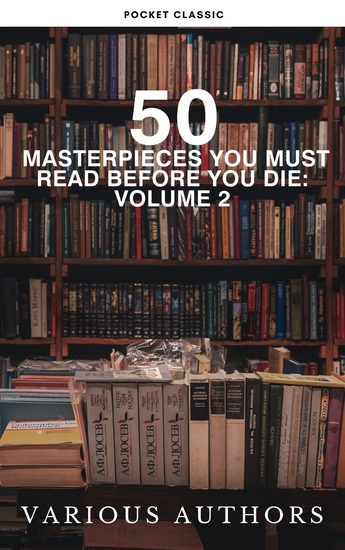
50 Masterpieces You Must Read Before You Die: Volume 2 - Unleash Your Inner Bookworm - cover

50 Masterpieces You Must Read Before You Die: Volume 2 - Unleash Your Inner Bookworm

George Eliot, Charles Dickens, Lewis Carroll, Louisa May Alcott, Jane Austen, Oscar Wilde, Alexandre Dumas, Bram Stoker, Joseph Conrad, Charlotte Brontë, Daniel Defoe, Emily Brontë, Henry James, D. H. Lawrence, Anne Brontë, Honoré de Balzac, Willa Cather, Edgar Rice Burroughs, Arthur Conan Doyle, Victor Hugo, Fyodor Dostoyevsky, James Joyce, E. Cummings, Miguel de Cervantes, Leo Tolstoy, Pocket Classic, Gustave Flaubert

Publisher: Pocket Classic

  • 0
  • 0
  • 0

Summary

Embark on a transformative journey through time and cultures with Vol. 2 of our acclaimed "50 Masterpieces" collection!
Dive into timeless tales from literary giants like James Joyce, D.H. Lawrence, and Leo Tolstoy. Experience the thrills of adventure with classics like
"Treasure Island" and "Moby Dick." Explore the depths of human nature with "The Scarlet Letter" and "War and Peace." This meticulously curated volume features easy-to-navigate HTML tables of content for a seamless reading experience."A must-have for any bibliophile! A fantastic selection that will keep you turning pages long into the night." - Bookish Blog
Don't miss this opportunity to expand your literary horizons and discover the transformative power of great storytelling. Start reading today!
This book contains now several HTML tables of contents that will make reading a real pleasure!
Novels
Jerome, Jerome K.: "Three Men in a Boat"
Joyce, James: "A Portrait of the Artist as a Young Man"
Joyce, James: "Ulysses"
Kingsley, Charles: "The Water-Babies"
Kipling, Rudyard: "Kim"
La Fayette, Madame de: "The Princess of Clèves"
Laclos, Pierre Choderlos de: "Dangerous Liaisons"
Lawrence, D. H.: "Sons and Lovers"
Lawrence, D. H.: "The Rainbow"
Le Fanu, Joseph Sheridan: "In a Glass Darkly"
Lewis, Matthew Gregory: "The Monk"
Lewis, Sinclair: "Main Street"
London, Jack: "The Call of the Wild"
Lovecraft, H. P.: "At the Mountains of Madness"
Mann, Thomas: "Royal Highness"
Maugham, W. Somerset: "Of Human Bondage"
Maupassant, Guy de: "Bel-Ami"
Melville, Herman: "Moby-Dick"
Poe, Edgar Allan: "The Fall of the House of Usher"
Proust, Marcel: "Swann's Way"
Radcliffe, Ann: "The Mysteries of Udolpho"
Richardson, Samuel: "Clarissa"
Sand, George: "The Devil's Pool"
Scott, Walter: "Ivanhoe"
Shelley, Mary: "Frankenstein"
Sienkiewicz, Henryk: "Quo Vadis"
Sinclair, May: "Life and Death of Harriett Frean"
Sinclair, Upton: "The Jungle"
Stendhal: "The Red and the Black"
Stendhal: "The Chartreuse of Parma"
Sterne, Laurence: "Tristram Shandy"
Stevenson, Robert Louis: "Treasure Island"
Stoker, Bram: "Dracula"
Stowe, Harriet Beecher: "Uncle Tom's Cabin"
Swift, Jonathan: "Gulliver's Travels"
Tagore, Rabindranath: "The Home and the World"
Thackeray, William Makepeace: "Vanity Fair"
Tolstoy, Leo: "War and Peace"
Tolstoy, Leo: "Anna Karenina"
Troloppe, Anthony: "The Way We Live Now"
Turgenev, Ivan: "Fathers and Sons"
Twain, Mark: "The Adventures of Huckleberry Finn"
Verne, Jules: "Journey to the Interior of the Earth"
Wallace, Lew: "Ben-Hur"
Wells, H. G.: "The Time Machine"
West, Rebecca: "The Return of the Soldier"
Wharton, Edith: "The Age of Innocence"
Wilde, Oscar: "The Picture of Dorian Gray"
Xueqin, Cao: "The Dream of the Red Chamber"
Zola, Émile: "Germinal" 
Available since: 06/24/2024.
Print length: 12300 pages.

Other books that might interest you

  • Campfire Stories to Tell in the Dark - Psychological Horror Stories for Those Who Crave Fear and Mystery - cover

    Campfire Stories to Tell in the...

    Jay Nero

    • 0
    • 0
    • 0
    What brought you here? A spark of curiosity? A whisper? Or something you can’t quite name? 
    And what if it wasn’t by chance—that detail that made you stop? 
    Some stories aren’t meant to be stumbled upon. They find you. They wait for you. 
    They take you where you didn’t want to go… but where you needed to be. 
    Campfire Stories to Tell in the Dark is a whispered invitation to step into the cracks, where appearances crumble, and normality quietly breaks, making room for the unexpected. 
    It’s a slow, silent descent into the shadowy corners of psychological horror, where fear doesn’t scream, but slips in. 
    Where every story starts with something familiar… then twists, silently shedding its skin before your eyes. 
    And just when you think you’ve figured it out… 
    The ending will take you by surprise. 
    What you’ll find inside: 
    🕯️ 7 original tales filled with unease, mystery, and mounting tension 
    🕯️ Final twists that turn everything you thought you knew upside down 
    🕯️ Short but intense stories, crafted to be read in low light 
    🕯️ A perfect balance of atmosphere and shock 
    🕯️ Subtle storytelling, where the real threat often hides in plain sight 
    🕯️ Themes like trauma, isolation, guilt, the inescapable—and unspeakable secrets 
    Turn off the noise. Keep just a little light with you. 
    The stories you’re about to listen demand it. 
    Let Stories to Tell in the Dark call you in. Let the journey begin. 
    But don’t look back… if you hear something moving behind you.
    Show book
  • God Sees the Truth But Waits - From their pens to your ears genius in every story - cover

    God Sees the Truth But Waits -...

    Leo Tolstoy

    • 0
    • 0
    • 0
    Leo Tolstoy was born in 1828 in the Russian province of Tula to a wealthy noble family. As a child, he had private tutors but he showed little interest in any formal education. When he went to the University of Kazan in 1843 to study oriental languages and law, he left without completing his courses.  Life now was relaxed and idle but with some writing also taking place.  Gambling debts forced an abrupt change of path and he joined the army to fight in the Crimean War.  He was commended for his bravery and promoted but was appalled at the brutality and loss of life.  He recorded these and other earlier experiences in his diaries which formed the basis of several of his works. 
    In 1852 ‘Childhood’ was published to immediate success and was followed by ‘Boyhood’ and ‘Youth’. 
    His experience in the army and the horrors he witnessed resulted in ‘The Cossacks’ in 1862 and the trilogy ‘Sevastopol Tales’. After the war he travelled around Europe, visiting London and Paris and meeting such luminaries as Victor Hugo and Charles Darwin.  
    It was now that Tolstoy began his masterpiece, ‘War and Peace’. Published in 1869 it was an epic work that changed literature. He quickly followed this with ‘Anna Karenina’.  
    These successes made Tolstoy rich and helped him accomplish many of his dreams but also brought problems as he grappled with his faith and the lot of the oppressed poor. These revolutionary views became so popular that the authorities now kept him under surveillance.  
    He led a life of asceticism and vegetarianism and put his socialist ideals into practice by establishing numerous schools for the poor and food programmes. He also believed in giving away his wealth, which caused much discord with his wife.  
    His writing continued to bring forth classics such as ‘The Death of Ivan Ilyich’ and many brilliant and incisive short stories such as ‘How Much Land Does A Man Need’.  
    In 1901 Tolstoy was excommunicated from the Church and controversially deselected for the Nobel Prize for Literature. 
    Whilst undertaking a pilgrimage by train in October 1910 with his daughter Aleksandra he caught pneumonia in the nearby town of Astapovo.  Leo Tolstoy died on November 9th, 1910, he was 82.
    Show book
  • Northern Albanian Folk Tales Myths and Legends - cover

    Northern Albanian Folk Tales...

    Arti Malaj

    • 0
    • 0
    • 0
    Generations of Northern Albanian are known as great story tellers. They shared many folk tales, myths, and legends with their descendants. The collected short stories include mysterious legends of lost treasures, mystical tales of mountain fairies, superhuman powers, century-old witches, blood feuds, and more written by a twelfth-generation Albanian. The lands described in the stories are still visible today, and locals share a sense of wonder and respect the mysteries that hide beneath. Northern Albania is a true treasure of raw natural beauty and a hidden gem in Southeastern Europe.
    Show book
  • The Pleasure in Pain - A Queer Horrortica Anthology - cover

    The Pleasure in Pain - A Queer...

    Written by A Full Anthology of...

    • 0
    • 0
    • 0
    UNBURY YOUR GAYS 
    For centuries our stories of romance and love were hidden, coded within for future readers to decipher. There is none of that here. 
    Here's a shovel. 
    Twenty-five stories and poems explore the spectrum of queerness through love and lust, and a little blood. Twisted fairytales, possessed jewelry, a house that offers your desires but you can never leave, a god's bathroom glory hole, an asexual cult, and more show you THE PLEASURE IN PAIN.
    Show book
  • At Christmas Time - From their pens to your ears genius in every story - cover

    At Christmas Time - From their...

    Anton Chekhov

    • 0
    • 0
    • 0
    Anton Pavlovich Chekhov was born on 29th January 1860 in Taganrog, on the south coast of Russia.  
    His family life was difficult; his father was strict and over-bearing but his mother was a passionate story-teller, a subject Chekhov warmed to. As he later said; ‘our talents we got from our father, but our soul from our mother’.  
    At school Chekhov was distinctly average. At 16 his father mis-managed his finances and was declared bankrupt. His family fled to Moscow. Chekhov remained and eked out a living by various means, including writing and selling short sketches to newspapers, to finish his schooling. That completed and with a scholarship to Moscow University obtained he rejoined his family. 
    He was able to help support them by selling satirical sketches and vignettes of Russian lifestyles and gradually obtained further commissions. In 1884, he qualified as a physician and, although it earned him little, he often treated the poor for free, he was fond of saying ‘Medicine is my lawful wife, and literature is my mistress.’ 
    His own health was now an issue as he began to cough up blood, a symptom of tuberculosis.  Despite this his writing success enabled him to move the family into more comfortable accommodation.  
    Chekhov wrote over 500 short stories which included many, many classics including ‘The Kiss’ and ‘The Lady with a Dog’.  His collection ‘At Dusk’ won him the coveted Pushkin Prize when was only 26.  
    He was also a major playwright beginning with the huge success of ‘Ivanov’ in 1887.   
    In 1892 Chekhov bought a country estate north of Moscow. Here his medical skills and money helped the peasants tackle outbreaks of cholera and bouts of famine. He also built three schools, a fire station and a clinic.  It left him with less time for writing but the interactions with real people gained him detailed knowledge about the peasantry and their living conditions for his stories.  
    His most famous work, ‘The Seagull’ was received disastrously at its premiere in St Petersburg. It was later restaged in Moscow to highlight its psychological aspects and was a huge success. It led to ‘Uncle Vanya’, ‘The Three Sisters’ and ‘The Cherry Orchard’.  
    Chekhov suffered a major lung hemorrhage in 1897 while visiting Moscow. A formal diagnosis confirmed tuberculosis and the doctors ordered changes to his lifestyle.  
    Despite a dread of weddings the elusive literary bachelor quietly married the actress Olga Knipper, whom he had met at rehearsals for ‘The Seagull’, on 25th May 1901. 
    By May 1904 with his tuberculosis worsening and death imminent he set off for the German town of Badenweiler writing cheerful, witty letters to his family and assuring them his health was improving.  
    On 15th July 1904 Anton Chekhov died at Badenweiler.  He was 44.
    Show book
  • A Warning to the Curious - From their pens to your ears genius in every story - cover

    A Warning to the Curious - From...

    M R James

    • 0
    • 0
    • 0
    Montague Rhodes James is cited as perhaps the greatest English writer of ghost stories, an opinion few would disagree with. 
    James was born on 1st August 1862 at Goodnestone Parsonage in Kent, where his father was Curate but at age 3 the family went to live at Livermere, near Bury St Edmunds in East Anglia.  
    From early childhood he had a passion for mediaeval books and antiques. He was educated initially as a boarder at Temple Grove School in East Sheen, west London, before gaining a scholarship to Eton and thence Cambridge where he gained a double first, becoming a distinguished linguist and mediaevalist.  
    Before the Great War vacations were usually spent touring Europe absorbing cultures and references for his later writing. 
    A man of enormous knowledge it was said he timed his breakfast egg whilst he completed the Times crossword.  
    Many of his elegant yet terrifying tales were created by discarding the prevailing gothic cliches and placing his characters and narrative in a realistic setting.  Thereby the stories gained atmosphere and menace on a grand scale and he was famed as the originator of the antiquarian ghost story. 
    Although story-telling and writing these 30 or so tales was a hobby, when published their effect transformed the genre and still chill the bones in our more modern times. 
    James was also a medievalist scholar and translator whose work remains highly respected. He was also Provost of Eton College between 1918 and 1936. 
    M R James died on 12th June 1936 at Eton in Buckinghamshire.  He was 73.
    Show book