Join us on a literary world trip!
Add this book to bookshelf
Grey
Write a new comment Default profile 50px
Grey
Subscribe to read the full book or read the first pages for free!
All characters reduced
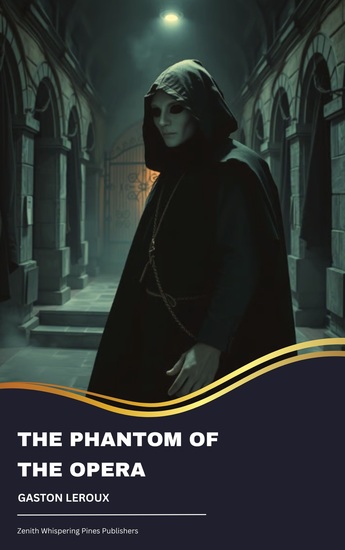
The Phantom of the Opera - cover

The Phantom of the Opera

Gaston Leroux

Publisher: Zenith Whispering Pines Publishers

  • 0
  • 0
  • 0

Summary

A voice in the darkness. A masked genius in the shadows. A love twisted into obsession.
Deep beneath the Paris Opera House, a brilliant but tormented figure watches from the catacombs—teaching, manipulating, and haunting the young soprano Christine Daaé. As his passion grows and his jealousy turns dangerous, the opera becomes a stage for secrets, deception, and a terrifying ultimatum that threatens everyone above.

Praised as "one of the most captivating gothic mysteries ever written," Gaston Leroux's classic blends romance, suspense, and haunting atmosphere into a story that has enthralled readers for over a century. Its unforgettable characters and emotional tension continue to inspire countless adaptations.

If you crave dark romance, dramatic twists, and a mystery wrapped in music and shadow, this timeless novel will hold you spellbound.

Open the book—and descend into the labyrinth where beauty meets terror.
Available since: 12/08/2025.
Print length: 310 pages.

Other books that might interest you

  • Some Words with A Mummy - cover

    Some Words with A Mummy

    SAMPI Books, Edgar Allan Poe

    • 0
    • 0
    • 0
    "Some Words with a Mummy" is a short story by Edgar Allan Poe that satirizes 19th-century science and attitudes, featuring gentlemen who awaken an ancient Egyptian mummy, challenging their views on life, technology, and health.
    Show book
  • The Possessed or The Devils - cover

    The Possessed or The Devils

    Fyodor Dostoyevsky

    • 0
    • 0
    • 0
    Originally published in 1872, "The Possessed" (also known as "The Devils" or "Demons") is a political novel by the renowned Russian writer Fyodor Dostoyevsky. The story focuses on a group of revolutionaries plotting an uprising in a provincial Russian town, exploring their motives, philosophies, and interpersonal dynamics. It delves deep into the psychology of its characters, offering a scathing critique of radical ideologies and the intellectuals who espoused them during Dostoyevsky's time. As with much of his work, the narrative is a profound exploration of good and evil, freedom and enslavement, and the nature of power.
    Show book
  • A Diagnosis of Death - From their pens to your ears genius in every story - cover

    A Diagnosis of Death - From...

    Ambrose Bierce

    • 0
    • 0
    • 0
    Ambrose Gwinnett Bierce was born on 24th June 1842 at Horse Cave Creek in Meigs County, Ohio. His parents were poor but they introduced him to literature at an early age, instilling in him a deep appreciation of books, the written word and the elegance of language.  
    Growing up in Koscuisko County, Indiana poverty and religion were defining features of his childhood, and he would later describe his parents as “unwashed savages” and fanatically religious, showing him little affection but always quick to punish. He came to resent religion, and his introduction to literature appears to be their only positive effect. 
    At age 15 Bierce left home to become a printer’s devil, mixing ink and fetching type at The Northern Indian, a small Ohio paper. Falsely accused of theft he returned to his farm and spent time sending out work in the hopes of being published. 
    His Uncle Lucius advised he be sent to the Kentucky Military Institute. A year later he was commissioned as an Officer.  As the Civil War started Bierce enlisted in the 9th Indiana Infantry Regiment.  
    In April 1862 Bierce fought at the Battle of Shiloh, an experience which, though terrifying, became the source of several short stories. Two years later he sustained a serious head wound and was off duty for several months. He was discharged in early 1865.  
    A later expedition to inspect military outposts across the Great Plains took him all the way to San Francisco. He remained there to become involved with publishing and editing and to marry, Mary Ellen on Christmas Day 1871.  They had a child, Day, the following year.  
    In 1872 the family moved to England for 3 years where he wrote for Fun magazine. His son, Leigh, was born, and first book, ‘The Fiend’s Delight’, was published.  
    They returned to San Francisco and to work for a number of papers where he gained admiration for his crime reporting. In 1887 he began a column at the William Randolph Hearst’s San Francisco Examiner.  
    Bierce’s marriage fell apart when he discovered compromising letters to his wife from a secret admirer. The following year, 1889 his son Day committed suicide, depressed by romantic rejection. 
    In 1891 Bierce wrote and published the collection of 26 short stories which included ‘An Occurrence at Owl Creek Bridge’.  Success and further works including poetry followed.  
    Bierce with Hearst’s resources helped uncover a financial plot by a railroad to turn 130 million dollars of loans into a handout. Confronted by the railroad and asked to name his price Bierce answered “my price is $130 million dollars. If, when you are ready to pay, I happen to be out of town, you may hand it over to my friend, the Treasurer of the United States”.  
    He now began his first foray as a fabulist, publishing ‘Fantastic Fables’ in 1899.  But tragedy again struck two years later when his second son Leigh died of pneumonia relating to his alcoholism.  
    He continued to write short stories and poetry and also published ‘The Devil’s Dictionary’.  
    At the age of 71, in 1913 Bierce departed from Washington, D.C., for a tour of the battlefields where he had fought during the civil war. At the city of Chihuahua he wrote his last known communication, a letter to a friend. It’s closing words were “as to me, I leave here tomorrow for an unknown destination,” Ambrose Bierce then vanished without trace.
    Show book
  • About Love - From their pens to your ears genius in every story - cover

    About Love - From their pens to...

    Anton Chekhov

    • 0
    • 0
    • 0
    Anton Pavlovich Chekhov was born on 29th January 1860 in Taganrog, on the south coast of Russia.  
    His family life was difficult; his father was strict and over-bearing but his mother was a passionate story-teller, a subject Chekhov warmed to. As he later said; ‘our talents we got from our father, but our soul from our mother’.  
    At school Chekhov was distinctly average. At 16 his father mis-managed his finances and was declared bankrupt. His family fled to Moscow. Chekhov remained and eked out a living by various means, including writing and selling short sketches to newspapers, to finish his schooling. That completed and with a scholarship to Moscow University obtained he rejoined his family. 
    He was able to help support them by selling satirical sketches and vignettes of Russian lifestyles and gradually obtained further commissions. In 1884, he qualified as a physician and, although it earned him little, he often treated the poor for free, he was fond of saying ‘Medicine is my lawful wife, and literature is my mistress.’ 
    His own health was now an issue as he began to cough up blood, a symptom of tuberculosis.  Despite this his writing success enabled him to move the family into more comfortable accommodation.  
    Chekhov wrote over 500 short stories which included many, many classics including ‘The Kiss’ and ‘The Lady with a Dog’.  His collection ‘At Dusk’ won him the coveted Pushkin Prize when was only 26.  
    He was also a major playwright beginning with the huge success of ‘Ivanov’ in 1887.   
    In 1892 Chekhov bought a country estate north of Moscow. Here his medical skills and money helped the peasants tackle outbreaks of cholera and bouts of famine. He also built three schools, a fire station and a clinic.  It left him with less time for writing but the interactions with real people gained him detailed knowledge about the peasantry and their living conditions for his stories.  
    His most famous work, ‘The Seagull’ was received disastrously at its premiere in St Petersburg. It was later restaged in Moscow to highlight its psychological aspects and was a huge success. It led to ‘Uncle Vanya’, ‘The Three Sisters’ and ‘The Cherry Orchard’.  
    Chekhov suffered a major lung hemorrhage in 1897 while visiting Moscow. A formal diagnosis confirmed tuberculosis and the doctors ordered changes to his lifestyle.  
    Despite a dread of weddings the elusive literary bachelor quietly married the actress Olga Knipper, whom he had met at rehearsals for ‘The Seagull’, on 25th May 1901. 
    By May 1904 with his tuberculosis worsening and death imminent he set off for the German town of Badenweiler writing cheerful, witty letters to his family and assuring them his health was improving.  
    On 15th July 1904 Anton Chekhov died at Badenweiler.  He was 44.
    Show book
  • In Our Time - cover

    In Our Time

    Ernest Hemingway

    • 0
    • 0
    • 0
    "In Our Time" is a collection of short stories by Ernest Hemingway, first published in 1925. The book is divided into two parts: the first consists of short vignettes, often referred to as "interchapters," while the second contains longer stories.  
    Set against the backdrop of World War I and the aftermath of the war, the collection explores themes of disillusionment, loss, and the struggle to find meaning in a chaotic world. Hemingway's spare, economical prose style, known for its understatement and minimalism, is on full display throughout the book. 
    The interchapters serve as interludes between the longer stories, providing glimpses into the lives of ordinary people and capturing moments of everyday existence. These vignettes offer insights into the human condition, often with a sense of detachment and stoicism. 
    The longer stories delve deeper into the lives of characters grappling with the effects of war, both physical and psychological. From soldiers coping with trauma to expatriates navigating the complexities of love and relationships, Hemingway paints a vivid portrait of individuals struggling to find their place in a world marked by violence and uncertainty. 
    "In Our Time" showcases Hemingway's mastery of the short story form and his ability to capture the essence of the human experience with precision and clarity. Through its exploration of themes such as war, trauma, and resilience, the collection remains a timeless work of literature that continues to resonate with readers today.
    Show book
  • About Chesterton and Belloc (Unabridged) - cover

    About Chesterton and Belloc...

    H. G. Wells

    • 0
    • 0
    • 0
    Herbert George Wells (21 September 1866 - 13 August 1946) was an English writer. Prolific in many genres, he wrote dozens of novels, short stories, and works of social commentary, history, satire, biography and autobiography. His work also included two books on recreational war games. Wells is now best remembered for his science fiction novels and is often called the "father of science fiction", along with Jules Verne and the publisher Hugo Gernsback.
    ABOUT CHESTERTON AND BELLOC: It has been one of the less possible dreams of my life to be a painted Pagan God and live upon a ceiling. I crown myself becomingly in stars or tendrils or with electric coruscations (as the mood takes me), and wear an easy costume free from complications and appropriate to the climate of those agreeable spaces.
    Show book